How to Develop a Nonprofit Donor Management Platform
Building a donor management platform is one of the most transformative investments a nonprofit organization can make. Far beyond a simple contact database, a well architected platform becomes the operational backbone of your entire fund development strategy — connecting donor relationships, campaign performance, gift records, and communications into a single, unified system. In this guide, we walk through the foundational principles, core development milestones, and strategic implementation steps required to build a platform that scales with your mission — helping you foster deeper donor loyalty and increase lifetime donor value for lasting organizational growth.
Foundational Data Modeling
The architecture of your donor management platform determines everything. Poor data modeling leads to fragmented records, reporting gaps, and costly technical debt down the road. The goal is to design a system that reflects how real-world relationships and financial transactions actually work within a nonprofit context — not just how a generic CRM might handle contacts and deals.
Constituent-Centric Schema Design
Design your database schemas around the constituent as the central node rather than organizing data around isolated transactions or campaigns. Every gift, interaction, event attendance, and communication should radiate outward from the individual or organization record.
This approach enables a holistic view of each supporter and prevents data silos that plague legacy systems.
Use normalized relational tables that allow a single constituent to appear in multiple contexts without duplicating core profile data — a critical foundation for accurate reporting and personalized outreach.
Flexible Relationship Modeling with Junction Tables
Real donors wear many hats. A single person may be all of these at once:
Implement flexible relationship models using junction tables that track evolving roles over time with date-stamped entries. This allows your platform to answer nuanced queries like:
Comprehensive Gift Record Architecture
A gift record is far more than an amount and a date. Properly architected gift data should capture:
Soft credits are essential for major gift portfolios and planned giving programs, as they ensure relationship managers receive proper credit and that the organization understands its true sphere of donor influence.
Structured gift records also enable accurate IRS compliance and audit-readiness.
Three layers, each built on the one beneath it:
Once your data model is established, development should follow a structured sequence of feature milestones — each building on the last. Rushing to add features before the core is stable leads to fragile platforms that require constant rework. Below are the three pillars every nonprofit donor management platform must deliver before broader feature expansion begins.
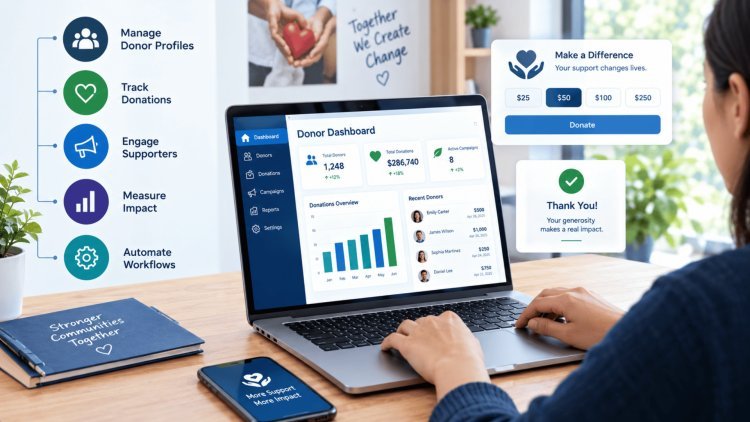
Prioritize the development of comprehensive donor profiles that surface a complete picture of every constituent at a glance. This means surfacing communication history — emails sent, calls logged, meetings attended — alongside lifetime giving totals, recurring gift schedules, campaign participation, and event RSVPs. Staff should never have to navigate multiple screens or systems to understand a donor's relationship with the organization. A well-designed profile page becomes the single source of truth that empowers major gift officers, annual fund managers, and executive directors alike to engage donors with context and confidence.
Learn more about building these profiles effectively via our Development Guide.
Build campaign management modules capable of monitoring performance across multiple dimensions — total raised, donor acquisition rate, average gift size, retention rate, and cost per dollar raised. Equally important is the ability to segment donor lists for targeted outreach: filtering by giving level, lapse status, geographic region, program interest, or communication preference. Targeted segmentation consistently outperforms mass communication in both response rate and average gift size. Your campaign module should also support multichannel attribution so you can understand whether a gift came from a direct mail appeal, email campaign, or personal solicitation — and optimize accordingly.
Donor data is among the most sensitive information a nonprofit handles — including giving histories, personal contact details, wealth indicators, and relationship notes. Implement Role-Based Access Control (RBAC) from the very first development sprint, not as an afterthought. Define clear permission tiers: executives may see full financial summaries, program staff may view only relevant constituent segments, and volunteers may access only event check-in lists. Audit logs should capture every data export, edit, and login event to support both internal accountability and regulatory compliance.
Strong access controls also build donor trust — a critical asset for long-term relationship stewardship.
Core Development Milestones
360-Degree Donor Profiles
Robust Campaign Management Modules
Role-Based Access Control
A technically sound platform will fail to deliver value if the implementation process is rushed or misaligned with organizational reality. The transition from legacy systems—or from spreadsheets—to a purpose-built donor management platform requires deliberate planning, staff buy-in, and a phased rollout strategy that prioritizes early wins while building toward long-term capability.
Deliberate planning, staff buy-in, and a phased rollout strategy determine whether a donor platform delivers lasting value.
Strategic
Implementation StepsPrioritize early wins while building toward long-term capability.
A donor management platform is not merely a technological upgrade—it is a strategic investment in your organization's long-term fundraising capacity, donor relationships, and mission fulfillment. When designed thoughtfully, the platform becomes the foundation for stronger engagement, deeper loyalty, and sustainable growth.
A donor management platform should function as an active fundraising strategy engine rather than a passive database. Every workflow, dashboard, automation, and report should answer critical development questions around donor retention, gift growth, stewardship effectiveness, and major donor identification.
When platform decisions are guided by mission outcomes instead of feature checklists, technology becomes a genuine competitive advantage for development teams.
Sustainable fundraising depends on long-term donor relationships. Retained donors generate significantly greater lifetime value than one-time supporters while requiring substantially lower acquisition investment.
Effective platforms identify retention risks early, celebrate loyalty milestones automatically, and help relationship managers focus on the donors and opportunities that create the greatest long-term impact.
The most successful donor platform implementations begin with a focused, stable core. Launch essential functionality first, gather feedback from real users, and expand capabilities incrementally through planned improvement cycles.
Avoid replicating every feature available in enterprise software from day one. Adoption and usability create more value than excessive complexity.
Understand donor behaviors, giving patterns, and engagement opportunities.
Build meaningful relationships through personalized outreach and stewardship.
Identify risk factors early and strengthen donor loyalty through proactive engagement.
Increase donor lifetime value through long-term relationship development.
The highest-performing donor management platforms are not defined by the number of features they contain. They are defined by their ability to strengthen relationships, improve retention, increase donor lifetime value, and guide smarter fundraising decisions. A lean platform that is widely adopted and strategically aligned will consistently outperform a complex system that staff struggle to use.
Build thoughtfully, launch deliberately, learn continuously, and expand only where measurable mission impact justifies the investment.
Conclusion: Driving Sustainable Growth
Platform as Strategy, Not Just Software
Scale, Loyalty & Lifetime Donor Value
Start Small, Iterate & Expand
Sustainable Growth Framework
Practical Implementation Guidance
Final Strategic Perspective
What's Your Reaction?