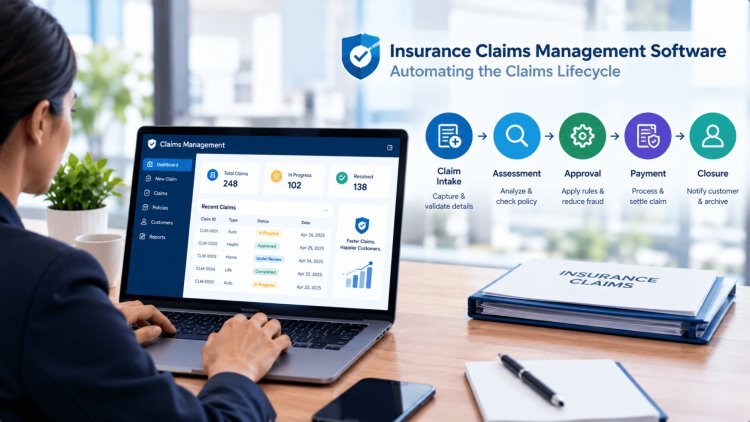
Insurance Claims Management Software: Automating the Claims Lifecycle
A single insurance claim shouldn't require a multi-system relay race. Yet for most insurers today, that's exactly what happens — FNOL is logged in one system, documents are routed manually through another, adjudication lives in a third, and payment approvals require yet another handoff. The result: delays, errors, and frustrated policyholders at their most vulnerable moments. Modern claims management software transforms that fragmented relay into a single, guided workflow — starting at First Notice of Loss (FNOL) and ending at settlement payment — with automation, rules-based routing, real-time financials, and compliance controls embedded at every stage. This presentation explores how leading platforms handle each phase of the claims lifecycle, and why end-to-end orchestration is now a competitive necessity for insurers.
FNOL Intake — Stop Delays at the Front Door
First Notice of Loss is the moment that sets the tone for the entire claims experience. A clumsy, paper-heavy, or incomplete intake process creates downstream errors that cascade through adjudication, reserving, and settlement. The best modern platforms eliminate these front-door delays with structured digital intake, intelligent document parsing, and immediate linkage to policy records.
Salesforce — Guided Digital Intake
Salesforce's claims platform delivers peril-specific guided intake that dynamically adjusts the data fields presented based on the type of claim being filed.
Each intake session automatically links all named parties directly to live policy records, ensuring that downstream adjudication begins with clean, validated data rather than manually reconciled fragments.
This dramatically reduces rework and accelerates the hand-off from intake to active investigation.
Regure — Replacing Legacy Handoffs
Regure targets the chronic problem of legacy multi-system handoffs by building a continuous, automated pipeline. Each step triggers the next automatically, eliminating the idle time between handoffs that inflates cycle times in traditional environments.
By structuring the process as a governed pipeline rather than a loose sequence of tasks, Regure ensures that no claim sits unattended and every SLA clock is actively tracked from the moment of first contact.
DICEUS — Multi-Channel Intake with Parsed-Field Review
DICEUS takes a flexible ingestion approach, supporting portal-submitted claims, email-based reports, and scanned document ingestion — all processed through an intelligent parsing engine that extracts structured fields from unstructured inputs.
Critically, extracted data passes through a human-reviewed parsed-field stage before the claim record is formally created, catching misclassifications or missing data before they contaminate the live case file.
This hybrid automation-plus-review model is particularly valuable for complex commercial lines where intake documents vary widely in format and completeness.
Intake is no longer a passive data-entry exercise. It is an active, intelligent process that validates, classifies, and routes from the first moment of contact — turning what was once a source of delay into a foundation for faster adjudication.
Once a claim is created, the next critical challenge is ensuring it reaches the right adjudicator, with the right context, at the right time. Poor routing — based on manual assignment queues, geography alone, or simple round-robin distribution — leads to mismatched expertise, overloaded adjusters, and inflated cycle times. Intelligent triage and routing engines solve this by applying rules-based and AI-augmented logic to every incoming claim.
Average reduction in claims cycle time reported by insurers adopting intelligent routing and STP for simple claims.
Increase in effective adjuster capacity when STP handles routine claims, freeing experts for complex cases.
Decrease in data entry and routing errors when rules-based assignment replaces manual queue management.
From Triage to Adjudication — Make Every Case Routable
Cycle Time Reduction
Adjuster Capacity
Error Reduction
Reserve accuracy is one of the most consequential and scrutinized functions in claims management. Under-reserving exposes insurers to adverse development; over-reserving distorts financial statements and ties up capital unnecessarily. Regulatory compliance—particularly for jurisdictions governed by frameworks like the FCA in the UK or state insurance commissioners in the US—demands complete, time-stamped, auditable records of every financial decision made during a claim’s lifecycle.
Embed complete, time-stamped, auditable controls in every financial workflow from reserve creation to final payment release.
Reserves, Financials & Compliance —
Prove Accuracy, Not AssumptionsCompliance is not a post-process audit—it is real-time governance.
The final phase of the claims lifecycle—from settlement negotiation through payment disbursement and closure—is where customer loyalty is either secured or lost. Even technically accurate claims can generate dissatisfaction if settlement is delayed, communication is inconsistent, or payment processes introduce unnecessary friction. The strongest claims platforms transform closure into a transparent, fast, and confidence-building experience.
Guided digital intake, multi-channel submission, parsed-field validation, and immediate policy linkage.
Rules-driven assignment by severity, coverage, geography, and automated straight-through processing for simple claims.
Coverage validation, liability determination, reserve management, and approval governance.
Negotiation workflows, settlement payments, personalized communications, and SLA-driven cycle-time management.
Cloud-native claims platforms bring intake, investigation, adjudication, settlement, and closure into a unified workflow environment. Eliminating system-to-system handoffs reduces processing delays, improves visibility, and creates a more seamless policyholder experience.
AI-supported personalization can tailor communication timing, preferred channels, and recommended actions for each claimant, improving engagement and strengthening customer retention through the final stages of the claim.
SLA-focused workflow governance reduces delays that commonly occur when claims move between departments, adjusters, reviewers, and approval teams. Automated triggers, escalation logic, and stage-specific monitoring maintain momentum across the entire claims pipeline.
Strong SLA compliance contributes directly to reduced indemnity costs, lower litigation exposure, improved customer satisfaction, and more predictable operational performance.
Replace disconnected point solutions with coordinated workflows spanning intake through final closure.
Tailor communication and service pathways according to claimant preferences and claim complexity.
Monitor, escalate, and measure every workflow stage automatically.
Reduce cycle times while preserving transparency, compliance, and settlement accuracy.
The insurer that closes claims faster, communicates clearly, eliminates unnecessary friction, and provides complete visibility during settlement earns more than operational efficiency—it earns renewal loyalty. End-to-end automation is no longer simply a cost-reduction initiative; it has become a customer-retention strategy that directly influences long-term profitability and competitive positioning. Contact our Website to build.
Settlement to Closure — Orchestrate End-to-End, Keep Customers
End-to-End Claims Lifecycle
FNOL Intake
Triage & Routing
Investigation & Adjudication
Settlement & Closure
Unified Cloud Lifecycle Orchestration
SLA Performance at Scale
What Modern Claims Platforms Must Deliver
Retention Is the Real Outcome
What's Your Reaction?