Developing a Customer Feedback and Experience Analytics Platform
From Signals to Business Impact — A strategic blueprint for transforming fragmented customer data into measurable outcomes that drive retention, revenue, and smarter decisions across every team in your organization.
Act 1: The Problem — Feedback Lives in Silos, Decisions Live in Delays
Most organizations are drowning in customer data yet starved of customer insight. Survey results sit in a marketing tool. Support tickets pile up in a CRM. Product reviews scatter across public platforms. NPS scores live in a spreadsheet no one updates. The result: each team operates with a partial, outdated, and self-serving view of the customer — and no one has the full picture.
The Cost of Siloed Feedback
When feedback cannot flow freely across teams, the downstream consequences compound rapidly. Customer-facing teams make decisions based on stale or incomplete signals. Product roadmaps are built on the loudest voices rather than the most representative data.
Marketing campaigns target the wrong segments. Sales teams lack the ammunition to address objections rooted in real experience failures.
The result is a cascade of missed opportunities: deals lost to unresolved pain points, churn that could have been predicted, and product investments that miss the mark — all because no one could see the full customer signal in one place.
What the Platform Must Replace
The goal is not simply to build another dashboard. Static reports are the core of the problem — they describe the past without enabling action in the present. A true Customer Feedback and Experience Analytics Platform must function as a living, measurable pipeline: one that connects raw CX data to specific, trackable business outcomes.
The platform becomes the connective tissue between customer signal and business action — turning feedback from a reporting artifact into a strategic asset.
From Customer Signal to Business Action
Organizations already collect enormous volumes of customer feedback. The challenge is not collection. The challenge is interpretation, prioritization, and operationalization.
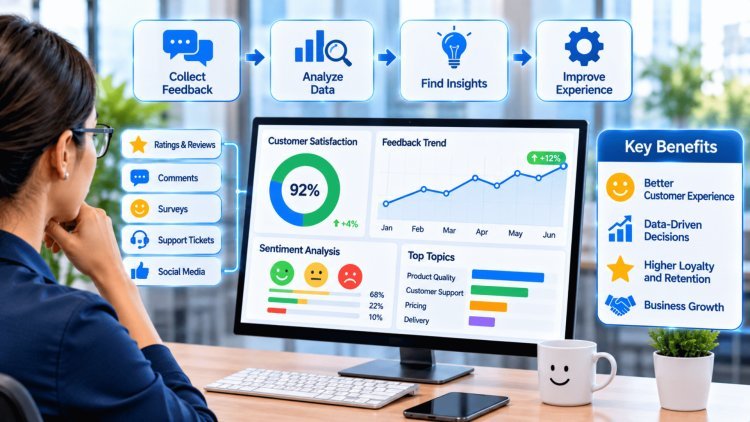
A modern CX analytics platform transforms fragmented surveys, reviews, support interactions, and behavioral signals into measurable actions that influence retention, revenue growth, product strategy, service quality, and customer loyalty.
The core transformation: from "we collect feedback" to "feedback drives revenue, retention, and roadmap decisions."
Customer feedback becomes valuable only when it changes behavior. The organizations that outperform their competitors are those that convert fragmented signals into coordinated decisions, turning customer experience from a reporting function into a strategic growth engine.
Act 2:
A central nervous system doesn't store information in isolated organs — it routes signals in real time to wherever a response is needed. That's the architectural ambition of this platform: ingest every customer signal, resolve it to a known identity, and route the right insight to the right stakeholder before the moment for action has passed.
The first layer is signal collection — broad, continuous, and identity-resolved. This means deploying capture mechanisms across every customer touchpoint: in-product surveys, post-interaction CSAT, website intercepts, app store reviews, social mentions, and support conversations. Each signal must be tagged to a known customer profile using identity resolution, so responses from the same user across channels are unified rather than duplicated. Scalability is non-negotiable — the architecture must handle both high-frequency transactional feedback and low-frequency relationship surveys without degradation in latency or completeness.
Raw data is not insight. The understanding layer applies three tiers of analytics to transform signals into meaning. Descriptive analytics surface what is happening — trend lines, score distributions, verbatim themes. Driver analytics explain why it's happening — identifying which touchpoints, product features, or service interactions most strongly predict satisfaction or churn. Predictive analytics surface what will happen next — scoring accounts by risk, flagging at-risk cohorts before they churn, and projecting the revenue impact of CX improvements. Each insight is then packaged for a specific role: an executive sees retention risk in dollars; a product manager sees feature-level friction scores; a frontline manager sees individual customer alerts.
Practical Example:
Qualtrics demonstrates this listen-to-understand loop in production. In-product popup surveys trigger at key moments in the user journey — after onboarding, after feature adoption, after support interactions. Responses feed directly into real-time dashboards that segment trends by persona, cohort, and product area. Stakeholders across product, marketing, and customer success see signal the moment it arrives, with enough context to act without waiting for a weekly report cycle. This reduces the lag between customer experience and organizational response from weeks to hours — a compounding advantage in fast-moving markets.
Act Like a Central Nervous System — Listen → Understand
Listen: Capture & Aggregate at Scale
Understand: From Raw Signals to Actionable Intelligence
Qualtrics in Action
Multi-channel is a word most vendors use loosely. True multi-channel capability is not about connecting a few integrations and calling the job done—it requires three sequential capabilities working in concert: integration breadth, data unification, and unified analysis. Without all three, you have aggregation, not insight.
Integrate every signal, normalize it into one schema, and analyze it across the customer lifecycle to turn feedback into timely decisions.
Act 3: Multi-Channel Unified
Analysis That Actually WorksSee compound risk and opportunity across every channel.
Insight alone does not create business value. The final stages of a CX analytics platform focus on turning signals into actions and ensuring the platform can operate securely, consistently, and at enterprise scale. By connecting customer feedback directly to automated interventions and measurable outcomes, organizations prove ROI while building a sustainable operational capability.
The Act layer transforms customer insight into operational response. When predefined thresholds are reached, the platform automatically initiates a corresponding playbook without requiring manual routing decisions.
Enterprise deployment requires clear governance, robust security controls, and operational discipline. As adoption grows, governance frameworks ensure accountability while compliance programs protect valuable customer data assets.
Customer experience analytics must be presented in terms executives and boards care about: retention, efficiency, growth, and financial performance.
Measure improvements in churn reduction and net revenue retention driven by proactive interventions for at-risk customers.
Track NPS, CSAT, and CES improvements relative to baseline performance and linked improvement initiatives.
Reduce support effort, escalation volumes, and operational friction through systematic issue resolution.
Identify promoters and automatically trigger referral, upsell, and cross-sell opportunities at peak satisfaction moments.
The ultimate success of a CX analytics platform is determined not by dashboards, survey volumes, or reporting activity, but by measurable business outcomes. When customer feedback automatically triggers action, governance supports scale, and results are framed in terms of retention, efficiency, and revenue growth, the platform evolves from a reporting tool into a strategic enterprise capability. Organizations that close the loop consistently transform customer insight into long-term competitive advantage.
Act 4: Closed-Loop Action and Proving ROI
Trigger Playbooks When It Matters
Govern, Secure & Scale
Outcome Framing: Prove the Business Case
Retention & Renewals
Customer Satisfaction
Cost-to-Serve Reduction
Expansion Revenue
Closed-Loop Customer Experience Lifecycle
Strategic Takeaway
What's Your Reaction?