Building a Predictive Maintenance Platform From Reactive to Prescriptive
Industrial equipment failures don't announce themselves — they strike at the worst possible moments, costing manufacturers billions in unplanned downtime, emergency repairs, and lost production. This presentation charts the journey from outdated breakfix maintenance models to a fully intelligent, AI-driven prescriptive maintenance platform that doesn't just predict failures — it tells you exactly what to do about them.
The Evolution of Reliability
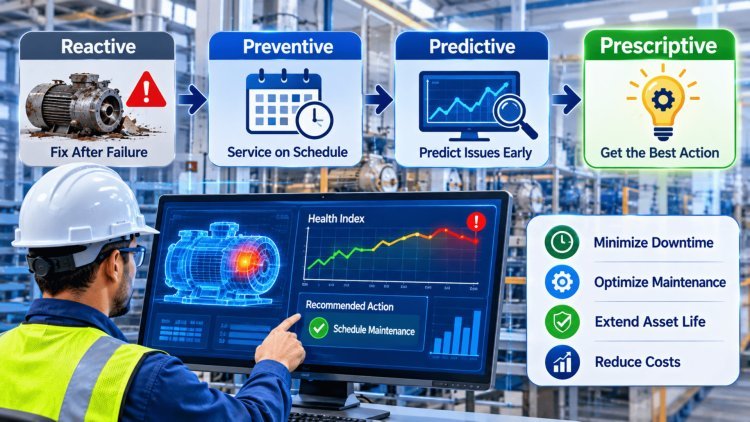
Maintenance philosophy has undergone a fundamental transformation over the past several decades. What began as a purely reactive discipline has steadily evolved into a proactive, data-driven science. Understanding each phase is critical to appreciating where the industry is heading — and why the leap to AI-driven prediction is so consequential.
Reactive
Run-to-failure was the default. Equipment was simply operated until it broke down, triggering emergency repairs. The costs — in unplanned downtime, expedited parts, and safety incidents — were enormous and largely invisible until the damage was done.
Scheduled Preventive
Time-based maintenance introduced routine servicing intervals, reducing catastrophic failures. However, rigid schedules meant organizations were often replacing components that still had significant life left — or missing failures that occurred between service windows.
Condition-Based
By wiring equipment with sensors and establishing rule-based alert thresholds, teams could respond to actual machine conditions rather than fixed schedules. This was a major step forward — but rule-based systems struggle to detect nuanced, multi-variable failure signatures before they cross obvious thresholds.
AI-Driven Predictive
Machine learning models trained on historical failure patterns can now detect subtle degradation signals weeks in advance — shifting maintenance from reactive firefighting and rigid schedules to proactive, evidence-based foresight. This is the phase where real ROI begins to compound.
What Changes Across the Reliability Journey
The greatest value of predictive maintenance is not preventing a single failure. It is creating a continuously improving reliability system that reduces downtime, extends asset life, improves maintenance planning, optimizes spare parts inventory, and delivers measurable operational efficiency year after year.
Reliability has evolved from reacting to failures to predicting them. Organizations that successfully adopt AI-driven maintenance move beyond fixing assets and begin managing asset health as a strategic, data-powered advantage.
The business case for predictive maintenance is not theoretical — it is measurable, repeatable, and substantial. Organizations that have deployed modern predictive analytics platforms consistently report outcomes that dwarf what any scheduled or condition-based approach can achieve. The numbers below represent validated benchmarks across industrial deployments.
Industrial equipment generates enormous volumes of raw sensor data — most of which appears as undifferentiated noise to human analysts. Predictive analytics platforms apply feature engineering, time-series analysis, and anomaly detection algorithms to transform this noise into clear, actionable machine health signals. What was once invisible degradation becomes a prioritized work order with a recommended intervention window.
Unlike rule-based systems that plateau once thresholds are set, machine learning models improve over time. Each confirmed failure — and each successful prediction — feeds back into the model, refining its understanding of how specific assets degrade under specific operating conditions. The platform gets smarter with every hour of runtime, widening the performance gap over static approaches.
The Power of Predictive Analytics
From Noise to Signal
The Compounding Advantage
A robust predictive maintenance platform is not a single tool—it is a carefully layered architecture that spans the physical machine all the way to enterprise work management systems. Each layer has a distinct role, and the strength of the entire system depends on how seamlessly these layers interoperate. The pipeline below defines the four functional zones that must be engineered for reliability, scalability, and real-time responsiveness.
Engineer the sensor, edge, inference, and integration layers together so predictive insights become reliable work orders—not another dashboard.
Architecting the
Data-to-Action PipelineTurn machine signals into prioritized maintenance action.
Predictive maintenance was once the destination. Today, it is the foundation for something far more powerful: prescriptive maintenance. The next frontier moves beyond telling operators that a failure is likely — it tells them exactly what to do, when to do it, and in what order. This is where AI-driven reliability transitions from a monitoring capability into a true operational intelligence system.
Modern AI platforms now layer recommendation engines on top of predictive models. Rather than simply surfacing a risk score, the system recommends specific interventions:
Recommendations are ranked by:
What makes prescriptive systems genuinely transformative is their ability to combine multiple data dimensions simultaneously:
The mature state of this platform is a fully integrated, continuously learning reliability engine that operates across the entire asset lifecycle:
The result is an organization that perpetually improves its maintenance efficiency without manual intervention.
The path to enterprise-wide prescriptive maintenance begins with a focused, high-value pilot.
A disciplined pilot-first approach de-risks the investment and accelerates the broader business case.
The organizations winning on reliability are not the ones with the most sensors — they are the ones who have built the tightest loop from data to decision to action.
Delivering Value: The Prescriptive Future
From Prediction to Prescription
Contextual Intelligence
The Ultimate Goal: Seamless Edge-to-Cloud Reliability
Implementation Strategy: Pilot, Validate, Scale
What's Your Reaction?