Manufacturing Execution Systems (MES): Connecting Production with Business Operations
In today's competitive industrial landscape, the gap between enterprise planning and shop-floor reality can cost manufacturers millions. Manufacturing Execution Systems bridge that gap — transforming raw data from the production floor into actionable intelligence that drives smarter business decisions.
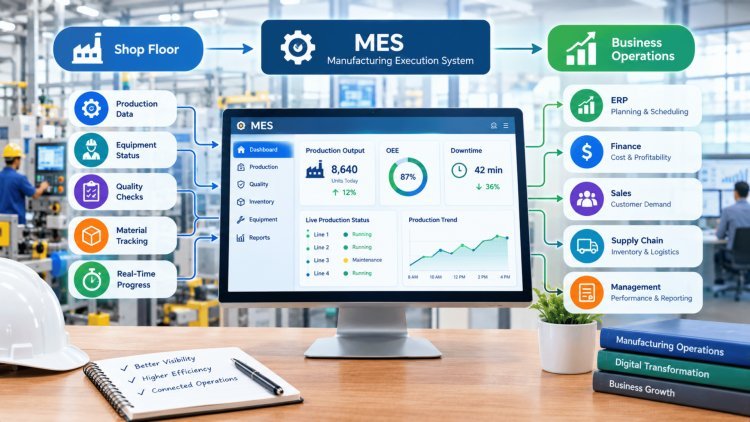
The Functional Bridge
Acting as the central nervous system of the factory, a Manufacturing Execution System (MES) synchronizes physical production with enterprise-level planning in real time. It sits at the intersection of operational technology and information technology — translating the chaos of the shop floor into structured, meaningful data streams that leadership can act upon.
MES vs. ERP: Understanding the Distinction
ERP systems are designed to manage business schedules, financial data, procurement, and high-level resource planning. They operate in the domain of business logic — forecasting demand, managing inventory records, and generating purchase orders. What they cannot do is see the factory floor in motion.
The MES fills precisely this blind spot. It provides real-time visibility into the transformation of raw materials into finished goods — tracking every work order, machine state, operator action, and quality checkpoint as it happens, not hours or days later when the ERP batch syncs.
Why the Bridge Matters
Without an MES, manufacturers operate on a dangerous lag. Production supervisors make decisions based on yesterday's data. Quality issues compound before anyone detects them. Scheduled outputs diverge from actual outputs with no mechanism to course-correct mid-shift.
With an MES in place, the feedback loop between what was planned and what is actually happening closes dramatically. Planners can adjust schedules dynamically. Operations managers can see live OEE metrics. Quality teams can intervene at the point of defect rather than at the point of shipment.
The result is a factory that doesn't just execute — it learns and adapts.
Real-Time Production Visibility
Track machine status, work orders, throughput, downtime, and operator activity as production unfolds.
Dynamic Schedule Adjustment
Compare planned versus actual output continuously and react immediately to disruptions, bottlenecks, and delays.
Quality Intervention
Detect defects and process deviations during production rather than after products have already been completed or shipped.
Actionable Enterprise Intelligence
Convert shop-floor events into structured operational data that business leaders can use for planning, forecasting, and decision-making.
MES is not a replacement for ERP — it is the critical real-time intelligence layer that makes ERP data trustworthy and actionable.
ERP plans the work. MES verifies, tracks, and optimizes the work as it happens. Together they create a connected manufacturing operation capable of learning, adapting, and improving in real time.
A robust MES is built on two interconnected pillars that together create a continuously self-correcting production environment. These pillars — execution management and deep systems integration — are what elevate an MES from a simple tracking tool to a strategic manufacturing asset.
At its core, MES execution management means commanding the production process with precision and accountability. This encompasses the full lifecycle of a work order — from initial release and resource allocation through real-time tracking of every operation performed on the shop floor.
The system assigns tasks to the right operators and machines, ensures that the correct materials and tooling are available at the right moment, and continuously monitors output against the production plan. When deviations occur — a machine running slower than expected, a batch yield dropping below threshold — the MES flags the issue immediately, enabling supervisors to intervene before a minor variance becomes a major disruption. Consistent output quality is not left to chance; it is engineered into every step of the workflow through systematic enforcement of standard operating procedures.
The second pillar is the MES's ability to serve as a universal translator between the physical world of machines and the digital world of enterprise software. Modern factories are populated with a heterogeneous mix of equipment — legacy PLCs, modern IIoT devices, vision inspection systems, environmental sensors, and SCADA networks — each speaking its own protocol and generating its own data format.
A well-architected MES ingests all of this signal data through standardized interfaces such as OPC-UA, MQTT, and REST APIs, normalizing it into a unified data model. This means that a temperature anomaly detected by a sensor on a CNC machine is instantly correlated with the specific batch being produced, the operator on shift, and the customer order it fulfills — creating an unbroken chain of production intelligence from the machine level to the boardroom level.
Core Operational Pillars
Execution Management
Systems Integration & Connectivity
Two of the most measurable outcomes a well-implemented MES delivers are operational efficiency and regulatory compliance—and critically, it achieves both simultaneously rather than forcing manufacturers to trade one off against the other.
A well-implemented MES turns production data into operational efficiency, audit-ready traceability, and proactive quality control.
Driving Efficiency
and ComplianceAchieve both simultaneously—without trade-offs.
Manufacturing Execution Systems have evolved far beyond their traditional role as production data repositories. The next generation of MES platforms actively orchestrates production, predicts operational risks, recommends corrective actions, and increasingly executes optimization decisions autonomously. This transformation is reshaping how manufacturers respond to disruption, variability, and competitive pressure.
Modern MES platforms increasingly incorporate agentic artificial intelligence capable of responding to production disruptions autonomously. Instead of simply reporting operational issues, these systems analyze impacts and coordinate corrective actions across scheduling, inventory, labor, logistics, and production resources.
When supplier delays, equipment failures, material shortages, or demand fluctuations occur, AI-enabled MES environments can recalculate production priorities, redistribute workloads, update commitments, and optimize resource allocation within seconds.
A mature MES creates a direct connection between production execution and strategic business objectives. By integrating with ERP systems, supply chain platforms, customer demand signals, and enterprise planning tools, manufacturers gain visibility that extends far beyond factory operations.
Market demand shifts, supply disruptions, and resource constraints can be modeled, analyzed, and addressed in near real time. This capability allows organizations to react to changing business conditions faster and with greater confidence than traditional planning approaches.
Future manufacturing leaders will be defined not only by efficiency but by resilience. Resilient factories are capable of absorbing disruptions, adapting quickly, and recovering faster than competitors while maintaining quality and delivery commitments.
MES serves as the digital backbone enabling this adaptability. Organizations investing in advanced MES capabilities today are building the operational intelligence infrastructure that will support future growth and long-term competitiveness.
Passive data capture and historical production reporting after events have already occurred.
Real-time visibility into OEE, production performance, quality metrics, downtime, and operational efficiency.
AI-driven autonomous optimization that predicts disruptions, recommends responses, and executes decisions automatically.
The highest-performing manufacturers no longer view MES as an isolated production application. Instead, it operates as the connection point between production systems, ERP platforms, supply chain networks, customer demand planning, maintenance systems, and executive decision-making. This unified architecture enables faster responses, more accurate forecasts, and stronger operational alignment across the entire business.
The future of manufacturing belongs to organizations that can transform information into action faster than competitors. Moving from systems of record to systems of insight and ultimately to systems of action gives manufacturers the ability to anticipate disruptions, optimize continuously, and operate with unprecedented agility. MES is no longer simply a production monitoring platform—it is becoming the operational intelligence layer that defines industrial competitiveness in the connected factory era.
The Future of Connected Production
From Tracking to Intelligent Manufacturing
Linking Shop Floor to Global Strategy
Building the Resilient Factory of the Future
Evolution of Manufacturing Execution Systems
The Connected Manufacturing Enterprise
Final Strategic Takeaway
What's Your Reaction?