Quality Management Software Development: Digitizing Inspections and Corrective Actions
Digitize inspection findings so every failed item automatically moves to NCR, CAPA, approvals, and closure evidence—no more disconnected checklists and guessing. Modern quality management demands a seamless, traceable, and fully connected workflow from the first inspection tap to verified corrective action closure.
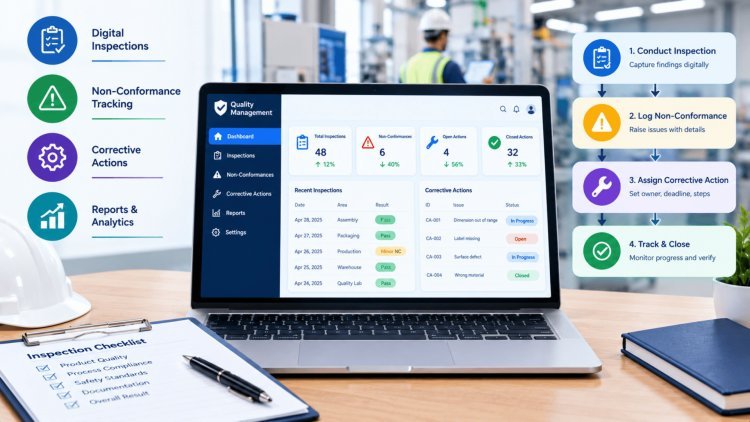
The Real Problem: Detection Without Closure
The most dangerous quality gap isn't failing to find defects—it's failing to close them. When inspections live in Excel spreadsheets, email threads, or disconnected paper forms, quality issues get re-detected instead of resolved. The same defect resurfaces in new batches, new shipments, and new audits because there is no systemic loop from finding to fix to verified closure.
The Disconnected Reality
Why Generic Workflows Break Down
Off-the-shelf tools and generic workflows collapse under the weight of real-world complexity. Quality processes must adapt dynamically to product type, supplier profile, job classification, and regulatory regime—ISO 9001, IATF 16949, FDA 21 CFR Part 820, AS9100, and others each impose specific documentation and traceability requirements.
A template designed for one product line will not serve another. A workflow built for a domestic supplier will fail for an offshore partner with different inspection cadences. When the system cannot flex, quality teams work around it—and every workaround is a traceability gap waiting to become an audit finding.
Disconnected Inspection Records
Findings captured in isolated tools create delays, data duplication, and a lack of accountability from detection through resolution.
Traceability Gaps
When NCRs, CAPAs, approvals, and evidence live in separate locations, proving compliance becomes difficult and audit risk increases.
Recurring Defects
Without connected quality data, organizations repeatedly detect the same failures because root causes were never fully closed and verified.
The Connected Quality Model
The solution is not more spreadsheets. It is a purpose-built, connected quality management platform where inspection findings, NCRs, CAPAs, approvals, and closure evidence all live in one auditable, role-aware system. Explore how a connected Inspection-to-CAPA workflow eliminates these gaps in practice.
Quality excellence is not measured by how many defects are found. It is measured by how consistently those defects are traced, corrected, verified, and prevented from returning.
A truly digital quality system doesn't just digitize paper—it connects every step of the quality loop into a single traceable record. From the first inspection trigger to the final verified closure, every action is linked, time-stamped, and role-enforced. This is the architecture that separates a real QMS from a glorified form tool.
Incoming, in-process, final checks with mobile evidence.
Failed item auto-generates NCR with disposition routing.
CAPA linked to NCR with owner, due date, root cause.
Evidence upload, approver sign-off, effectiveness check.
Inspections are initiated against a defined plan—incoming material, in-process checkpoint, or final release. Inspectors use tablets or mobile devices to record measurements, attach photos, capture signatures, and log contextual notes in real time. Every submission is time-stamped and tied to a specific lot, batch, job, or purchase order. Templates adapt per product family or supplier profile, ensuring the right criteria are applied every time without manual template selection errors.
When an inspection item fails, the system automatically generates a Non-Conformance Report (NCR) pre-populated with the finding details, evidence, and context from the inspection record. No manual re-entry. Disposition routing—accept-as-is, reject, rework, or hold—is enforced through a configurable workflow with the right approvers notified instantly. The NCR remains permanently linked to the originating inspection record, creating an unbroken chain of traceability.
Learn more about Quality and Compliance workflow platforms that automate this handoff.
Once an NCR is accepted, a Corrective and Preventive Action (CAPA) is assigned with a named owner, due date, and escalation path. The CAPA record is bidirectionally linked to the NCR and the original inspection finding. Root cause analysis tools—5-Why, fishbone, or freeform—are embedded in the workflow, ensuring teams diagnose the systemic cause rather than just patching the symptom. Preventive actions can be triggered proactively based on trend data before a non-conformance formally occurs.
Each stage of the NC lifecycle—disposition, CAPA plan approval, corrective action completion, and final closure—requires explicit sign-off from configured roles. The system enforces sequence: no step can be bypassed or skipped. Approvers receive in-app and email notifications with direct links to the record. Delegations and escalations are time-boxed, so overdue approvals surface automatically on management dashboards rather than silently stalling in someone's inbox.
From Inspection to NCR/CAPA: The Connected Workflow
Inspection Triggered
NCR Created
CAPA Assigned
Verified Closure
Stage 1 — Inspection Triggering
Stage 2 — NCR Creation & Disposition
CAPA Assignment & Root Cause
Approval Routing & Role Enforcement
A quality record is only as strong as the evidence it contains and the audit trail that proves nothing was altered after the fact. Digital QMS platforms are designed to capture evidence where the work actually happens—on the shop floor, at the receiving dock, in the field—and to preserve every decision with immutable, time-stamped traceability.
Immutable evidence, append-only audit trails, and offline resilience make quality records authoritative, complete, and instantly retrievable.
Evidence, Decisions, and
Audit-Ready TraceabilityProve what was observed, when, and by whom.
The effectiveness of a quality management system is not measured by the volume of non-conformances it records, but by its ability to prevent those issues from recurring. Modern digital QMS platforms create a closed-loop quality process where every corrective action must be verified, every workflow is enforced, and every improvement is backed by objective evidence.
Corrective actions should never be considered complete simply because a status field changes. A robust quality platform requires objective supporting evidence before closure can occur, ensuring that root causes are actually addressed rather than administratively dismissed.
Supporting documentation may include inspection results, updated procedures, employee training records, supplier responses, process validations, and implementation proof. Approval workflows provide an independent verification step before final closure authorization.
Instead of maintaining disconnected systems for receiving inspections, in-process inspections, supplier audits, and final-release verification, modern QMS platforms consolidate all inspection activities into a configurable and unified framework.
Shared evidence repositories, common NCR/CAPA workflows, harmonized reporting structures, and consolidated quality dashboards create a single source of truth across the organization while enabling meaningful defect trend analysis.
Effective quality systems enforce a structured non-conformance lifecycle using configurable workflow states and role-based permissions. Every quality issue must progress through predefined review, disposition, corrective action, evidence verification, and closure stages.
By eliminating stage skipping and unauthorized advancement, organizations create the operational discipline regulators expect during audits and certification reviews.
Product, supplier, and regulatory-specific inspection templates with version history and change tracking.
Automatic corrective action initiation, ownership assignment, escalation control, and due-date enforcement.
Automated certificates of conformance generated directly from approved inspection records.
Defect Pareto analysis, supplier scorecards, trend reporting, and CAPA effectiveness monitoring.
The goal of a modern quality management platform is not merely documenting problems—it is systematically preventing them from recurring. By combining unified inspections, enforced NCR/CAPA workflows, evidence-based corrective action verification, and real-time analytics, organizations build a quality ecosystem where audit readiness becomes a daily operating condition rather than a periodic compliance exercise. Less rework, verified fixes, and faster learning cycles ultimately create stronger products, lower costs, and a more resilient operation. Contact with us for more information.
The Outcome: Less Rework, Verified Fixes, Faster Quality Loop
Verified Closure — Not Checkbox Closure
Unified Inspection Module Across Types
Enforced NC Lifecycle — No Shortcuts
Controlled Non-Conformance Lifecycle
Core Quality Modules
Building a True Continuous Improvement Loop
What's Your Reaction?