How to Build a Digital Twin Platform for Industrial Operations
A step-by-step technical and strategic guide to designing, deploying, and scaling digital twin solutions that deliver real operational value — from engineering data to live production intelligence.
What a Twin Must Do — Not Just Look Like It
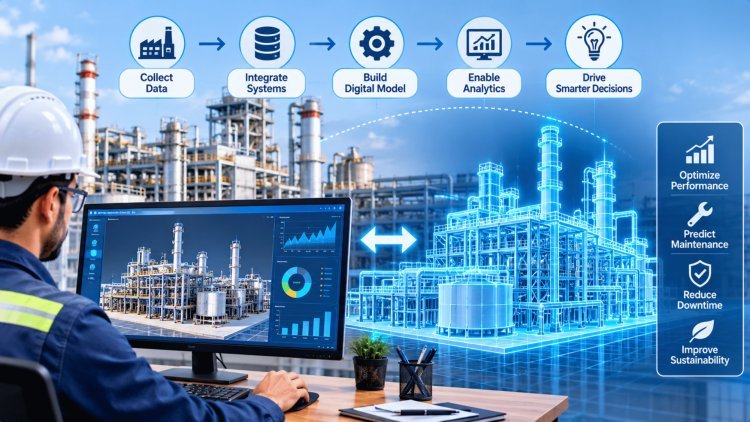
The most common mistake organizations make when investing in digital twin technology is confusing a visually impressive 3D model with a genuinely functional operational asset. A digital twin is not a rendering. It is a living, data-driven replica of a physical system that continuously ingests field data, reflects real-world conditions, and actively supports day-to-day decisions across engineering, operations, and maintenance teams.
Define Operational Intent First
Before selecting software or sensors, start with the operational questions your teams are asking every day. What systems are hardest to monitor remotely? Where do unplanned failures cause the most downtime? Which assets are consuming resources beyond their design parameters? The twin must be scoped around answering these questions — not around visual fidelity.
Key use cases to define upfront include: real-time monitoring of critical systems, space and asset utilization optimization, and predictive maintenance outcome tracking. Each of these demands a different data model and integration strategy.
Digital Reality as a Living System
The concept of "digital reality" goes beyond simulation. It means creating a system your engineering, facilities, and operations teams can trust as a single source of truth — from initial design through decades of ongoing operations. This engineering-to-operations continuity is what separates a true digital twin from a project deliverable that sits on a shelf.
To achieve this, the twin must be designed with continuous data ingestion in mind from day one. Static models become stale within months. Operational twins stay accurate because they are connected to the physical systems they represent through sensors, IoT endpoints, and integration middleware.
Real-Time Monitoring
Connect live sensor feeds to the twin so operators see the current state of every critical system without stepping onto the floor.
Space & Asset Optimization
Use the twin to analyze utilization patterns, identify underperforming assets, and model layout changes before physical implementation.
Predictive Maintenance
Feed historical and real-time performance data into predictive models to anticipate failures and schedule interventions before breakdowns occur.
Learn more about how Consac.dev approaches operational digital twin strategy for industrial clients. The most successful digital twins are not judged by how realistic they look, but by how effectively they improve visibility, decision-making, asset performance, and operational outcomes.
A true digital twin is not a visualization project. It is an operational intelligence platform that continuously connects physical assets, live data, and business decisions into a single trusted source of truth.
A digital twin is only as intelligent as the engineering data that underpins it. The transition from design documentation to a decision-ready twin requires deliberate choices about data richness, accuracy, and lifecycle continuity. Whether you are building from greenfield BIM deliverables or capturing an existing brownfield facility, the goal is the same: geometry and metadata that evolve with the asset, not freeze at handover.
The highest-value twins begin during the Front-End Engineering and Design (FEED) phase, where process and layout decisions are still fluid. Carrying that design intent forward through detailed engineering into LOD 400 and LOD 500 BIM models produces a 3D information model that is clash-free, dimensionally accurate, and loaded with asset attributes — the ideal seed for a production digital twin.
At LOD 400, every component includes fabrication-level geometry and installation information. At LOD 500, the model reflects as-built conditions verified on site. This level of fidelity means that when the twin is connected to live data, operators are navigating a model that matches what actually exists in the field — not an approximation.
Explore Consac.dev's BIM and engineering services to understand how design-phase data can be structured for twin readiness from the start.
For existing industrial facilities where as-built documentation is incomplete or outdated, laser scanning provides a path to millimeter-accurate capture of real-world site conditions. Point cloud data collected from terrestrial or mobile scanners can be registered, cleaned, and converted into intelligent BIM geometry — giving brownfield and retrofit projects a solid geometric foundation without relying on legacy drawings that may no longer reflect reality.
This approach is particularly powerful for retrofit twin projects where new equipment must be integrated into an existing spatial model. Clash detection, pipe routing, and structural analysis all depend on accurate existing-conditions data that only scan-to-BIM can reliably deliver at scale.
Dimensionally accurate 3D representations of all structural, mechanical, and architectural elements — updated to reflect as-built conditions at every project milestone.
Material grades, coatings, insulation types, and procurement specifications embedded as metadata so maintenance teams have the right information at the point of need.
Structural load paths, connection details, and support conditions modeled and updated across the lifecycle to support structural health monitoring and future modification assessments.
Data handover protocols that ensure the twin model remains current through construction, commissioning, operations, and eventual decommissioning or retrofit.
Structural twin quality compounds over time — the more lifecycle events you capture, the more valuable the asset intelligence becomes for future engineering decisions.
The Backbone — Engineering Data That Becomes Decisions
From FEED to LOD 400/500 BIM
Brownfield Capture via Laser Scanning
Engineering Data Components
Geometry
Materials & Specifications
Loads & Connections
Lifecycle Continuity
Building a digital twin platform that actually scales across a facility—or an enterprise—requires treating the twin as a software product, not a one-time deliverable. That means applying disciplined software development lifecycle (SDLC) practices, selecting standards-aligned authoring tools, and planning for integration and continuous evaluation from the outset.
It is the phase that determines whether the twin remains accurate and trusted over its operational life. Build a cadence of model audits, sensor health checks, and use-case reviews into the platform roadmap from day one.
Platform Build — Interoperable,
Scalable Twin DevelopmentPost-deployment evaluation is not optional.
The highest-performing digital twin initiatives begin with focused operational objectives, demonstrate measurable value quickly, and expand systematically across the enterprise. Rather than attempting a facility-wide deployment from day one, successful organizations validate return on investment through targeted pilots and use proven results to drive broader adoption.
Begin with a high-value operational domain such as HVAC, electrical distribution, energy management, or asset-condition monitoring. Establish measurable KPIs before deployment, including uptime improvements, maintenance savings, energy reductions, and response times to operational anomalies.
Utilize existing BIM models, as-built documentation, engineering records, and facility drawings as the starting point. Extend beyond geometry by linking maintenance histories, asset records, operational procedures, inspection logs, and lifecycle information.
Integrate IoT sensors, SCADA systems, telemetry platforms, and cloud services to provide continuous operational visibility. Ongoing data collection improves predictive analytics, anomaly detection accuracy, energy optimization, and maintenance planning over time.
After validating success, expand using standardized templates, reusable Asset Administration Shell (AAS) models, established integrations, and proven deployment workflows. The digital twin evolves into a scalable enterprise platform rather than a standalone project.
Validate value with one critical operational system.
Integrate BIM, maintenance records, and operational data.
Apply analytics, monitoring, and predictive intelligence.
Replicate proven methodology across the enterprise.
Evaluate facility systems against three essential criteria: operational criticality, data availability, and business value of improvement. Prioritize systems where performance gains can be measured clearly and where operational challenges already justify improvement efforts. The ideal pilot combines high operational impact with sufficient data maturity to demonstrate success quickly.
This initial deployment establishes the standards, governance model, integration architecture, and organizational confidence required for broader digital twin adoption.
The digital twin journey succeeds when operational evidence drives expansion decisions. Start with a focused, measurable pilot. Capture outcomes rigorously. Build organizational confidence through demonstrated value. Then scale using proven methods, reusable architectures, and standardized workflows. Over time, the digital twin evolves from a single operational initiative into an enterprise intelligence platform that continuously improves performance, resilience, efficiency, and decision-making across the entire facility portfolio.
Deploy, Expand, and Prove Value — Your Operational Roadmap
Pilot on Critical Systems
Build from Existing BIM
Operationalize with Continuous Sensor Ingestion
Extend Facility-Wide
Expansion Lifecycle
Your Next Action
Avoid These Common Pitfalls
Final Strategic Principle
What's Your Reaction?