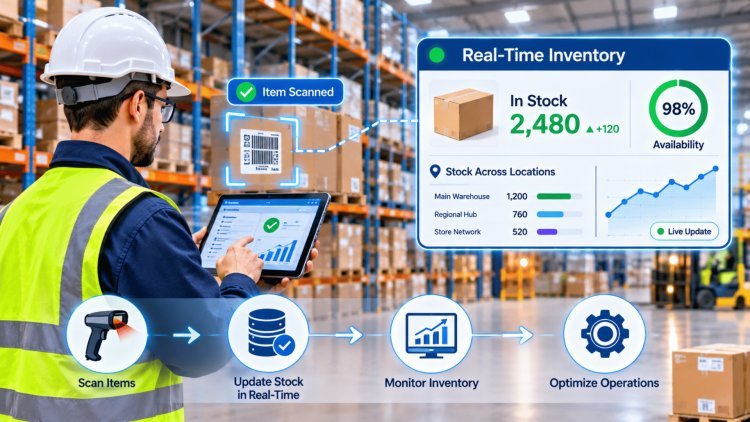
Warehouse Inventory Management Platform
The Hidden Cost of Manual Tracking
Across warehouses that still rely on spreadsheets, clipboards, and periodic cycle counts, the operational consequences are severe and compounding. Manual tracking introduces systemic blind spots that ripple outward — affecting fulfillment accuracy, customer satisfaction, and bottom-line profitability in ways that are often underestimated until a crisis forces a reckoning.
Chaotic Fulfillment & Elevated Error Rates
When inventory data lives in disconnected spreadsheets and paper logs, pick-pack-ship operations become a guessing game. Workers spend valuable time searching for items that are logged in one location but physically stored in another.
Error rates climb, returns increase, and customer trust erodes with every misfulfilled order. Studies consistently show that manual data entry carries a 1– 3% error rate — compounding into thousands of costly mistakes per month at scale.
Systemic Latency & Poor Responsiveness
Traditional systems suffer from inherent data latency — inventory counts reflect the past, not the present. By the time a discrepancy is caught and corrected, purchasing decisions have already been made on stale data.
This lack of responsiveness means that sudden demand spikes or supplier shortfalls cannot be addressed in real time, leaving operations perpetually reactive rather than proactive.
Stockouts, Misplacements & Inflated Safety Stock
Without reliable visibility, warehouse managers are forced to pad safety stock buffers to compensate for uncertainty — tying up working capital in excess inventory.
Meanwhile, misplaced SKUs ghost the system entirely, triggering emergency replenishment orders for items that are physically on-hand but invisible to the system. The result is a warehouse that is simultaneously overstocked and understocked, depending on the SKU.
Why Manual Tracking Creates Structural Risk
Inventory visibility is the foundation of every warehouse decision. When location accuracy, stock counts, replenishment triggers, fulfillment activity, and purchasing records are maintained manually, leaders lose confidence in the data that drives operations.
Every inventory discrepancy creates downstream consequences: delayed shipments, inaccurate purchasing, excess carrying costs, customer complaints, emergency freight spend, and avoidable labor inefficiencies. The longer these blind spots persist, the more difficult they become to diagnose and correct.
Manual tracking doesn't just slow operations — it actively undermines profitability, customer trust, and strategic decision-making at every level of the organization.
The true cost of manual inventory management is not the time spent updating spreadsheets. It is the accumulation of hidden errors, delayed decisions, excess inventory, fulfillment failures, and lost opportunities that compound every day the warehouse operates without real-time visibility.
The Technical Anatomy of Real-Time Visibility
Achieving genuine real-time inventory visibility is not a single technology decision — it is an engineered stack of complementary hardware, connectivity infrastructure, and integrated software systems. Each layer must be deliberately selected and configured to work in concert, eliminating latency and ensuring that every movement of every SKU is captured, transmitted, and recorded with minimal delay.
01
Layer 1 — Capture Hardware
The foundation of visibility begins at the physical edge of the warehouse. RFID portals installed at dock doors and zone transitions automatically log pallet and case movements without line-of-sight requirements, delivering read rates exceeding 99% under proper antenna configuration. IoT sensors extend coverage to environmental monitoring — tracking temperature, humidity, and dwell time for sensitive SKUs. Mobile barcode scanners and wearable ring scanners empower associates to capture item-level data during pick, receive, and put-away operations, ensuring no movement goes unrecorded. Together, these devices form a dense sensing mesh that feeds continuous data into the upstream layers of the stack.
02
Layer 2 — Connectivity & Middleware
Raw scan events are only valuable if they reach the system of record instantly and reliably. A robust wireless network infrastructure — combining enterprise Wi-Fi 6, private LTE, and wired backbone — ensures that no dead zones exist within the facility. Event-streaming middleware platforms such as Apache Kafka or AWS EventBridge act as the nervous system of the architecture, ingesting high-throughput scan events, deduplicating records, and routing validated data to downstream consumers in milliseconds. This layer is critical for eliminating the latency that plagues batch-upload legacy systems, ensuring that inventory state is always current rather than hours or days behind reality.
03
Layer 3 — System of Record
The final layer is where raw scan events are transformed into authoritative inventory intelligence. A modern Warehouse Management System (WMS) or Enterprise Resource Planning (ERP) platform serves as the single source of truth — maintaining a continuously updated ledger of every SKU's location, quantity, status, and movement history. Bi-directional API integrations with procurement, order management, and transportation systems ensure that inventory data flows horizontally across the enterprise. Every stakeholder — from the warehouse floor to the C-suite — operates from the same real-time dataset, eliminating the data silos that undermine cross-functional decision-making.
Real-Time Inventory Visibility
Deploying a real-time inventory visibility system requires disciplined sequencing. Rushing to install hardware before resolving master-data quality issues is one of the most common—and costly—implementation mistakes. The following four-phase roadmap is designed to minimize risk, validate performance at each stage, and ensure that the full-scale rollout achieves the accuracy and latency benchmarks required for operational impact.
Implementation sequence
From Baseline Audit to Full-Scale Rollout
01
Phase 1 — Baseline Audit
Conduct a comprehensive physical inventory count across all storage locations. Identify and resolve duplicate SKUs, missing locations, inaccurate UOM conversions, and stale on-hand quantities. Establish a clean, validated baseline as the authoritative starting point for all future inventory records.
→
02
Phase 2 — API Integration
Build and validate the integration layer connecting capture hardware to the WMS or ERP system of record. Use RESTful or event-driven APIs to sync scan events into live inventory tables with a target latency of under 5 seconds from physical movement to system update. Test network interruptions, duplicate scan events, and high-throughput burst scenarios. Confirm downstream propagation to order management and replenishment engines before live operations.
→
03
Phase 3 — Controlled Pilot
Launch in one contained environment—one distribution center zone, one product category, or one outbound transport lane. Tune RFID antenna power levels, optimize scanner placement, stress-test network bandwidth, train associates, refine exception workflows, and establish KPI dashboards. Document every configuration decision and performance result to accelerate subsequent rollout phases.
→
04
Phase 4 — Full-Scale Rollout
Expand to full-facility deployment only after the pilot demonstrates at least 98% RFID read accuracy across all SKU types and packaging formats, and sub-10-second end-to-end latency from scan event to WMS record update. Gate the rollout on these metrics—not on calendar timelines.
Go-live gates
Critical Success Metrics
Read accuracy
≥ 98%
RFID read accuracy sustained over 30 consecutive days before full rollout.
Latency
Sub-10 seconds
From physical scan event to WMS inventory update.
Integration
99.9% uptime
API sync reliability across all integration endpoints.
Master data
Zero gaps
Zero master-data gaps in item master and location tables prior to go-live.
Implementation risk
Common Implementation Pitfalls to Avoid
Pitfall 01
Skipping the baseline audit phase and deploying on corrupted master data.
Pitfall 02
Expanding beyond the pilot before achieving read-accuracy benchmarks.
Pitfall 03
Underestimating network infrastructure requirements in high-metal environments.
Pitfall 04
Failing to train floor associates on exception handling and manual override protocols.
Rollout discipline
Gate the rollout on performance—not the calendar.
Clean master data, validated integrations, a controlled pilot, and sustained accuracy and latency benchmarks prevent costly remediation and ensure operational impact.
REAL-TIME INVENTORY VISIBILITY
The Modern Warehouse Advantage
Organizations that successfully deploy real-time inventory visibility systems don't just solve an operational problem — they unlock a fundamentally different model of warehouse management. The benefits compound over time, transforming the warehouse from a cost center into a strategic competitive asset that drives measurable improvements across fulfillment speed, labor efficiency, working capital optimization, and customer experience.
Digital Twin Operations
A fully instrumented warehouse with real-time scan data creates a continuously updated digital twin of the physical facility. Every pallet, every SKU, every movement is mirrored in the system with sub-10-second fidelity.
Live Spatial View
Stock position, dwell time, and condition across every zone, aisle, and dock door.
Proactive Intervention
Operations managers act before issues escalate.
Cross-Facility Visibility
A unified operational picture across distribution networks — previously impossible without real-time data infrastructure.
Event-driven task management eliminates the need for supervisors to manually assign these tasks:
Put-away Replenishment Pick tasks
System detects inventory event → Work order dispatched automatically → Nearest associate or autonomous mobile robot
AI-powered demand forecasting engines continuously analyze historical velocity, seasonal trends, and inbound pipeline data to dynamically optimize safety stock levels, reducing carrying costs without increasing stockout risk.
Labor utilization improves dramatically as workers spend time executing high-value tasks rather than searching for inventory or manually reconciling counts.
Business Transformation at Scale
The strategic payoff of real-time visibility extends well beyond the four walls of the warehouse:
DRASTICALLY REDUCED WASTE
From expired, misplaced, or over-ordered inventory
RESULT →
Directly improves gross margin
OPTIMIZED LABOR DEPLOYMENT
Guided by live inventory intelligence rather than static schedules
RESULT →
Reduces overtime costs and improves associate satisfaction
LIVE ORDER TRACKING
Delivered to customers and customer-facing teams
RESULT →
Trust and transparency that drive repeat business and reduce inbound inquiry volume
Most importantly, it differentiates the brand in markets where delivery reliability is a primary purchase driver.
PERFORMANCE BENCHMARKS
99%+
Inventory Accuracy
Achievable with mature RFID and WMS integration, up from typical 65–75% accuracy in manual environments.
Manual: 65–75%
RFID + WMS: 99%+
30%
Labor Cost Reduction
Typical reduction in direct labor hours attributed to automated task management and elimination of manual cycle counts.
<5s
System Latency Target
From physical scan event to live WMS record update, enabling truly real-time operational decision-making.
Scan → Live WMS record
25%
Safety Stock Reduction
Average reduction in safety stock buffers enabled by reliable, real-time demand and inventory signal accuracy.