How to Develop a Revenue Management System for Hospitality Businesses
In an industry where a single unsold room night is revenue lost forever, hospitality businesses can no longer afford to rely on intuition, spreadsheets, or reactive competitor-chasing. A well-engineered Revenue Management System (RMS) transforms raw booking data into intelligent, automated pricing decisions — maximizing yield across every room, every channel, and every night of the year. This presentation walks through the architecture, logic, controls, and governance required to build a production-grade RMS that drives measurable results for hotels of any scale.
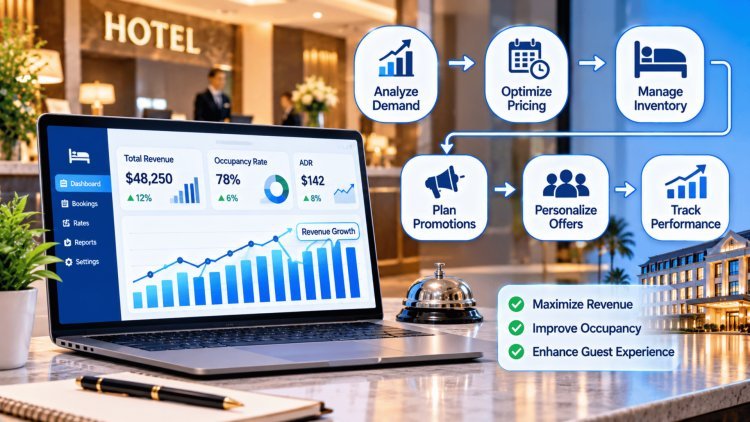
What the RMS Must Decide — and Why Manual Breaks
At its core, a Revenue Management System exists to answer one deceptively complex question: what is the right price, for the right room, sold through the right channel, at the right time? Human revenue managers simply cannot process the volume, velocity, and variety of signals required to answer that question at scale — especially across multi-property portfolios. The RMS replaces reactive guesswork with systematic, data-driven decision-making.
What the RMS Optimizes
Rather than blindly matching competitors, a robust RMS maximizes the total value of each room night by simultaneously optimizing pricing, availability controls, and distribution strategy. It treats pricing as a continuous function of market conditions — not a static tariff grid.
Key Demand Signals the System Consumes
The RMS ingests both internal property signals and external market signals to build a real-time picture of demand. The richer and cleaner the signal feed, the more accurate the forecast — and the more confident the pricing recommendation.
Why Manual Revenue Management Breaks
Revenue managers are not limited by expertise. They are limited by the scale of the decision space. Every room type, every arrival date, every market segment, every distribution channel, and every booking window introduces another variable into the pricing equation.
Demand conditions can change multiple times per day. Competitor pricing shifts, event demand spikes, cancellations occur, occupancy forecasts update, and channel costs fluctuate. Manual workflows simply cannot evaluate and respond to these signals with the speed and consistency required to maximize revenue performance.
Manual pricing breaks not because managers are incompetent — it breaks because the data volume and decision frequency exceed human cognitive capacity. At 365 nights × multiple room types × multiple channels, the combinatorial space demands automation.
A modern Revenue Management System succeeds when it continuously converts market signals into pricing, inventory, and distribution decisions faster and more consistently than any human team could achieve manually.
Building a production-grade RMS requires carefully engineering each layer of the data and decision stack. From raw reservation data flowing out of the Property Management System (PMS) to rate recommendations being pushed back to the channel manager, every component must be reliable, auditable, and scalable. Below is the complete platform flow and the integration architecture that underpins it.
Approval & Push to PMS
Pricing Logic Rule Checks
Demand Forecasting
Data Validation
The PMS is both the primary data source and the final destination for the RMS outputs. Integration must handle bidirectional data flows reliably, even when the PMS vendor API has rate limits or downtime windows.
Reservations, blocks, and group bookings by room type
Current rate plans, BAR levels, and inventory availability
Historical stay data for training forecasting models
Restriction states (CTA, CTD, min/max LOS) already in effect
The RMS then pushes back updated rates, inventory controls, and restriction changes — which the PMS propagates downstream to the channel manager and GDS connections.
Not all data flows should be treated equally. Choosing the right synchronization pattern is critical for system performance and data freshness at scale:
Bulk historical extraction via asynchronous batch jobs — triggered once at onboarding or after major PMS migrations. Handles large data volumes without blocking live operations.
Lightweight delta pulls every few hours or overnight, capturing only new reservations, modifications, and cancellations since the last run. Keeps forecasting models current without full reingestion.
For modern PMS platforms, webhook-based push notifications on reservation events allow near-instant demand signal upd
The Build: Data Pipeline to Pricing Engine
PMS Integration Architecture
Key data extracted from the PMS includes:
Async vs. Sync API Strategy
Initial Full Sync (Async)
Daily Incremental Updates (Sync)
Real-Time Event Webhooks
Average Daily Rate (ADR) is a vanity metric if rooms are being sold on the wrong nights, through the wrong channels, or to guests who displace higher-value business. A mature RMS goes beyond rate-setting to enforce a comprehensive set of yield controls and channel governance rules that protect total net revenue—including future high-demand periods.
Use stay restrictions, channel sequencing, rolling forecasts, overbooking logic, and displacement analysis to protect profitability across every demand window.
Controls That Protect Profit —
Not Just ADRProtect total net revenue—not just the headline rate.
A Revenue Management System is never truly "finished." The most valuable RMS implementations treat the platform as a continuously learning organism — one that automates high-confidence decisions, escalates edge cases to human reviewers, monitors its own performance, and retrains its models as market conditions evolve. This final layer separates a functional pricing tool from a genuinely strategic revenue intelligence platform.
Not every rate recommendation should require a human to click "approve." A mature RMS applies a tiered approval framework: changes within predefined guardrails (e.g., rate moves within ±15% of BAR) are auto-applied; larger moves or unusual restriction changes are queued for revenue manager review.
This keeps the system fast and scalable while preserving human judgment for genuinely ambiguous situations.
For multi-property chains, a Hotel RMS built for multi-property chains must also support property-level customization within a shared governance framework — allowing cluster revenue managers to set property-specific guardrails while corporate maintains visibility across the portfolio.
The RMS must continuously measure its own impact. A robust performance monitoring layer tracks KPIs on a rolling basis — daily, weekly, and month-to-date — comparing actuals against forecast and against competitive benchmarks from STR or similar sources.
ADR, RevPAR, TRevPAR, GOPAR — monitored daily with variance alerts.
Rolling forecast horizon updated every 24 hours as demand signals shift.
Rate shopping data triggers alerts when key competitors make material price moves.
The statistical engine underpinning the RMS must be treated with the same rigor as production software. Segmentation-driven time-series forecasting routines produce stable, hotel-specific demand models that update incrementally rather than retraining from scratch each cycle.
Separate models per segment (leisure transient, corporate negotiated, group, OTA) prevent high-volume segments from obscuring low-volume but high-value booking patterns. Each model carries its own forecast accuracy metric.
MAPE (Mean Absolute Percentage Error) and forecast bias are tracked at property and segment level. Degrading accuracy triggers model retraining or manual override — preventing the RMS from pricing on stale assumptions.
Oracle Hospitality OPERA and similar enterprise PMS platforms require carefully documented integration protocols. Revenue, rate, inventory, and restriction updates must move reliably between the RMS and distribution ecosystem at scale.
Every override, every anomaly, and every post-stay actual vs. forecast comparison feeds back into the model training pipeline — creating a system that genuinely improves over time rather than decaying as market conditions shift away from its training data.
The most successful hospitality RMS deployments treat automation as a trust-building exercise: start with recommendations, graduate to auto-approvals as confidence grows, and continuously expand the scope of autonomous decisions as model accuracy is validated in production.
Mature System: Automation, Governance & Continuous Learning
Automation with Human Oversight
KPI Monitoring & Competitive Alerting
Core KPIs Tracked
Days Forward
Competitive Alerts
Forecasting Model Governance & Continuous Learning
Demand Segmentation
Model Accuracy Tracking
PMS & Channel Integration
Continuous Improvement Loop
A mature Revenue Management System does more than forecast demand. It governs decisions, measures its own performance, learns from outcomes, and steadily expands automation while maintaining transparency, accountability, and commercial control. For more details contact with us.
What's Your Reaction?