How to Develop a Permit & Licensing Management System for Organizations
Build a risk-based system that turns permit requirements into trackable tasks, evidence, and on-time decisions—without slowing projects down. This guide walks through the core pillars of a modern Permit & Licensing Management System (PLMS): from foundational risk principles and data architecture, through workflow automation, to continuous compliance improvement.
Start With the Standard: Risk-Based Licensing, Not Paperwork
The OECD framework is clear: licenses and permits exist to manage risks before harm occurs. That means your system should be built around proportionality—requiring only the oversight that genuinely matches the level of risk involved. When permit requirements are layered on indiscriminately, organizations face delays, unnecessary costs, and eroding trust with both regulators and internal stakeholders. The antidote is intentional, risk-calibrated design.
Apply Permits Only Where Truly Necessary
Not every operational activity warrants a formal permit. Begin by auditing your current permit obligations and mapping each one to a specific risk category— environmental, public safety, health, structural, or financial.
Remove or consolidate requirements that are purely procedural with no measurable risk justification. This reduces administrative burden while keeping meaningful safeguards intact.
Streamline Fragmented Procedures to Reduce Costs
Fragmented processes—where applicants must visit multiple departments, submit overlapping documentation, or wait on disconnected approval chains—introduce hidden costs and breed frustration.
Consolidate intake points, establish unified review timelines, and eliminate duplicative data requests. Organizations that streamline these procedures routinely report 30–50% reductions in administrative overhead and significant improvements in applicant satisfaction and regulatory trust.
Design for Speed and Agility
Expectations for government and corporate compliance response times are rising sharply. Projects stall when permit decisions lag weeks behind operational readiness.
Build your system with speed as a first-class design constraint—not an afterthought. Use pre-defined review lanes by risk tier (fast-track for low-risk, full review for high-risk), and define maximum turnaround SLAs for every stage of the process to hold all parties accountable.
Risk-Based Decision Framework
The goal is proportionality: match the rigor of your permit process to the magnitude of the risk—no more, no less.
Effective licensing systems do not measure success by the number of permits issued or reviews performed. They succeed when oversight is precisely targeted, risks are controlled, approvals are timely, and compliance becomes a facilitator of safe operations rather than a barrier to progress.
A well-designed Permit & Licensing Management System lives or dies on the quality of its underlying data model. Without a canonical, authoritative record of every permit—its scope, status, obligations, and owner—compliance gaps are inevitable. The goal is to create a Single Source of Truth (SSOT) that every team, system, and regulator can rely on without question.
Create a structured permit registry that captures all critical metadata for every permit in your portfolio. Each record should store: issuing authority, regulatory scope, effective and expiration dates, geographic or operational boundaries, renewal requirements, associated conditions and obligations, and document version history. This is not just a filing system—it is the operational backbone of your compliance program. Every decision, every task, and every alert should trace back to a record in this inventory.
Ambiguous ownership is one of the most common causes of permit lapses. For each record in the inventory, designate a named permit owner who is explicitly responsible for renewals, inspection scheduling, corrective actions, and regulatory correspondence. Ownership should cascade down to task-level accountability—so when a monitoring deadline approaches or an inspection is flagged, there is no confusion about who acts. Use role-based access controls to enforce this ownership structure within the system.
Static compliance checklists become outdated quickly. Instead, connect permit conditions to live operational data through integrations with your EHS/EMS platforms, environmental monitoring systems, GIS tools, and asset or maintenance management software. When a monitoring threshold is breached or a scheduled maintenance event is missed, the system should automatically surface the relevant permit obligation and initiate a workflow. This transforms compliance from a periodic audit exercise into a continuous, real-time operational function.
Operational Integration
Ownership Assignment
Permit Inventory
Slide the Pieces Into Place: Data Model + Single Source of Truth
Build the Permit Inventory
Assign Clear Permit Owners
Link Obligations to Operational Triggers
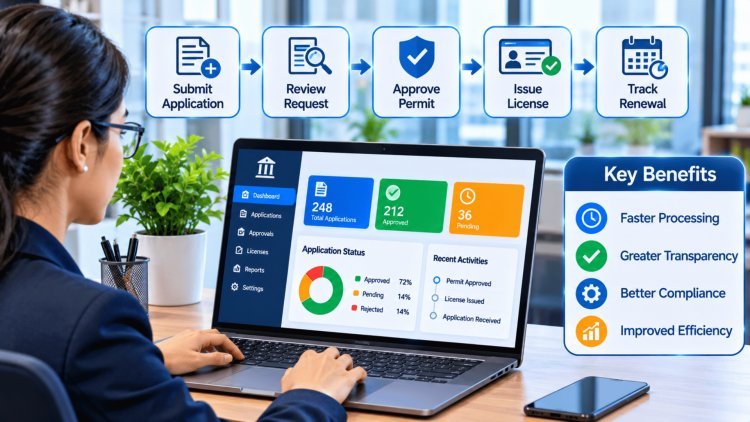
A robust workflow engine is what separates a modern PLMS from a glorified spreadsheet. Every stage of the permit lifecycle—application intake, technical review, inspection scheduling, approval or denial, issuance, and renewal—should follow a documented, template-driven process with defined roles, timelines, and decision criteria. This creates predictability for applicants and accountability for reviewers.
Standardize intake, technical review, inspections, issuance, and renewal with defined roles, SLAs, checklists, and real-time status visibility.
Build the Workflow Engine: From
Intake to Inspections to DecisionsMake every permit stage visible, accountable, and predictable.
The most valuable component of a Permit & Licensing Management System is its compliance backbone. This operational layer transforms permit obligations into measurable activities, automated monitoring processes, corrective-action workflows, audit-ready evidence, and continuous improvement mechanisms. Rather than treating permits as documents, mature organizations manage them as active compliance programs that evolve throughout every permit lifecycle.
Every monitoring requirement, operational condition, reporting obligation, and compliance commitment should be converted into a scheduled system task. Standardized monitoring protocols ensure data is collected consistently, accurately, and in accordance with regulatory requirements.
Automated report generation using monitoring data reduces administrative effort while helping ensure reporting deadlines are consistently achieved.
Compliance events, threshold exceedances, and monitoring exceptions should automatically initiate Corrective and Preventive Action workflows. These processes document causes, assign accountability, define remediation activities, and verify effectiveness before closure.
Closed-loop CAPA management prevents recurring violations and provides defensible evidence of due diligence during inspections and audits.
Renewal deadlines, inspections, reporting obligations, and permit milestones should be supported by structured escalation workflows. Automated alerts dramatically reduce the risk of permit lapses and missed compliance obligations.
Every notification, acknowledgment, approval, and escalation should be retained within a complete audit trail alongside version-controlled supporting documents.
Mature compliance programs continuously evaluate performance using objective metrics. Trend analysis, lessons learned, regulatory reviews, and procedural updates transform compliance from a reactive activity into a strategic business capability.
Regulatory change management ensures workflows, templates, checklists, and compliance controls remain aligned with evolving requirements.
Capture compliance data and operational performance continuously.
Generate inspection records, reports, audit logs, and supporting documentation.
Resolve non-conformances and eliminate recurring compliance risks.
Update processes, templates, and controls based on lessons learned.
Initiate renewal alerts at least 90 days before permit expiration.
Every document revision, notification, action, and approval should be traceable.
Renewals, violations, documentation completeness, and cycle-time performance.
Lessons learned continuously improve system design and compliance controls.
The compliance backbone is not a one-time software implementation. It is a continuously evolving operational system that becomes smarter with every permit renewal, inspection, audit, corrective action, and regulatory update. Organizations that treat compliance as an integrated business capability rather than an administrative requirement consistently achieve stronger regulatory performance, lower risk exposure, improved operational transparency, and greater long-term resilience. For more details contact Consac.dev today.
The Compliance Backbone + Modern Automation
Translate Conditions Into Monitoring Tasks
Corrective Actions & Root-Cause Traceability
Automated Alerts & Escalation
KPI Reviews & Continuous Improvement
Compliance Improvement Lifecycle
Compliance Performance Indicators
Example Alert Escalation Framework
Final Strategic Takeaway
What's Your Reaction?