How to Build a Supplier Quality Management Platform for Global Supply Chains
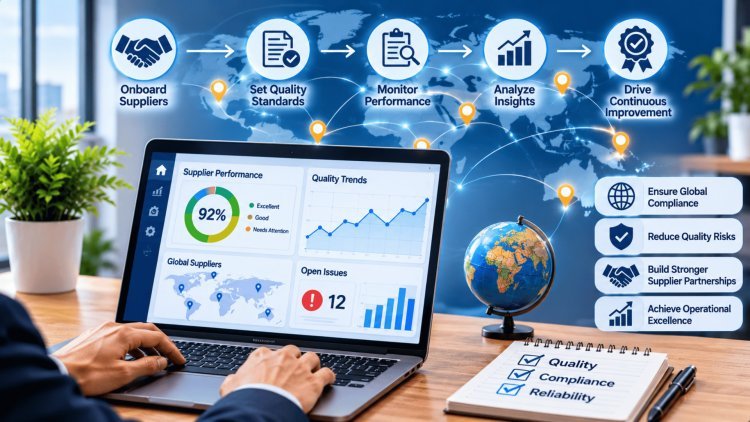
Global supply chains are under pressure like never before. Rising complexity, multi-tier supplier networks, and regulatory demands mean that quality failures don't just cost money — they cost market position, customer trust, and compliance standing. This presentation walks through the architecture, workflows, and technology decisions required to build a Supplier Quality Management (SQM) platform that scales across regions, connects stakeholders, and closes the loop on every defect — from first inspection to verified corrective action.
The Real Problem: Quality Failures Repeat Because Data Is Fragmented
Most organizations already have quality processes in place — inspections happen, non-conformance reports get filed, corrective actions get assigned. And yet, the same defects resurface quarter after quarter with the same suppliers. The root cause is almost never a lack of effort. It's a fundamental fragmentation of quality data across incompatible systems, inboxes, and regional teams. Until that fragmentation is solved at the infrastructure level, recurrence is structurally guaranteed.
The Email-Based SCAR Problem
When Supplier Corrective Action Requests (SCARs) are managed through email, each inbox becomes its own version of the truth. Quality managers in different regions may have entirely different views of a supplier's performance history.
When leadership asks "how many quality issues has Supplier X caused this year?" the honest answer is: nobody knows without manual digging.
SCARs get buried in threads, attachments go unversioned, and follow-up falls to whoever remembers to follow up. This isn't a process failure — it's a system design failure.
NCRs and 8D Actions in Mixed Formats
Non-Conformance Reports (NCRs) and 8D corrective action forms are frequently exported to Excel, emailed as PDFs, or logged in disconnected regional databases.
When formats differ — and they always do across geographies — there is no reliable way to aggregate data, identify patterns, or confirm that a corrective action was actually verified.
Recurrence is discovered late, if at all, often only when a customer complaint arrives or an audit exposes a gap. By that point, the cost of the failure has multiplied many times over.
The Hidden Cost of "Local Truth"
Fragmented systems don't just create operational confusion — they create risk blind spots. A supplier that has triggered five NCRs across three regional teams may appear low-risk to each team individually.
Without a unified view, sourcing decisions, qualification renewals, and audit scheduling are all made with incomplete information.
The platform you build must eliminate local truth and replace it with a single, authoritative, real-time record of supplier quality performance.
Why Recurrence Becomes Inevitable
When supplier quality records, SCARs, NCRs, audit findings, 8D investigations, corrective actions, approvals, and verification evidence exist across multiple disconnected repositories, organizations lose the ability to identify recurring patterns, quantify supplier risk, validate corrective action effectiveness, and proactively prevent future failures. Fragmentation breaks the feedback loop that quality management depends upon.
Organizations that rely on email-based SCARs and mixed-format NCR tracking are structurally unable to prevent recurrence — the data architecture makes it impossible, regardless of team effort.
Quality failures rarely repeat because organizations lack processes. They repeat because the data needed to learn, correlate, verify, and prevent recurrence is fragmented across systems that were never designed to work together.
Building a supplier quality management platform begins with a foundational architectural decision: every quality event, inspection record, corrective action, and supplier credential must live in one system of record. This isn't just about convenience — it's about making quality performance defensible, auditable, and actionable across every region and business unit. The design must account for integration with existing enterprise systems, real-time data capture from the field, and long-term supplier lifecycle management.
All inspection reports, audit findings, and compliance documents must be stored in a unified repository — not siloed by region, product line, or business unit. When an inspector completes a receiving inspection in Vietnam and a third-party audit occurs in Mexico, both records must feed into the same supplier profile, triggering the same scoring logic and visibility rules. This centralization is what transforms reactive quality management into a proactive, pattern-driven discipline.
Platforms like P2HS Supplier Quality Management demonstrate how centralized inspection data can be structured for global scalability.
A quality platform that operates in isolation from procurement and logistics will always lose the race against spreadsheet drift. The moment a Purchase Order is created, the quality system should know: which supplier, which part numbers, which inspection requirements apply, and which quality history is relevant. Integration with ERP systems (SAP, Oracle, NetSuite) ensures that inspection triggers are automatic, not manual. Connections to freight forwarders and logistics systems enable pre-shipment inspections to be scheduled relative to cargo booking — not discovered after goods have already shipped.
For a detailed view of how integration architecture is structured for global teams, the Benchmark Platform Overview provides a useful reference model.
Keep all supplier certifications (ISO, IATF, FDA, etc.), expiry dates, renewal reminders, and qualification status in a live, searchable database. Approval decisions must be traceable — with documentation, audit trails, and version history — so that when a regulator or customer asks why a supplier was approved, the answer is immediate and complete.
Supplier performance scoring must update automatically as inspections close, NCRs are logged, and corrective actions are verified. Static quarterly scorecards that are assembled manually are always out of date by the time they're distributed. A live analytics layer ensures that sourcing, procurement, and quality teams are always working from the same current picture of supplier risk.
Global supply chains operate across time zones, regulatory environments, and languages. The platform must support role-based access by region, configurable workflows that reflect local regulatory requirements, and reporting that consolidates global data while still allowing regional drill-down. Data sovereignty and localization requirements should be baked in from day one, not bolted on later.
Design the "Single Source of Quality Truth" System
Centralize Inspections, Audits & Compliance
Connect to ERPs, Freight Forwarders & PO Workflows
Supplier Credential & Qualification Management
Real-Time Supplier Analytics & Scoring
Multi-Region, Multi-Language Architecture
A platform is only as powerful as the workflow it enforces. The goal is to standardize every step of the quality management cycle—from the moment a purchase order is created to the moment a corrective action is verified closed—so that nothing falls through the cracks and every outcome is measurable. The closed-loop model replaces ad hoc process management with controlled, traceable daily execution that scales across teams and geographies.
Standardize inspection, NCR handling, 8D execution, containment, and verified closure so supplier quality becomes measurable, defensible, and continuously improving.
Build the Closed-Loop Workflow:
From Inspection to Verified Recurrence ControlClose the loop with verified evidence—not paperwork.
The true measure of a Supplier Quality Management (SQM) platform is not the software itself but the business outcomes it generates. Effective platforms connect supplier collaboration, inspection data, corrective action management, risk monitoring, and sourcing intelligence into a unified decision-making ecosystem that continuously improves supplier performance and organizational resilience.
High-performing supplier quality ecosystems treat suppliers as collaborative partners rather than passive recipients of corrective actions. Supplier-facing portals create direct visibility into NCRs, SCARs, corrective action status, audit findings, scorecards, and compliance requirements.
By enabling real-time communication, evidence submission, root-cause documentation, and progress tracking, organizations shorten response cycles while strengthening accountability and transparency across the supply chain.
Modern supply chains depend on information from multiple inspection sources including internal receiving inspections, supplier self-assessments, in-process audits, and third-party inspectors. Integrating these datasets creates a comprehensive view of supplier performance.
Comparing supplier-reported results against independent inspection findings helps identify systemic quality gaps, reporting inconsistencies, and potential emerging risks before they impact production, customers, or regulatory compliance.
Supplier quality metrics should directly support procurement and sourcing decisions. Pass rates, defect trends, NCR recurrence, SCAR closure performance, and audit outcomes provide objective data that influence supplier selection, volume allocation, qualification status, and sourcing strategies.
Real-time performance visibility transforms quality data from a reporting function into a strategic sourcing tool that proactively identifies risk before it becomes a customer-facing issue.
Internal, supplier, and third-party quality findings enter the platform.
Trend tracking, defect evaluation, and supplier risk assessment.
NCR and SCAR workflows drive containment and improvement activities.
Quality intelligence informs supplier selection and allocation decisions.
Successful Supplier Quality Management platforms evolve continuously. As supplier networks expand, organizations should onboard new inspection sources, refine risk models, improve scorecard weighting, automate additional workflows, and strengthen integration with procurement, ERP, and manufacturing systems.
The objective is not to achieve perfection on day one. The objective is to create a defensible, measurable, scalable quality ecosystem capable of improving continuously as more supplier data becomes available.
An SQM platform delivers its greatest value when supplier collaboration, inspection intelligence, corrective actions, compliance management, and sourcing decisions operate within a single connected system. The organizations that excel treat supplier quality as an ongoing strategic capability rather than an isolated software initiative. By continuously measuring performance, reducing risk, and improving transparency, the platform becomes a competitive advantage that scales with the supply chain and strengthens operational resilience year after year.
Launch, Integrate, and Prove Value: Scorecards, Risk & Compliance
Supplier Collaboration Portals
External Inspection Data Integration
Metrics That Drive Sourcing Decisions
Supplier Quality Intelligence Cycle
Metrics That Matter
Building a Continuous Improvement Platform
Final Strategic Takeaway
What's Your Reaction?