Building a Warranty Management System for Product- Based Companies
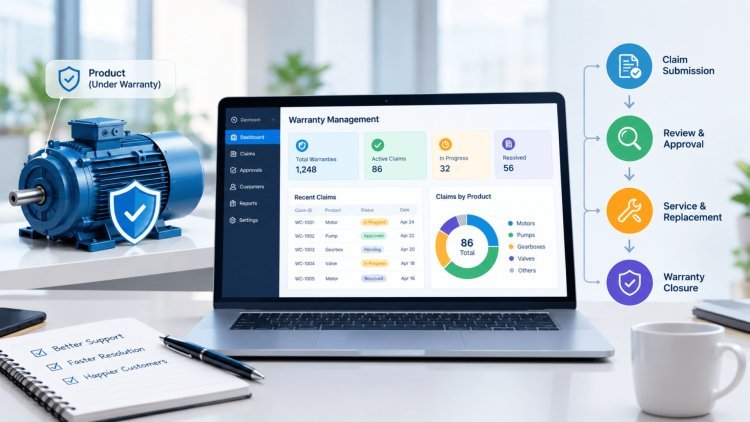
For product-based businesses, warranty management is far more than a post-sale formality — it is a strategic lever that directly impacts customer retention, operational efficiency, and long-term profitability. Yet most companies still rely on disconnected spreadsheets, overflowing support inboxes, and ad hoc approval processes that erode margins silently. This blog explores how to architect a robust, scalable Warranty Management System (WMS) from the ground up — one that transforms after-sales service from a cost centre into a competitive differentiator.
The Hidden Margin Killer
Across the product industry, warranty mismanagement is quietly bleeding margins. Studies consistently reveal that up to 30% of all warranty claims are rejected — not because the product did not fail, but because the claimant could not furnish sufficient evidence. Photographs arrive blurry, purchase invoices are missing, serial numbers are unreadable, and support agents spend hours manually cross-referencing data that should take seconds to validate. This is not a customer problem — it is a systems problem.
The Real Cost of Manual Processes
When claims travel through disconnected spreadsheets and support email chains, every touchpoint introduces delay, duplication, and error. A single unresolved claim can require 4–7 back-and-forth messages, consuming an average of 45 minutes of agent time. Multiply that across hundreds of monthly claims and the hidden labour cost becomes staggering — before even accounting for customer churn caused by poor after-sales experience.
Rejection rates spike further when field agents apply the policy inconsistently, approving borderline cases on instinct rather than codified rules. This creates legal exposure, brand reputation damage, and unpredictable financial provisioning.
Defining Your Warranty Policy: The Foundation of Everything
Before automating a single workflow, product companies must establish a canonical warranty policy — a single source of truth that answers three critical questions:
Coverage: Which product categories, failure modes, and usage conditions are included? Define explicitly what constitutes normal wear versus defect.
Exclusions: Physical damage, unauthorised modifications, consumable parts, and geographic restrictions must be codified, not left to agent discretion.
Remedy Hierarchy: Establish the sequence — Repair first, Replace if repair is not feasible, Refund as a last resort — and define the decision criteria at each stage.
A well-documented policy is the backbone of every automated rule your system will enforce. Explore how Consac.dev approaches policy architecture to understand the structural thinking required before a single line of code is written.
Claims Rejected
Due to insufficient or improperly captured evidence at intake.
Avg. Agent Time
Spent per claim when processed manually via email threads.
Back-and-Forths
Average message exchanges per unresolved claim in legacy systems.
This is not a customer problem — it is a systems problem.
A well-engineered claims pipeline is the operational heart of any Warranty Management System. It replaces the chaotic, error-prone journey of emails and spreadsheets with a structured, auditable, and largely automated flow — from the moment a customer reports an issue to the moment a resolution is dispatched. Each stage of the pipeline must be designed with data quality, speed, and decision-making accuracy as primary objectives.
The first stage is where most legacy systems fail catastrophically. Allowing customers to describe their issue in free-text emails guarantees inconsistency. A modern WMS replaces this with a structured intake form that mandates the capture of:
— pulled from a catalogue lookup, not typed manually
— validated against a master dispatch register at submission
— linked directly to invoice or order records
— matched to a CRM profile for history and entitlement checks
Structured intake alone can reduce claim processing time by over 60%, as agents receive complete, validated dossiers rather than incomplete email threads to unpack.
Once intake data is captured, validation must happen in real time — not hours or days later. The system should automatically crossreference the submitted serial number and purchase date against:
Confirm the unit was actually sold and shipped by your organisation
Calculate coverage window from the dispatch or purchase date
Flag units that have been claimed multiple times
Apply coverage and exclusion logic automatically
Instant validation eliminates the human bottleneck in claim triage and ensures policy is applied uniformly — removing agent bias and reducing both over-approval and incorrect rejection rates.
The move from free-text problem descriptions to structured failure mode taxonomies is one of the highest-leverage improvements a product company can make. Instead of "the product stopped working," the system prompts the customer to select from a pre-defined failure mode library — Motor Failure, Display Defect, Seal Breach, Electrical Short — and upload standardised photographic evidence using guided prompts.
This structured data serves a dual purpose. First, it makes immediate claim adjudication faster and more objective. Second, it feeds a product quality intelligence layer: when 15% of a specific SKU cohort reports the same failure mode within 6 months of dispatch, your engineering team can act before a full recall becomes necessary.
Visit Consac.dev to understand how structured data models underpin every effective claims pipeline.
Designing the Claims Pipeline
Stage 1 — Intelligent Intake
Stage 2 — Automated Validation
Stage 3 — Standardised Evidence Collection
Once the claims pipeline captures clean, validated, structured data, the operations layer can be almost entirely automated. This is where a Warranty Management System transforms from a passive record-keeping tool into an active operational engine—one that drives resolution speed, reduces costs, and generates the business intelligence needed to make product and supply chain decisions with confidence.
Automation and
Operations
A mature Warranty Management System is not merely a cost-containment tool — it is a strategic growth asset. The companies that outperform their competitors in after-sales service are not just those that resolve claims faster; they are the ones that use warranty data to improve their products, deepen customer relationships, and create new revenue streams that did not exist in their original business model.
In commoditised product markets, the post-purchase experience is often the last remaining frontier for differentiation. When a customer submits a claim and receives a resolution in 24 hours with zero friction, that experience becomes a powerful retention and advocacy driver. Net Promoter Scores from post-claim surveys consistently outperform those from new purchase surveys — when the resolution experience is excellent.
Beyond individual interactions, the aggregate warranty data your system collects becomes a product intelligence gold mine: which components fail first, which manufacturing batches underperform, which geographies experience climate-related failures. This intelligence flows directly into R&D prioritisation, supplier negotiations, and quality assurance processes. Discover how Consac.dev approaches competitive after-sales strategy for product-based businesses.
Extended warranty and service contract renewals represent one of the most underexploited revenue streams in the product industry. A WMS with a built-in renewals engine can automatically identify customers whose warranty is approaching expiry — 90, 60, and 30 days out — and trigger personalised renewal offers through email, SMS, or in-app notifications.
The conversion economics are compelling: a customer who has already experienced a smooth warranty resolution has a dramatically higher propensity to purchase an extension than a new customer. Automated renewals, priced intelligently based on product age, failure history, and cohort risk profiles, can add 8–15% to annual revenue with minimal additional operational overhead. This is recurring, high-margin revenue built on the trust your after-sales experience has already earned.
Final Takeaway: The path to a world-class Warranty Management System follows a clear sequence — first, establish a canonical warranty policy that codifies every coverage decision, exclusion, and remedy rule. Second, build a structured claims pipeline that captures clean data at intake and validates it automatically. Third, automate resolution workflows and give customers self-service visibility. Finally, use the intelligence your system generates to improve products, reduce defects, and grow revenue through renewals. Start with the policy. Automate to scale. Let your warranty programme become the proof point that your brand stands behind every product it ships. For a deeper exploration of the frameworks and technology decisions behind each of these stages, Contact Consac.dev.
Document every coverage rule, exclusion, and remedy decision in a single authoritative source before building any automation.
Structured intake, real-time validation, and standardised failure mode capture replace email chaos with auditable process.
Repair, Replace, and Refund workflows execute automatically, triggering logistics, inventory, and finance without manual handoff.
KPI dashboards, renewal automation, and product intelligence loops turn your WMS into a strategic growth platform.
Scaling for the Future
Turning After-Sales into a Competitive Advantage
Automating Renewals to Drive Recurring Revenue
Define Canonical Policy
Build the Claims Pipeline
Automate Resolution
Measure and Scale
Start with the policy. Automate to scale. Let your warranty programme become the proof point that your brand stands behind every product it ships.
What's Your Reaction?