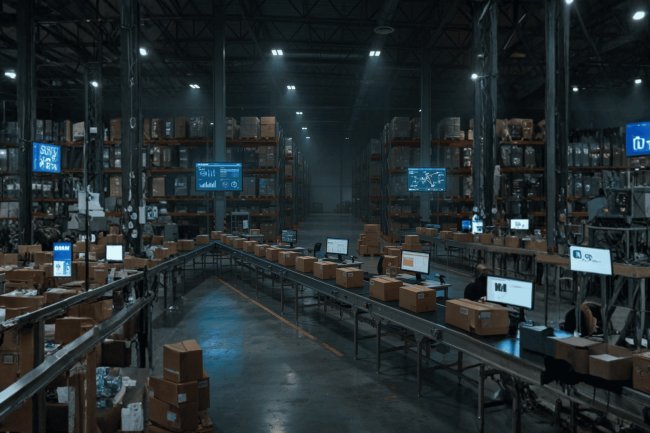
Building Inventory Management Software for Growing Businesses
A strategic guide to replacing outdated manual processes with intelligent, scalable systems — and why the businesses that act now will outperform those that don't.

The Hidden Cost of Growing Pains
For many growing businesses, the inventory management tools that worked at launch quietly become the biggest obstacle to scaling. The moment a company expands beyond a single warehouse, a handful of SKUs, or a few sales channels, the cracks in manual systems begin to show and they widen fast.
Growth Exposes Every Weakness In Manual Inventory Systems
What feels manageable with one location, a small catalog, and limited order volume can quickly become a major operational liability once complexity increases across the business.
Average revenue lost by businesses experiencing frequent inventory inaccuracies and stockouts.
Of SMBs still rely on manual spreadsheets or disconnected tools as their primary inventory method.
Inventory discrepancies grow 3.5× faster in businesses that scale without upgrading their systems.
Spreadsheets Are the Enemy of Scale
Manual data entry introduces compounding errors at every stage, from receiving inventory to fulfilling customer orders. Ghost stock, items recorded as available but physically absent, creates overselling, missed shipments, and customer dissatisfaction. Unlike modern inventory platforms, spreadsheets provide no reliable real-time visibility. By the time discrepancies are identified, the opportunity to resolve them has often already passed.
Ghost Stock
Inventory appears available but cannot actually be fulfilled.
Overselling
Orders are accepted for products that no longer exist in stock.
No Visibility
Managers operate using outdated or incomplete information.
Version Conflicts
Multiple users create competing records that nobody fully trusts.
The Tipping Point: When Errors Become Existential
Stock discrepancies do not remain isolated operational issues. A single stockout during a high-demand sales period can result in permanent customer loss. Emergency procurement, rush shipping, and reactive purchasing decisions rapidly erode margins while creating additional disruption throughout the supply chain.
How Inventory Errors Cascade
Customer Impact
Stockouts damage customer confidence and push buyers toward competitors. In many cases, those customers never return.
Profitability Impact
Expedited shipping, emergency purchasing, and inefficient inventory decisions directly reduce profit margins and operating efficiency.
Signals You've Outgrown Manual Inventory Management
The Problem Isn't Growth
Growth does not create inventory problems. Growth simply exposes weaknesses that already existed. Businesses that continue relying on spreadsheets and disconnected processes eventually reach a point where operational complexity exceeds the capabilities of their systems.
The Cost of Waiting Increases With Every Stage of Growth
Spreadsheets and disconnected inventory processes may support a business in its earliest stages, but they become increasingly fragile as operational complexity grows. Revenue losses, inventory inaccuracies, customer dissatisfaction, and supply chain bottlenecks are often symptoms of systems that can no longer keep up. Sustainable growth requires accurate, real-time inventory visibility that scales alongside the business.
Moving from manual inventory logs to a centralized digital platform is not simply a technology upgrade. It creates an operational backbone that connects item movement, locations, people, and decisions in one continuously updated system.
Replace handwritten logs and repetitive manual entry with barcode or RFID scanning at receiving, picking, transfers, and dispatch. Each movement is captured immediately, creating a continuous digital record from supplier delivery through customer shipment.
Centralize stock information across warehouses, retail locations, and fulfillment centers. A shared view of inventory enables better transfer decisions, reduces unnecessary safety stock, and helps route orders from the most appropriate location.
The goal of inventory digitization is not merely to replace paper with screens. It is to create a connected operating system where every item movement is captured, every location is visible, every user has the right level of access, and emerging inventory problems can be addressed before they become operational crises.
Foundations: The Digital Transformation
Barcode & RFID Integration
Multi-Location Tracking
VISIBILITYWhat Changes After Transformation?
Reactive Firefighting
Proactive Control
An API-first approach treats integrations as core features. Exposing APIs for purchasing, fulfillment, and reporting transforms the inventory platform into an operational hub. Bi-directional flows connect POS systems, e-commerce storefronts, and accounting platforms, eliminating silos and ensuring instant synchronization across all channels.
Cloud-native systems on AWS, Azure, or Google Cloud deliver 99.9%+ uptime, automatic scaling, and global synchronization. A warehouse update in Chicago at 2 AM is instantly reflected for teams in Los Angeles and customers online. Disaster recovery and backups are embedded, not bolted on.
Inventory databases must scale from hundreds to millions of SKUs. Optimized indexing, partitioned tables, and caching layers keep queries fast. Concurrent updates by multiple operators must never cause race conditions or corruption, ensuring reliability as businesses expand.
Modern architecture in inventory management is a strategic decision. API-first design, cloud-native infrastructure, and scalable databases ensure resilience, agility, and seamless growth as businesses expand into new markets.
The Modern Architecture
API-First Design
Cloud-Native Infrastructure
Scalable Database Architecture
Key Insight
Collecting accurate data is the foundation — but the true competitive advantage of modern inventory software lies in transforming that data into actionable intelligence. Businesses that leverage analytics and automation don't just react faster; they prevent problems from occurring in the first place.
By analyzing historical sales velocity, seasonal trends, promotional uplift, and supplier lead times, predictive models generate demand forecasts at the SKU level — so purchasing teams order the right quantities at the right time, neither tying up capital in excess inventory nor running dry during peak demand.
The downstream effects of intelligent inventory management are quantifiable and significant. Holding costs — the combined expense of warehousing, insurance, spoilage, and opportunity cost — decrease as excess stock is reduced, while order accuracy rates climb and customer satisfaction rises alongside margin improvements.
Inventory data alone is inert — it only becomes a competitive advantage once forecasting, automation, and measurement turn it into action. The strongest inventory systems close the loop: predict demand accurately, act on it automatically, and prove the impact with hard numbers.
From Data to Intelligence
Predictive Demand Forecasting
Measurable Business Impact
The businesses winning in competitive markets aren't simply managing inventory more efficiently. They're using intelligent software as a strategic advantage. Future-proofing means building systems that adapt to increasing complexity, expanding operations, and changing customer demands without requiring a complete rebuild every time the business evolves.
Modern inventory platforms replace reactive management with predictive intelligence, creating operational systems capable of outperforming tomorrow's challenges as efficiently as today's.
Generic forecasting tools rely on broad statistical assumptions that treat every business similarly. AI-driven demand models take a fundamentally different approach by learning from your unique product mix, customer purchasing behavior, geographic demand patterns, supplier performance, and sales history. As these models process additional data over time, forecasting accuracy continuously improves, creating a competitive advantage that becomes increasingly difficult for competitors to replicate.
Forecasting models learn SKU-level demand behavior.
Purchasing trends become increasingly predictable over time.
Regional buying behavior influences inventory planning.
Lead-time patterns improve replenishment decisions.
Machine learning continuously monitors inventory activity and identifies unusual behavior patterns in real time. Unexpected consumption spikes, suspicious inventory movements, potential theft, forecasting anomalies, and data entry errors can be detected long before they propagate throughout the broader supply chain.
Organizations fully adopting intelligent inventory systems consistently achieve substantial operational gains.
Better forecasting, accurate inventory data, automated workflows, and intelligent decision support create a direct path to improved profitability, faster fulfillment, lower operating costs, and stronger customer satisfaction.
Every month spent operating on outdated inventory systems increases inefficiencies, erodes margins, frustrates customers, and limits growth potential. The path forward is clear: replace friction with automation, replace guesswork with intelligence, and replace reactive management with proactive control.
Audit current inventory processes, identify error rates, and quantify the true cost of manual operations.
Architect a cloud-native, API-first platform tailored to SKU volume, locations, and sales channels.
Roll out barcode integration, automated workflows, and role-based access using phased onboarding.
Layer in predictive analytics and AI demand models to continuously improve efficiency and profitability.
Intelligent inventory management is no longer just an operational improvement. It is a strategic growth platform. Businesses that combine barcode-driven automation, cloud-native architecture, predictive analytics, and AI-powered demand forecasting create scalable systems capable of supporting growth without increasing complexity. The technology exists, the ROI is proven, and the organizations that act decisively today will be the ones defining their markets tomorrow.
Future-Proofing for Scale
Build Once. Scale Continuously.
AI-Driven Demand Models
Product Intelligence
Customer Patterns
Geographic Demand
Supplier Insights
Detect Problems Before They Spread
Higher Efficiency
The Path to Long-Term Profitability
Efficiency Translates Into Results
The Cost of Delay Compounds Every Month
Implementation Roadmap
Assess
Design
Deploy
Optimize
Future-Proofing Means Building for Tomorrow Today
What's Your Reaction?