Building a Secure Multi- Organization Software Platform
A strategic guide to unifying security, compliance, and delivery velocity across autonomous engineering teams — without sacrificing developer experience or organizational agility.
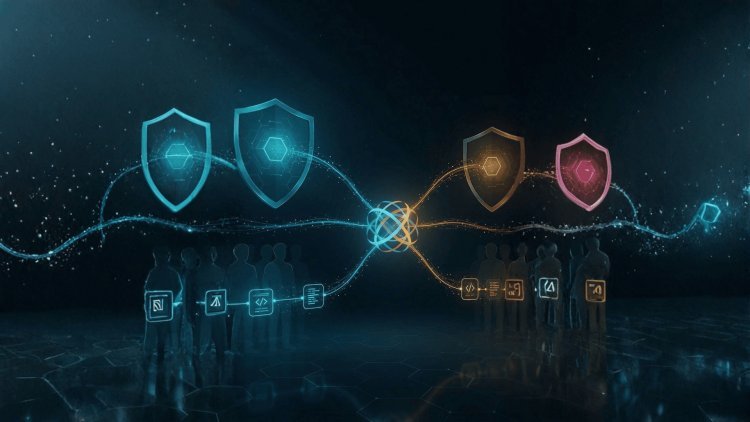
The Friction of Siloed Development
Large enterprises rarely function as a single engineering organization. Instead, they operate as collections of autonomous teams, each making independent technology decisions while pursuing local optimization. Although this autonomy can accelerate innovation, it often introduces fragmentation that reduces visibility, complicates governance, increases security risk, and creates significant operational inefficiencies across the broader enterprise.
What Enterprise Fragmentation Looks Like
Autonomous Groups, Divergent Stacks
Product teams independently select programming languages, CI/CD platforms, observability tools, infrastructure providers, deployment frameworks, and security workflows. While each choice may be justified locally, the cumulative effect is reduced operational consistency and limited visibility across the organization.
Manual Compliance Becomes A Delivery Bottleneck
When compliance validation occurs only near release milestones, teams discover policy violations late in the development lifecycle. Evidence collection becomes expensive, remediation is reactive, and deployment schedules become increasingly unpredictable.
Uneven Vulnerability Visibility
Auto Remediation
Critical vulnerabilities patched within hours.
Manual Tracking
Findings maintained through local ticket workflows.
No Visibility
Critical CVEs remain unresolved for months.
The shift from siloed, reactive security to integrated, proactive DevSecOps is not merely a tooling upgrade—it is a cultural and architectural transformation. Security becomes a shared responsibility embedded throughout the software development lifecycle, not an afterthought applied at the final gate before production.
The cultural shift requires more than adding scanners. Teams need executive sponsorship, clear ownership models, and tooling that makes doing the right thing easy for every developer—regardless of team or business unit.
Integrating security directly into the CI/CD pipeline means every code commit triggers automated security analysis before it reaches a human reviewer. This dramatically reduces the feedback loop between writing vulnerable code and discovering it—from weeks to minutes.
Analyzes source code for vulnerabilities at build time. Finds insecure patterns before code is packaged or deployed.
Identifies known CVEs in third-party libraries and open-source dependencies across the software supply chain.
Probes running applications for exploitable weaknesses from the outside, validating security in realistic runtime conditions.
IaC tools like Terraform, Pulumi, and AWS CloudFormation allow infrastructure configurations to be version-controlled, peer-reviewed, and automatically validated against security benchmarks. Every environment—from development to production—can be provisioned identically and compliantly.
When security waits until the end, vulnerabilities are expensive to remediate and ownership is unclear. DevSecOps moves controls earlier, makes findings actionable, and keeps security active after deployment.
“Can security approve this release?”
The DevSecOps question
“Have security controls continuously verified this change across code, dependencies, infrastructure, runtime, and production monitoring?”
DevSecOps is not a collection of scanners added to a pipeline. It is a cultural and architectural transformation in which developers, operations engineers, and security practitioners share responsibility for secure delivery. Integrate SAST early, run SCA and DAST in CI, validate Infrastructure as Code before release, and continuously manage vulnerabilities in production. With executive sponsorship, clear ownership, and developer-friendly automation, security becomes the path of least resistance—and vulnerable code is discovered in minutes instead of weeks.
The Evolution to DevSecOps
Security in a Silo
Security as Shared Responsibility
Make Secure Delivery the Path of Least Resistance
Move Feedback from Weeks to Minutes
Static Application Security Testing
Software Composition Analysis
Dynamic Application Security Testing
Make Infrastructure Consistent, Reviewable, and Compliant
Security Across the Delivery Lifecycle
Security Cannot Be a Final Gate
The DevSecOps Principle
A unified secure delivery platform balances standardization with flexibility. It enforces consistent security and compliance while accommodating diverse technology stacks, ensuring teams retain autonomy without sacrificing governance.
Built around a pluggable integration model, the platform supports preferred languages and frameworks while enforcing a standardized security contract. Scanner plugins, build adapters, and repository connectors reduce friction when onboarding new stacks.
The platform layers on top of existing CI/CD tools like Jenkins, GitHub Actions, GitLab CI, or Azure DevOps. It inserts standardized quality gates — scanning, policy evaluation, and compliance attestation — without requiring pipeline migration.
A centralized workbench aggregates findings from SAST, SCA, DAST, container, and secrets scanning. Security teams prioritize by CVSS score, exploitability, and SLA risk. Developers receive findings directly in workflow tools, eliminating context-switching.
Every codebase, artifact, and infrastructure resource is tagged with metadata linking it to team, business unit, cost center, and risk tier. This enables automated ownership routing, ensuring vulnerabilities trigger the correct escalation workflow instantly.
The unified platform is not about identical tools — it is about a structured, extensible framework that enforces consistent security and compliance while empowering diverse teams to innovate within safe boundaries.
Architecting the Unified Platform
Pluggable Framework for Diverse Stacks
Layered CI/CD Integration
Standardized Vulnerability Workbench
Machine-Readable Metadata & Ownership
Key Insight
Enterprise transformation stories become meaningful only when measurable outcomes validate the strategy. This financial services organization demonstrates how a unified secure delivery platform can simultaneously improve compliance, deployment speed, security posture, and developer experience across thousands of engineers operating within highly regulated environments.
Operating within a highly regulated financial services environment, the organization faced growing pressure from both regulators and competitors. Teams needed stronger compliance controls while simultaneously accelerating software delivery. Existing processes made achieving both goals nearly impossible.
Every release required dedicated security review meetings and manual approval cycles.
Teams manually assembled compliance documentation for every audit review.
A centralized security team struggled to keep pace with release demand.
Deployment cycles regularly exceeded three weeks.
Vulnerability data was fragmented across multiple scanning platforms, creating inconsistent reporting and preventing leadership from accurately understanding enterprise-wide security exposure.
Leadership faced a difficult tradeoff: improve governance and slow delivery further, or accelerate releases while accepting increased regulatory risk.
Real-World Impact: Financial Services Case Study
2,000+ Engineers. 14 Product Teams. One Scaling Problem.
The Challenge
Seven Different Security Tools
Compliance vs Delivery
The Strategy
Before vs After
The journey to a unified, secure multi-organization platform is iterative. Organizations that sustain long-term success prioritize developer enablement, build modular foundations, and earn organizational consensus before mandating adoption. These are not optional best practices; they are the difference between a platform teams champion and one they route around.
Resist the temptation to build a monolithic platform that mandates a single toolchain. Architect around a stable core with well-defined extension points instead.
Security programs that rely on shame, blame, or bureaucratic friction consistently fail. Developers route around tools that slow them down or generate noise without signal.
A technically excellent platform that lacks organizational buy-in will fail. Before writing a single line of platform code, invest in alignment with the people who control priorities, adoption, risk, and budgets.
Manual processes do not scale. Every compliance check, environment provisioning step, vulnerability triage workflow, and audit evidence collection task that can be automated should be automated.
Mandates can create nominal compliance, but adoption creates durable security. Build a platform that earns usage by reducing friction and improving the developer experience.
The journey to a unified, secure multi-organization platform is iterative. Long-term success comes from a pluggable, modular architecture; developer enablement that removes friction; enterprise-wide consensus built before implementation; and automation that makes secure delivery repeatable. These principles allow organizations to expand engineering capacity without linearly expanding risk or security headcount. The most secure platforms are not the most restrictive—they are the platforms developers choose because they make building and shipping great software faster, safer, and more satisfying than any alternative.
The Future: Scaling Secure Delivery
Adopt a Pluggable, Modular Tooling Framework
Prioritize Developer Enablement Over Security Theater
Establish Enterprise-Wide Stakeholder Consensus Early
Scale Securely Through Automation and Repeatability
A Platform Teams Champion vs. One They Route Around
The Secure Scaling Flywheel
The Best Security Control Is the One People Choose to Use
The Secure Scaling Principle
What's Your Reaction?