How to Build a Secure Partner Portal for B2B Businesses
A comprehensive guide to designing, securing, and scaling a partner portal that protects sensitive data, enforces fine-grained access control, and earns lasting trust from every partner in your ecosystem — built on the principles behind Consac.dev.
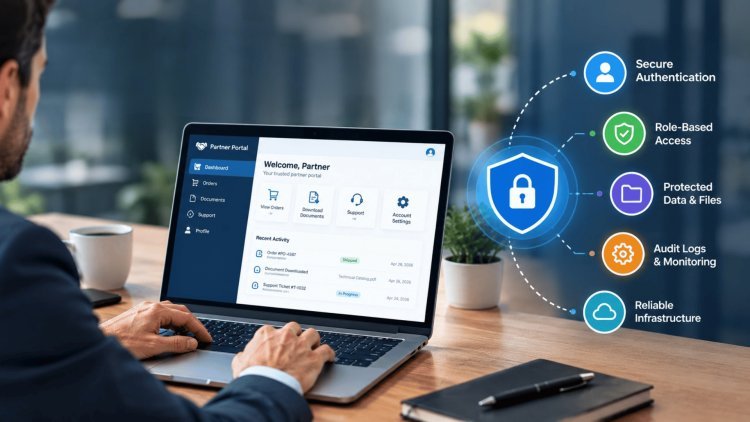
1 No Centralised Auth
Credentials are scattered across inboxes and shared drives. A single departing employee can retain access indefinitely, creating silent data leakage risks that are nearly impossible to detect without systematic monitoring.
2 Inconsistent Policy Enforcement
Different partners receive different versions of documents, different permission levels, and different update cadences. There is no single source of truth, and reconciling discrepancies becomes a full-time operational burden.
3 Zero Audit Trails
Without structured logging, you cannot demonstrate compliance with GDPR, SOC 2, or ISO 27001 requirements. Regulatory bodies require evidence of access control, and email threads do not qualify as evidence.
What a Purpose-Built Portal Changes
A dedicated partner portal transforms the login event into a single source of truth. Every partner interaction — document download, contract view, API call, support ticket — is captured against an authenticated identity with a precise timestamp.
Reduced Manual Hand-offs
Automated provisioning and role assignments replace email-driven onboarding. New partners go from invite to productive access in minutes, not days, dramatically reducing the window of insecure interim access.
Protected Sensitive Data
Contracts, pricing tiers, product roadmaps, and integration credentials are stored behind authenticated, permission-governed endpoints — never in an email attachment that can be forwarded without your knowledge.
Scalable Trust Infrastructure
As explored in the Consac.dev platform philosophy, building trust is not a one-time event — it is a continuously maintained state enforced by technology, process, and visibility operating together.
Building trust is not a one-time event — it is a continuously maintained state enforced by technology, process, and visibility operating together.
The most common mistake organisations make is treating security as a compliance checkbox — something to be completed once and filed away. A genuinely secure partner portal is engineered as a layered, interdependent system where each control reinforces the others. From the transport layer to the application layer to the data layer, every component must be configured with defence-in-depth in mind.
Enforce TLS 1.3 exclusively — reject downgrade negotiation to older protocol versions. Deploy WAF rules and DDoS mitigation at the edge. Implement strict firewall egress rules so that compromised application servers cannot exfiltrate data to arbitrary external endpoints. Network segmentation ensures that a breach in one zone cannot trivially pivot into a more sensitive zone.
Input validation must be enforced server-side — never trust client-supplied data. Integrate static analysis (SAST) and dependency scanning into your CI/CD pipeline so that vulnerabilities are caught before merge, not after deployment. Parameterised queries and ORM frameworks prevent SQL injection; Content Security Policy headers prevent XSS. Code review gates for security-sensitive paths are non-negotiable.
Encrypt all partner data at rest using AES-256 with rotating encryption keys managed by a dedicated key management service (KMS). Store API keys, database credentials, and signing secrets in a vault solution — never hard-coded in source code or environment variable files committed to version control. Implement automated secret rotation policies so that credential exposure windows are minimised even if a secret is compromised.
Security is a system property, not a feature. Every layer — from the CDN edge to the database row — must be treated as a potential attack surface and designed accordingly.
Build Security Like a System, Not a Checklist
Transport & Network Layer
Secure Coding Practices
Data Encryption & Secret Management
Authentication confirms who you are. Authorisation determines what you can do. These two concerns are architecturally distinct, and conflating them is one of the most common sources of data leakage in partner portals. A robust identity architecture separates the two decisively, using industry-standard protocols to ensure interoperability, auditability, and cryptographic integrity at every boundary.
Roles are assigned at provisioning and reviewed quarterly. Principle of least privilege applies—roles grant only the minimum permissions required to complete the partner’s function.
It must be re-evaluated on every request. As detailed in the Consac.dev security architecture resources, mid-session role changes, contract expirations, or compliance flags must immediately revoke or restrict access without waiting for the next login cycle.
Authentication + Authorisation
That Won’t Leak DataDefine roles that map directly to business relationships
Authorisation is not a login-time event.
A technically sound portal that partners find confusing or cumbersome will be abandoned — and an abandoned portal is a security risk in its own right. The final dimension of a successful partner portal is the deliberate engineering of partner experience, integration reliability, and measurable value delivery. Security must be invisible to the partner whilst remaining absolute under the hood.
Security must be invisible to the partner whilst remaining absolute under the hood.
Walk new partners through profile setup, credential configuration, and first integration in a structured, step-by-step flow. Completion rates for guided onboarding consistently outperform self-service documentation by a significant margin — partners who reach their first successful API call within 24 hours are far more likely to remain active.
A searchable, versioned document library — integration guides, API references, contract templates, compliance certificates — reduces support ticket volume and empowers partners to self-serve. Structure content by partner tier so that each partner sees only what is relevant to their relationship level, reducing cognitive overhead.
Give partners real-time visibility into their API usage, data sync status, and account health. Automated alerts for approaching rate limits, upcoming contract renewals, or compliance document expirations ensure partners are never caught off-guard — and that your team is not fielding reactive support calls.
Route all partner API traffic through a governed gateway that enforces rate limiting, request validation, and authentication token inspection before requests reach backend services. Use event-driven architectures (webhooks, message queues) for data sync — avoiding tight polling loops that create both performance and security exposure.
Publish machine-readable OpenAPI specifications for every partner-facing integration endpoint. This enables partners to generate client SDKs automatically, reduces integration errors, and creates a contractual boundary that your team can version and deprecate without breaking existing integrations silently.
Measure portal health through adoption KPIs (active partners, integration completion rate, support ticket deflection) and security signals (failed login rates, anomalous API call patterns, permission escalation attempts). Schedule quarterly role reviews and annual penetration tests. As the team at Consac.dev advocates, trust is not granted once — it is continuously re-earned through transparent, measurable security operations.
The portal that earns lasting partner trust is one that is simultaneously invisible in its security friction and powerful in its value delivery. Build both with equal intentionality — and plan for continuous improvement from day one.
Onboarding & Partner Experience
Guided Onboarding Wizard
Searchable Knowledge Base
Dashboards & Automation
Integration, Measurement & Continuous Trust
API Gateways & Event-Driven Sync
OpenAPI Documentation
KPIs, Security Signals & Audits
What's Your Reaction?