How to Build Laboratory Information Management Software (LIMS)
From Workflows to Audit-Ready Systems — a comprehensive guide to designing, building, and validating a LIMS that holds up under regulatory scrutiny and real-world lab pressure.
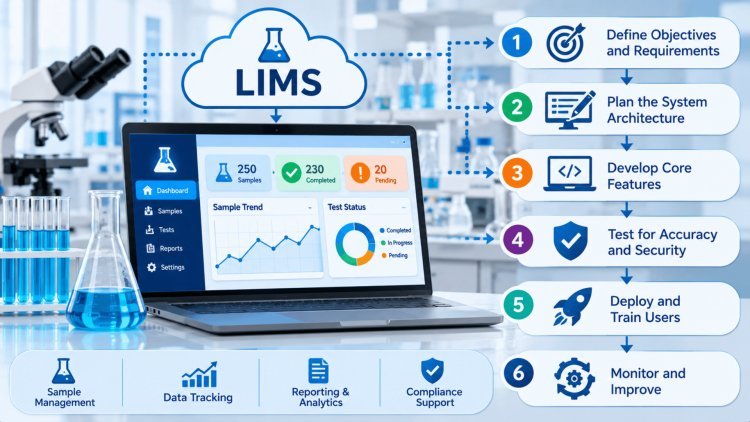
Act 1: What a LIMS Must Actually Control
A Laboratory Information Management System (LIMS) is far more than a database — it is the digital backbone that governs every touchpoint in the lab environment. From the moment a sample arrives at intake to the final signed-off report filed for an audit, the LIMS must actively manage samples, tests, instruments, users, data pipelines, and compliant reporting across the full sample lifecycle. Unlike generic enterprise software, a LIMS must be architected to fit lab-specific workflows and enforce data traceability as a non-negotiable requirement — not an afterthought.
Sample Management
Track every sample from accession through disposal. Chain-of-custody, labeling, aliquoting, and storage location must be logged with timestamps and user attribution at every step.
Test & Instrument Control
Assign tests to samples, link results directly to calibrated instruments, and capture raw data automatically — eliminating manual transcription errors that compromise data integrity.
User & Role Governance
Define who can approve, edit, or view records. Role-based access is not just a security feature — it is a compliance requirement under frameworks like FDA 21 CFR Part 11 and ISO/IEC 17025.
Audit-Ready Reporting
Every result, revision, and approval must produce an immutable audit trail. Regulators and accreditation bodies expect electronic records that are attributable, legible, contemporaneous, original, and accurate (ALCOA+).
Why Basic Data Storage Is No Longer Enough
As data integrity requirements intensify across clinical, pharmaceutical, environmental, and food safety labs, a LIMS that merely stores results is no longer sufficient. The system must enforce workflow correctness — locking steps, requiring electronic signatures, and preventing unauthorized edits in ways that paper logs and spreadsheets simply cannot.
Learn more about industry standards shaping LIMS design at the ASTM E1578 LIMS Standard Guide, which defines terminology and functional requirements accepted across the industry.
A modern LIMS does not simply record laboratory activity. It controls, validates, tracks, and enforces every step required to produce trustworthy, compliant, and audit-ready scientific data.
Before a single line of code is written, the most critical investment is workflow discovery. The gap between "how the lab is supposed to work" and "what actually happens at the bench" is where most LIMS projects fail. Conducting structured observations, interviews with analysts and lab managers, and process mapping sessions reveals the true data flows — and the gaps that compliance frameworks will eventually expose.
Map sample intake and labeling, test assignment, result validation, peer review, reporting, and long-term archiving as they actually occur — not as the SOP ideally describes them. This "as-is" state drives the data model design.
Identify applicable frameworks before architecture begins: FDA 21 CFR Part 11 for electronic records, CLIA for clinical labs, CAP or ISO/IEC 17025 for accreditation. Each framework shapes roles, audit log granularity, validation requirements, and user permission hierarchies in distinct ways.
Think beyond "build and go-live." A compliant LIMS is managed through project initiation, requirements definition, design, build, validation, deployment, ongoing support, and eventual retirement — with documentation artifacts produced at every phase that must survive regulatory inspection.
Define analyst, reviewer, approver, administrator, and read-only roles with documented justification. Permission matrices should map directly to SOPs and be version-controlled alongside the software.
Retrofitting audit controls onto a working system is exponentially more expensive than building them in from the start. Every data field, every status transition, and every user action should be designed with the question: "Can we prove what happened, when, and by whom?"
Regulatory bodies including the FDA, EMA, and MHRA have issued repeated guidance that electronic records must be as trustworthy as paper — and in practice, far more traceable. The LIMS development guide by Tateeda provides a detailed walkthrough of how compliance architecture influences every layer of the system, from the database schema to the UI approval workflow.
Labs that skip this phase tend to build systems that work operationally but fail at the first external audit — requiring costly re-validation or even complete rebuilds.
Act 2: Map the Lab Like a System, Then Lock Compliance Into It
Document the Real Workflow
Define Regulatory Scope Early
Adopt the Full LIMS Lifecycle
Model Roles and Permissions Explicitly
Why "Design for Audit" First?
Once workflows are mapped and regulatory requirements are defined, implementation begins. A successful Laboratory Information Management System (LIMS) build depends on three foundational pillars: robust integration architecture, process-driven validation, and security-by-design. Together, these disciplines ensure that laboratory data remains traceable, compliant, reliable, and inspection-ready throughout the system lifecycle.
Laboratory results must be captured automatically, accurately, and with complete traceability. Bi-directional API integrations connect analytical instruments such as HPLC systems, mass spectrometers, PCR platforms, ERP systems, Electronic Laboratory Notebooks (ELN), and Hospital Information Systems (HIS) directly with the LIMS environment.
Every integration transaction should record the originating source, transfer timestamp, transformation logic, and receiving destination. This creates a complete chain of custody from raw instrument output through final laboratory reporting without manual re-entry.
Regulatory-grade software development requires a structured delivery methodology. Development activities should follow a controlled sequence beginning with discovery and compliance assessment, progressing through architecture design and iterative prototyping, and concluding with formal validation activities.
Validation generates documented evidence proving the system performs according to intended requirements and remains suitable for regulated laboratory operations.
Security controls must be embedded into the application architecture rather than added after deployment. Role-Based Access Control (RBAC), encryption, auditability, testing automation, and vulnerability management should be established from project inception.
Regulatory environments require complete accountability, making tamper-evident audit trails, secure authentication, and continuous verification essential platform capabilities.
Confirms the platform, infrastructure, software components, and supporting environment have been installed correctly according to approved specifications.
Verifies the system functions as intended across defined operating ranges and satisfies all documented functional requirements.
Demonstrates successful operation under actual laboratory conditions using representative workflows, users, and production scenarios.
IQ, OQ, and PQ each require documented protocols, executed test scripts, and summary reports suitable for regulatory review.
Foundational FDA requirements governing electronic records, electronic signatures, auditability, and controlled laboratory data management.
Every create, read, update, and delete action must be attributable, timestamped, traceable, and immutable throughout the system lifecycle.
A modern LIMS succeeds when integration, validation, and security are treated as core architectural disciplines rather than implementation afterthoughts. Automated instrument connectivity, documented validation evidence, regulatory-grade audit trails, and security-by-design controls create a platform capable of supporting laboratory operations with complete confidence in data integrity. The strongest systems are not merely compliant—they are built so compliance becomes a natural outcome of everyday operation.
Act 3: Build for Integration, Validation, and Data Integrity
Wire Instrument & Enterprise Integrations via Robust APIs
Process-Driven Development & Formal Validation
Plan Secure Operation from Day One
Formal Validation Framework
Installation Qualification
Operational Qualification
Performance Qualification
Security-by-Design Requirements
Engineering Takeaway
A validated LIMS that never reaches successful deployment is a failed project. The final act—deployment, data migration, training, and long-term lifecycle management—is where technical excellence meets organizational change management. Each phase carries its own compliance obligations and its own failure modes.
Replace paper logs, isolated spreadsheets, and manual audit reconstruction with a system that proves what happened at every step, automatically.
Teams that invest in rigorous workflow mapping, compliance-first architecture, formal validation, and disciplined lifecycle management end up with a system that accelerates science rather than obstructing it. For teams evaluating where to begin, the LIMS development overview at Tateeda and the ASTM E1578 standard together provide an excellent starting framework for scoping both the technical and regulatory dimensions of the build.
Act 4: Deploy, Migrate, Train,
and Keep the Audit Trail AliveA single, compliant, timestamped source of truth.
A LIMS is not a software project with a finish line—it is the foundation of a lab’s quality system.
What's Your Reaction?