Developing Expense Reimbursement Software for Distributed Workforces
As remote and hybrid work becomes the global standard, finance teams face an urgent need to rethink how they manage employee expenses. Traditional reimbursement workflows — built for centralized offices — buckle under the complexity of distributed teams spanning time zones, currencies, and compliance regimes. This presentation explores how purpose-built expense reimbursement software transforms a notoriously painful process into a streamlined, automated, and strategically valuable operation for modern organizations.
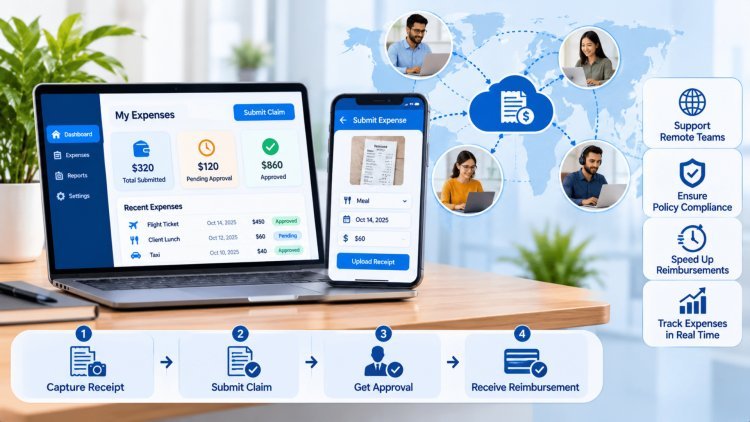
The Era of Spreadsheet Chaos
For decades, expense reimbursement has been synonymous with frustration. Employees dig through bags for crumpled receipts, finance teams reconcile mismatched spreadsheet rows, and managers chase approvals across overflowing inboxes. In distributed workforces, these inefficiencies are magnified dramatically — and the cost is measurable.
Lost Receipts & Human Error
Manual tracking systems depend entirely on individual diligence. When employees submit expenses days or weeks after the fact, receipts get lost, amounts are mis-keyed, and duplicate claims slip through undetected. Finance teams spend hours auditing data that should never have required human intervention. Even a single transposition error in a multi-currency submission can cascade into hours of reconciliation work.
Inconsistent Policy Adherence
Distributed teams operate in different regions with different spending norms, per-diem rates, and tax regulations. Without a centralized enforcement mechanism, policy violations become routine — not out of bad intent, but simply because employees lack real-time guidance. A sales rep in Singapore may not know the company's hotel cap for their region, resulting in an out-of-policy claim that stalls reimbursement and frustrates everyone involved.
Email & Spreadsheet Bottlenecks
Chasing expense claims through email and spreadsheets to find missing data is a productivity drain that compounds across organizations. A single missing receipt can freeze a reimbursement cycle, delay payroll processing, and erode employee trust. Finance teams operating under month-end pressure cannot afford to play detective across dozens of email threads — yet that is precisely what legacy workflows demand of them.
Organizations relying on manual expense processes lose an average of 12+ hours per employee per year to reimbursement administration — time that could be reinvested in revenue-generating activity.
The real cost of manual expense management is not paperwork alone. It is lost productivity, delayed reimbursements, policy violations, and unnecessary administrative overhead across the organization.
Building expense reimbursement software for a globally distributed team requires far more than a digital form. The architecture must account for geographic diversity, device variability, policy complexity, and the lived experience of employees who are often submitting claims while traveling, between meetings, or in low-connectivity environments. Great design begins with empathy for the end user — and translates that empathy into intelligent, frictionless functionality.
Enable employees to submit claims the moment they incur an expense using mobile-first receipt capture powered by OCR technology. Optical Character Recognition automatically extracts merchant name, date, amount, and currency from a photographed receipt — eliminating manual data entry entirely. This single feature dramatically reduces submission errors and accelerates the reimbursement cycle for field teams who rarely sit at a desk.
Create a centralized platform for employees to submit claims from any location, on any device. A unified submission portal ensures that whether a team member is in Tokyo or Toronto, their claim follows the same structured workflow, attaches to the right cost center, and is immediately visible to the relevant approver. Centralization eliminates the fragmentation that makes distributed expense management so difficult to govern.
Support multi-currency submissions with realtime exchange rate conversion and configurable global per-diem tables to ensure compliance across borders. Employees should be able to submit in their local currency, with the system automatically converting and tagging the homecurrency equivalent. Per-diem rules should be configurable by country, city, and role — giving finance teams the precision they need without burdening employees with policy lookup tables.
Designing for the Distributed Workforce
Mobile-First Receipt Capture with OCR
Centralized Submission Platform
Multi-Currency & Global Per-Diem Support
Manual approval chains remain one of the largest sources of delay in traditional expense management processes. Automated workflow engines eliminate unnecessary bottlenecks by routing claims intelligently, enforcing policy compliance automatically, and providing complete visibility into every approval decision. The outcome is faster employee reimbursement, lower administrative overhead, and stronger financial governance.
Automated routing mechanisms eliminate the need for manual approver assignments. Claims are directed automatically using organizational hierarchy data, project ownership rules, departmental structures, cost-center assignments, and configured approval thresholds.
Routine low-value expenses can be approved automatically, while larger expenditures trigger multi-level approval workflows. This ensures managerial focus remains on exceptions and strategic financial decisions rather than repetitive administrative reviews.
Employees and managers should have immediate visibility into claim status at every stage of the approval lifecycle. Live dashboards eliminate uncertainty by providing real-time information about pending reviews, approval decisions, and reimbursement progress.
Complete audit histories record comments, status changes, policy evaluations, approver actions, and workflow transitions. This transparency improves trust, reduces support inquiries, and strengthens compliance reporting.
Compliance validation is most effective when applied before claims enter the approval process. Automated policy engines evaluate expenses immediately against reimbursement rules, spending limits, approved supplier lists, project budgets, and organizational policies.
By identifying issues before submission, organizations reduce rejection rates, eliminate unnecessary rework, and prevent finance teams from spending time resolving avoidable policy violations.
Employee submits the expense. OCR extraction, policy validation, duplicate detection, and category verification occur automatically.
Smart workflow engines identify the appropriate approvers based on project ownership, organization structure, and financial controls.
Approved claims are reimbursed automatically, accounting entries are posted, and audit records are finalized for compliance retention.
The strongest expense management platforms remove friction without sacrificing control. By combining intelligent routing, pre-submission compliance validation, real-time visibility, automated approvals, and comprehensive audit trails, organizations can accelerate reimbursement cycles while strengthening governance. Automation transforms expense management from an administrative burden into a transparent, efficient, and policy-driven financial process that benefits employees, managers, and finance teams alike.
Automating the Approval Lifecycle
Intelligent Routing by Department, Project & Cost Center
Real-Time Status Tracking & Transparent History
Pre-Submission Policy Flagging
Automated Approval Workflow
Operational Benefits of Approval Automation
Final Business Takeaway
The true value of modern expense reimbursement software is realized not in the submission UI, but in its deep integration with the broader financial stack. When reimbursement data flows automatically into accounting systems, payroll platforms, and executive dashboards, expense management transforms from an administrative burden into a source of strategic business intelligence.
Empower leadership to make smarter, faster decisions about workforce investment and operational efficiency.
Integrating for
Seamless Financial ControlExpense platforms don’t just process claims—they generate financial intelligence.
What's Your Reaction?