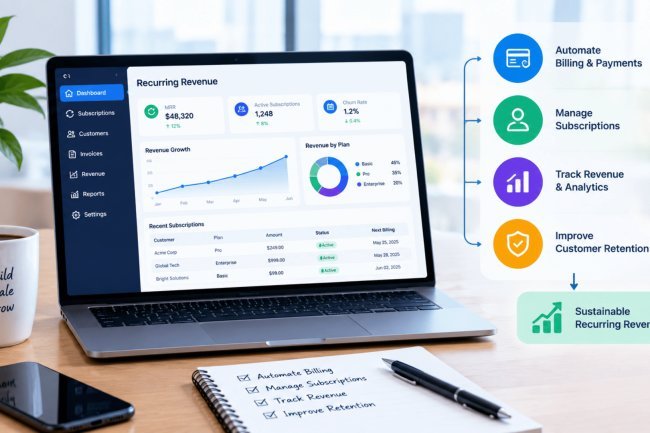
Building Subscription Billing: Scaling SaaS Growth
A comprehensive guide to designing, implementing, and optimizing recurring billing infrastructure for modern SaaS products and digital businesses — from foundational architecture to revenue intelligence.

The Subscription Mandate
The transition from one-time software purchases to recurring subscription revenue has fundamentally reshaped the digital economy. Modern SaaS organizations no longer compete solely on product features. They compete on retention, customer lifetime value, predictable revenue, and operational efficiency. Companies that successfully implement subscription billing create scalable business systems capable of generating sustained growth, while organizations dependent on transactional sales often struggle with revenue volatility and forecasting uncertainty.
Recurring Revenue Changes Everything
Subscription businesses replace unpredictable sales cycles with continuous customer relationships, creating stable revenue streams that support long-term planning, investment, and sustainable growth.
The Revenue Model Evolution
Transactional Revenue
• Difficult forecasting
• Constant acquisition pressure
• Lower customer lifetime value
• Unpredictable cash flow
Recurring Revenue
• Predictable growth patterns
• Stronger retention focus
• Higher customer value
• Stable financial outlook
Manual Invoicing Doesn't Scale
As customer volume grows, manual billing introduces reconciliation issues, invoice errors, delayed collections, missed renewals, and revenue leakage. Every manual process becomes a scaling constraint that limits operational efficiency.
Common Problems With Manual Billing
Strategic Advantages of Subscription Models
Predictable MRR
Revenue compounds over time, creating a stable financial foundation for growth.
Lower CAC Amortization
Acquisition costs are spread across longer customer relationships and greater lifetime value.
Investor Confidence
Predictable revenue metrics improve visibility and support premium company valuations.
Operational Scale
Automation processes thousands of billing events without proportional increases in staffing.
The Subscription Growth Flywheel
Subscription Billing Is Infrastructure, Not Administration
High-performing SaaS companies do not view billing as a back-office accounting function. Billing systems directly influence revenue predictability, customer retention, cash flow management, investor perception, and operational scalability.
The Future of SaaS Runs on Recurring Revenue
Subscription-based business models provide the financial predictability, scalability, and customer lifetime value required for sustainable SaaS growth. By replacing manual invoicing with automated recurring billing systems, organizations reduce operational friction, improve cash collection, support complex pricing structures, and create a foundation for long-term expansion. In today's software economy, subscription automation is no longer a convenience. It is a core business requirement.
Behind every seamless subscription experience lies a sophisticated technical stack. Understanding the critical components of a billing system—and the risks of building versus buying—is essential for any engineering or product leader making infrastructure decisions. API integration layer, transaction and invoicing engine, and the in-house build trap are the three critical areas that define billing infrastructure decisions.
The API is the backbone of the entire billing system—the bridge between your product's usage data and downstream payment gateways like Stripe, Braintree, or Adyen. Well-designed APIs enable real-time event streaming (seat changes, feature upgrades, usage overages), webhook-driven state changes, and idempotent retry logic that prevents duplicate charges during network failures.
The core of the billing system manages three interconnected responsibilities: transaction lifecycle management (authorization, capture, refunds, disputes), automated recurring invoicing aligned to each customer's billing cycle and plan, and trial lifecycle orchestration—converting free or trial accounts into paying subscribers with configurable grace periods, upgrade nudges, and expiry logic.
Proration on mid-cycle upgrades is deceptively complex. Calculating accurate charges for partial billing periods across different plan tiers, seat counts, and usage thresholds requires sophisticated logic that most teams underestimate.
Global billing in 135+ currencies with FX handling. Exchange rate fluctuations, currency rounding rules, and regional pricing strategies add layers of complexity that compound over time.
Tax rates vary by country, state, province, and even city. Tax rules change frequently. Compliance requires continuous monitoring and updates—a permanent maintenance burden for engineering teams.
Payment Card Industry Data Security Standard compliance is mandatory for handling card data. Managing PCI-DSS scope in-house requires significant security infrastructure, audits, and ongoing compliance maintenance.
Failed payment retry logic, grace period management, account suspension workflows, and reactivation processes. Dunning logic directly impacts revenue recovery but requires extensive testing across edge cases.
The result is that engineering resources intended for core product innovation get permanently diverted to billing maintenance. For most SaaS companies, a purpose-built billing platform delivers a faster path to compliance, scalability, and feature parity.
Connect external clients and services. Bridge between product usage data and payment gateways (Stripe, Braintree, Adyen). Real-time event streaming, webhook-driven state changes, idempotent retry logic.
Validate and record billing events. Transaction lifecycle management: authorization, capture, refunds, disputes. Auditable, idempotent, fault-tolerant processing.
Assemble charges and produce invoices. Automated recurring invoicing aligned to each customer's billing cycle and plan. Trial lifecycle orchestration with grace periods and upgrade nudges.
Collect payments and reconcile accounts. Multi-currency support with FX handling. Dunning logic for failed payments. Tax jurisdiction compliance and reporting.
Many early-stage teams attempt to build billing in-house, underestimating the complexity of edge cases. The result is that engineering resources intended for core product innovation get permanently diverted to billing maintenance. For most SaaS companies, a purpose-built billing platform delivers a faster path to compliance, scalability, and feature parity.
Managed by the platform, not your team. No security infrastructure, audits, or ongoing compliance maintenance required from engineering.
Global billing in 135+ currencies with FX handling. Exchange rate fluctuations, currency rounding rules, and regional pricing handled automatically.
Accurate mid-cycle adjustments on plan changes. Sophisticated logic for partial billing periods across different plan tiers, seat counts, and usage thresholds.
Connect external clients and services. Real-time event streaming, webhook-driven state changes, idempotent retry logic. Decouples product code from payment providers.
Validate and record billing events. Authorization, capture, refunds, disputes. Auditable, idempotent, fault-tolerant processing built-in.
Assemble charges and produce invoices. Automated recurring invoicing aligned to billing cycles. Trial lifecycle orchestration with grace periods.
Collect payments and reconcile accounts. Dunning logic for failed payments. Tax jurisdiction compliance and reporting handled automatically.
Revenue recognition, MRR/ARR tracking, churn analysis, cohort analytics. Built-in dashboards and export capabilities for financial reporting.
Engineering resources intended for core product innovation get permanently diverted to billing maintenance. Every hour spent on billing is an hour not spent on differentiation.
Teams building billing in-house ship core product features slower. Competitors using purpose-built platforms move faster and capture market share.
The true cost of building billing in-house isn't just engineering hours—it's the opportunity cost of delayed features, slower growth, and lost competitive advantage.
Understanding the critical components of a billing system—and the risks of building versus buying—is essential for any engineering or product leader making infrastructure decisions.
Behind every seamless subscription experience lies a sophisticated technical stack. Understanding the critical components of a billing system—and the risks of building versus buying—is essential for any engineering or product leader making infrastructure decisions. The API is the backbone of the entire billing system—the bridge between your product's usage data and downstream payment gateways like Stripe, Braintree, or Adyen. Well-designed APIs enable real-time event streaming (seat changes, feature upgrades, usage overages), webhook-driven state changes, and idempotent retry logic that prevents duplicate charges during network failures. A robust integration layer also decouples your product code from payment provider specifics, making future migrations far less painful. The core of the billing system manages three interconnected responsibilities: transaction lifecycle management (authorization, capture, refunds, disputes), automated recurring invoicing aligned to each customer's billing cycle and plan, and trial lifecycle orchestration—converting free or trial accounts into paying subscribers with configurable grace periods, upgrade nudges, and expiry logic. Each of these processes must be auditable, idempotent, and fault-tolerant. Many early-stage teams attempt to build billing in-house, underestimating the complexity of edge cases: proration on mid-cycle upgrades, multi-currency support, tax jurisdiction compliance, PCI-DSS scope management, and dunning logic. The result is that engineering resources intended for core product innovation get permanently diverted to billing maintenance. For most SaaS companies, a purpose-built billing platform delivers a faster path to compliance, scalability, and feature parity. PCI-DSS compliance managed by the platform, not your team. Multi-currency global billing in 135+ currencies with FX handling. Proration logic for accurate mid-cycle adjustments on plan changes. API integration to connect external clients and services. Transaction processing to validate and record billing events. Invoice generation to assemble charges and produce invoices. Payment settlement to collect payments and reconcile accounts. Build vs buy is not just a technical decision—it's a strategic choice that determines whether engineering focuses on core product innovation or permanent billing maintenance.
The Technical Anatomy of Billing
API Integration Layer
• Real-time event streaming (seat changes, feature upgrades, usage overages)
• Webhook-driven state changes
• Idempotent retry logic prevents duplicate charges
• Bridge to payment gateways (Stripe, Braintree, Adyen)
• Decouples product code from payment provider specifics
• Makes future migrations far less painfulTransaction & Invoicing Engine
• Transaction lifecycle management (authorization, capture, refunds, disputes)
• Automated recurring invoicing aligned to billing cycle and plan
• Trial lifecycle orchestration (grace periods, upgrade nudges, expiry logic)
• Each process must be auditable, idempotent, and fault-tolerantThe In-House Build Trap: Complexity of Edge Cases
Proration Logic
Multi-Currency Support
Tax Jurisdiction Compliance
PCI-DSS Scope Management
Dunning Logic
Engineering Diversion
Billing System Architecture: Core Components
Build vs Buy: The Engineering Trade-Off
• Engineering diverted from core product
• Permanent maintenance burden
• Compliance complexity (PCI-DSS, tax)
• Edge case underestimation
• Slower path to feature parity
• Scalability challenges
• Faster path to compliance
• Scalability built-in
• Feature parity out of the box
• Engineering focuses on core product
• PCI-DSS managed by platform
• Multi-currency, tax, dunning handledPurpose-Built Billing Platform: Key Capabilities
The Engineering Opportunity Cost
Engineering Diversion
Slower Innovation
True Cost
For Most SaaS Companies, a Purpose-Built Billing Platform Delivers a Faster Path to Compliance, Scalability, and Feature Parity
The Billing Infrastructure Principle
Acquiring a new customer costs 6–7 times more than retaining an existing one. In subscription businesses, churn is the greatest destroyer of compounding growth. A billing system that actively fights churn is not back-office — it is strategic revenue protection.
Failed payments are inevitable. Sophisticated dunning systems orchestrate multi-touch retry sequences with intelligent timing, dynamic messaging, and in-app prompts. Best-in-class implementations recover 20–40% of otherwise-lost revenue.
Advanced retention strategies correlate product usage telemetry with subscription health. Metrics like login frequency, feature adoption, and session duration identify at-risk accounts weeks before cancellation. Automated workflows trigger outreach, success team escalation, or personalized offers at the highest probability of success.
Cost to Acquire vs. cost to retain
Revenue Recovered by optimized dunning
Churn Reduction can increase profit by 25–95%
Retention is not just a customer success metric — it is a billing system design requirement. Intelligent dunning, behavioral signals, and proactive engagement transform retention into the ultimate growth engine.
Retention as the Ultimate Growth Engine
Dunning Management: Recovering Lost Revenue
Behavior-Driven Churn Prevention
The Retention Multiplier
Key Insight
Modern SaaS pricing is no longer a static list of subscription tiers. Revenue leaders increasingly view pricing as a dynamic system that adapts to customer behavior, product usage, and evolving market conditions. The most successful organizations combine flexible monetization models with deep analytics and rigorous experimentation, transforming billing from an administrative function into a powerful revenue optimization engine.
Flexible pricing, real-time analytics, and experimentation allow SaaS businesses to align revenue more closely with customer value while continuously improving monetization performance.
Usage-based pricing depends on reliable metering infrastructure. Engineering teams must capture, aggregate, and validate consumption data while billing systems convert those usage events into accurate invoices and entitlement decisions.
Tracks new revenue, expansions, contractions, and churn as they occur.
Measures whether existing customers generate more revenue over time.
Reveals monetization efficiency across customer segments.
Guides acquisition spending and retention investments.
Systematic pricing experiments frequently generate meaningful revenue gains without requiring new features, additional engineering effort, or expanded sales teams. Small pricing improvements scale across every customer relationship.
Organizations that connect billing systems, CRM platforms, product analytics, and customer success tools gain a complete view of revenue behavior. This unified intelligence enables faster decisions, more effective pricing, and stronger long-term growth.
Subscription billing is evolving from static recurring invoices into an intelligent revenue platform. Usage-based pricing aligns cost with value, real-time analytics provide visibility into growth drivers, and structured experimentation continuously improves monetization outcomes. SaaS companies that build strong metering infrastructure, embrace revenue intelligence, and treat pricing as an ongoing optimization discipline will be best positioned to capture growth in the next generation of software markets.
2025 Strategy: Flexibility and Data
Pricing Has Become A Continuous Optimization Process
Three Pillars of Modern SaaS Monetization
Why Usage-Based Pricing Is Growing
Pricing Flexibility Requires Product-Level Metering
Revenue Metrics That Drive Strategy
MRR Movement
NRR & Expansion
ARPU
Lifetime Value
Pricing Tests Can Outperform Product Changes
Modern Pricing Experiment Workflow
Billing Data Is Becoming A Competitive Advantage
The Future of SaaS Pricing Is Flexible, Measurable, and Adaptive
The endgame of subscription billing is a fully automated, unified revenue platform where every billing event—from renewal to proration to tax remittance—is handled without manual intervention. Companies that achieve this state eliminate revenue leakage, reduce operational overhead, and free their teams to focus on growth rather than back-office firefighting. Eliminate revenue leakage, unify finance and support platforms, and audit your billing stack using a comprehensive checklist to assess readiness for scale.
Revenue leakage in SaaS is insidious and widespread. It accumulates through missed renewals, billing errors on plan changes, incorrect proration calculations, uncollected overages, and non-compliant tax handling across jurisdictions. A fully automated billing platform eliminates these failure modes by codifying every billing rule into deterministic logic—renewals fire automatically, proration is calculated to the second, and tax compliance is handled dynamically by jurisdiction using real-time rate data from providers like Avalara or TaxJar.
When billing data, support tickets, and customer health metrics live in silos, critical information falls through the cracks. A billing platform that integrates natively with CRM, support tooling, and data warehouses creates a single source of truth. Support teams can instantly see a customer's billing history, plan details, and payment status without switching tools. Finance teams can close books faster with automated revenue recognition aligned to ASC 606 and IFRS 15 standards.
Zero-touch renewal processing with configurable retry logic and customer notifications. Renewals fire automatically without manual intervention. Dunning sequences handle failed payments with configurable retry schedules.
Connect billing, CRM, and support into one coherent revenue intelligence layer. Single source of truth across all customer-facing teams. No silos, no information gaps, no tool-switching for context.
Dynamic tax calculation across global jurisdictions without manual intervention. Real-time rate data from Avalara or TaxJar. Automated tax remittance and reporting. Compliance handled dynamically by jurisdiction.
Identify leakage points before scale amplifies their cost. Act with urgency. Use the billing audit checklist to assess readiness. If more than two items are unchecked, your infrastructure is a growth bottleneck.
Organizations that audit their billing stack frequently discover 3–8% of revenue was silently being lost. This is not edge-case loss—it is systemic leakage that compounds with every billing cycle.
Manual renewal processes fail. Customers slip through cracks. Automated renewal logic with configurable dunning sequences ensures zero-touch renewal processing.
Incorrect proration calculations on mid-cycle upgrades and downgrades. Deterministic logic calculates proration to the second, eliminating manual calculation errors.
Usage beyond plan limits goes uncharged. Usage-based metering infrastructure tracks consumption and automatically bills overages according to pricing rules.
Non-compliant tax handling across jurisdictions creates liability. Dynamic tax calculation using real-time rate data from Avalara or TaxJar ensures compliance without manual intervention.
Incorrect charges on plan changes, seat count adjustments, and feature upgrades. Codifying every billing rule into deterministic logic eliminates human error in charge calculation.
3–8% revenue leakage = $30K–$80K annually. Manual processes manageable. Billing gaps are annoying but not existential. Team can firefight as issues arise.
3–8% revenue leakage = $300K–$800K annually. Manual processes break. Billing gaps become existential. Team spends 30–50% of time on billing firefighting instead of growth.
3–8% revenue leakage = $1.5M–$4M annually. Manual processes impossible. Billing gaps threaten IPO readiness. Compliance risks, audit failures, and investor scrutiny become constant.
If more than two items on the billing audit checklist are unchecked, your billing infrastructure is a growth bottleneck. Act now before scale exposes the gaps. The cost of inaction compounds with every billing cycle.
The cost of inaction compounds with every billing cycle. Revenue leakage, operational overhead, and compliance risks all scale with ARR.
The endgame of subscription billing is a fully automated, unified revenue platform where every billing event—from renewal to proration to tax remittance—is handled without manual intervention. Companies that achieve this state eliminate revenue leakage, reduce operational overhead, and free their teams to focus on growth rather than back-office firefighting. Revenue leakage in SaaS is insidious and widespread, accumulating through missed renewals, billing errors on plan changes, incorrect proration calculations, uncollected overages, and non-compliant tax handling across jurisdictions. A fully automated billing platform eliminates these failure modes by codifying every billing rule into deterministic logic—renewals fire automatically, proration is calculated to the second, and tax compliance is handled dynamically by jurisdiction using real-time rate data from providers like Avalara or TaxJar. Organizations that audit their billing stack frequently discover 3–8% of revenue was silently being lost. A billing platform that integrates natively with CRM, support tooling, and data warehouses creates a single source of truth. Support teams can instantly see a customer's billing history, plan details, and payment status without switching tools. Finance teams can close books faster with automated revenue recognition aligned to ASC 606 and IFRS 15 standards. The result is an organization where every team speaks the same revenue language. Use the billing audit checklist to assess readiness for scale: automated renewal and retry logic with configurable dunning sequences, proration engine handles mid-cycle upgrades and downgrades accurately, tax compliance is automated across all operating jurisdictions, real-time MRR/NRR/churn dashboards available to leadership, billing data integrated with CRM and product analytics, usage-based metering infrastructure in place or roadmapped, revenue recognition automated and audit-ready, pricing experimentation framework supports A/B testing by segment. If more than two of these are unchecked, your billing infrastructure is a growth bottleneck—act now before scale exposes the gaps. The four pillars of automated billing: automate renewals with zero-touch processing and configurable retry logic, unify revenue data by connecting billing/CRM/support into one coherent revenue intelligence layer, enforce tax compliance with dynamic calculation across global jurisdictions without manual intervention, and audit your stack to identify leakage points before scale amplifies their cost. Act with urgency.
The Future is Automated
Eliminate Revenue Leakage
• Missed renewals (manual renewal processes fail)
• Billing errors on plan changes (incorrect charges)
• Incorrect proration calculations (partial period errors)
• Uncollected overages (usage beyond plan limits)
• Non-compliant tax handling (jurisdiction errors)
• Silent revenue loss: 3–8% discovered in auditsA Unified Finance and Support Platform
• Single source of truth across billing, CRM, support
• Support teams see billing history instantly
• No tool-switching for customer context
• Finance closes books faster
• Automated revenue recognition (ASC 606, IFRS 15)
• Every team speaks the same revenue languageYour Billing Audit Checklist: Assess Readiness for Scale
The Four Pillars of Automated Billing
Automate Renewals
Unify Revenue Data
Enforce Tax Compliance
Audit Your Stack
Revenue Leakage: The Silent Growth Killer
Unified Revenue Intelligence: Breaking Down Silos
Team
Siloed Data Problem
Unified Platform Solution
Business Impact
Support
Cannot see billing history without switching tools
Instant visibility into billing, plan, payment status
Faster resolution, better customer experience
Finance
Manual revenue recognition, slow book close
Automated revenue recognition (ASC 606, IFRS 15)
Faster book close, audit-ready compliance
Sales
No visibility into customer health or expansion opportunities
CRM integration shows usage, expansion signals
Identify upsell opportunities, reduce churn risk
Leadership
No real-time visibility into MRR, NRR, churn
Real-time dashboards for key revenue metrics
Data-driven decisions, proactive intervention
The Cost of Inaction: Scale Amplifies Gaps
At $1M ARR
At $10M ARR
At $50M ARR
Act Now
If More Than Two of These Are Unchecked, Your Billing Infrastructure Is a Growth Bottleneck—Act Now Before Scale Exposes the Gaps
The Automation Principle
What's Your Reaction?