How to Develop a Recurring Revenue Management Platform
A comprehensive guide to architecting, scaling, and automating subscription infrastructure that compounds growth — and eliminates the revenue leakage silently eroding your SaaS margins.
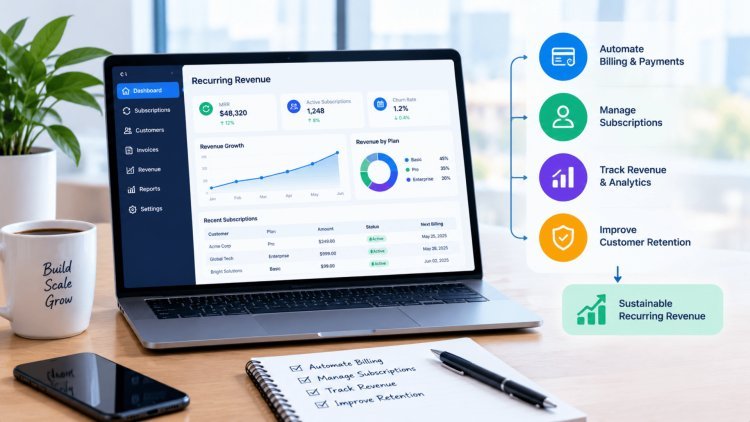
The Subscription Mandate
The global software economy has undergone a fundamental structural shift. Transactional, one-time-purchase models are rapidly ceding ground to recurring revenue architectures — and for good reason. SaaS companies with predictable recurring revenue command significantly higher valuation multiples, attract more favorable investor sentiment, and exhibit far greater operational resilience during market downturns. The Annual Recurring Revenue (ARR) figure has become the single most scrutinized metric in a SaaS company's financial profile.
But capturing the full value of a subscription model is not simply a matter of flipping a billing switch. It demands a deeply integrated operational architecture where every system speaks a common language in real time.
Billing & Revenue Systems
Your billing engine must handle proration, upgrades, downgrades, and renewals automatically — with zero manual intervention. Revenue recognition must be audit-ready at all times, conforming to ASC 606 and IFRS 15 standards for deferred and earned revenue.
CRM Integration
Customer lifecycle data — from trial conversion to expansion revenue — must flow bidirectionally between your billing platform and CRM. Disconnected systems create dangerous blind spots where high-churn accounts go undetected until it's too late to intervene.
Authentication & Access Control
Subscription state must instantly govern feature access. Entitlement logic tied to billing events (upgrades, cancellations, payment failures) must propagate across your application in milliseconds, not hours or days.
Achieving this level of native system communication requires intentional architectural planning from day one. Explore our expertise in Enterprise Web Application Development to see how we design and build integrated architectures that eliminate manual bottlenecks, prevent revenue leakage, and position your platform for sustainable compounding growth.
Every system must speak a common language in real time.
Many SaaS founders underestimate the true cost of building billing infrastructure in-house. What begins as a simple invoicing module quickly balloons into a sprawling, mission-critical system consuming 20–40% of core engineering bandwidth. Every sprint dedicated to billing logic, dunning management, or tax compliance is a sprint not spent on the product features that actually differentiate your offering in the market.
The smarter path for most companies is a hybrid model: leverage purpose-built billing platforms for commodity complexity (tax, payment gateway abstraction, dunning) while investing engineering resources in the custom logic that creates genuine competitive moat — your pricing model, your entitlement rules, your analytics layer.
A resilient, scalable billing engine is not a single tool — it is a carefully composed stack of interoperating systems. Each layer must be independently reliable and collectively coherent.
Renewal workflows must handle every edge case: free-trial expirations, annual vs. monthly cadence switches, multi-seat adjustments, and grandfathered pricing tiers — all without manual triggers.
Mid-cycle plan changes require instant, accurate proration calculations. Errors here create customer trust issues and complicate revenue recognition reconciliation at month-end.
Tax obligations vary by jurisdiction, product type, and customer classification. Your platform must apply the correct tax rules dynamically at checkout and invoice generation — not as a posthoc manual process.
Industry research consistently shows that 3–8% of gross revenue is silently lost to poor billing infrastructure — through failed payment mishandling, proration errors, and untracked downgrades. Read our deep dive on Building Subscription Billing to understand exactly where these losses occur and how to architect your way out of them.
The Technical Anatomy of Scaling
Build vs. Buy: The Hidden Cost Trap
The Core Technical Stack
Automated Renewal Logic
Real-Time Proration Engine
Dynamic Tax Compliance
Churn is not merely a customer success problem—it is the most destructive force acting against the compounding growth that makes SaaS valuable. A business growing at 10% monthly while churning 5% monthly is effectively running in place. Every percentage point of churn reduction has an outsized, exponential impact on long-term ARR trajectory and company valuation.
NRR is the definitive metric of subscription business health. An NRR above 100% means your existing customer base is growing in revenue terms even without new acquisitions—the hallmark of elite SaaS businesses. Building the infrastructure to accurately measure, report, and actively improve NRR requires tight integration between your billing engine, product analytics, and customer success workflows.
Browse our Full Blog Library to explore in-depth guides on MRR optimization, cohort analysis methodologies, and the operational playbooks that high-growth SaaS companies use to sustain elite retention performance.
Retention as a
Growth EngineNet Revenue Retention (NRR)
Mastering these metrics requires both the right infrastructure and the right strategic knowledge.
The ultimate objective of recurring revenue infrastructure development is total, end-to-end automation — a state where every billing event, from initial subscription creation through renewal, upgrade, downgrade, cancellation, and final audit-ready revenue recognition, executes without a single manual touchpoint. This is not a distant aspiration; it is an achievable operational reality for companies that make deliberate, sequenced infrastructure investments.
Every revenue recognition event is logged, timestamped, and reconciled automatically — eliminating month-end close chaos and audit preparation bottlenecks.
Your team spends zero cycles on billing infrastructure firefighting, redirecting 100% of product engineering toward competitive differentiation.
Executive dashboards reflect live ARR, MRR, churn, and expansion revenue without manual reporting delays or spreadsheet reconciliation.
Your revenue operations scale with subscriber volume through automation, not proportional headcount growth in finance and operations teams.
Transforming your revenue infrastructure is a high-leverage investment with measurable, compounding returns. The companies that build unified, automated revenue platforms today will operate with structural cost and agility advantages that are very difficult for competitors to replicate.
Whether you are architecting your first subscription billing system, migrating off a fragmented legacy stack, or scaling an existing platform to handle enterprise-grade complexity, the path forward begins with a clear-eyed assessment of your current infrastructure gaps and growth objectives.
Start your transformation today by exploring our Custom Digital Solutions and initiating a discovery session. Our team will work with you to map your existing systems, identify the highest-impact integration and automation opportunities, and design a phased implementation roadmap aligned with your growth trajectory.
Ready to eliminate revenue leakage and build a platform that scales?
Visit Consac.dev to begin your discovery session today The Path to a Unified Revenue Platform
The Four-Stage Path
What Total Automation Unlocks
Your Next Step
What's Your Reaction?