Healthcare Software Development: Building Better Patient Management Systems
A practical, narrative-driven guide to designing, building, and scaling patient management systems that solve real operational problems—while meeting the compliance, interoperability, and adoption challenges that define modern healthcare IT.
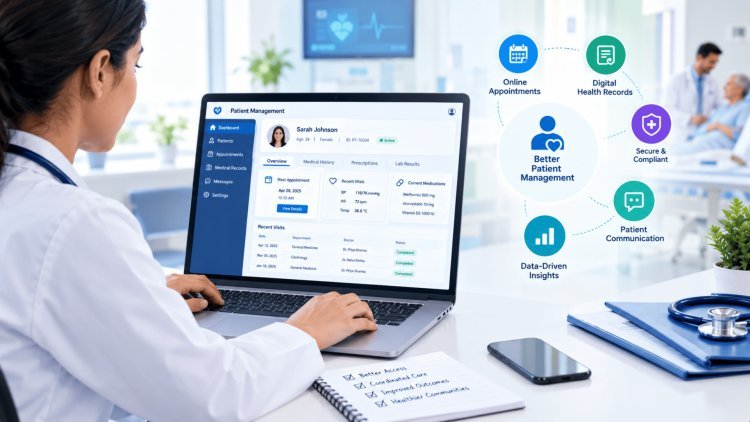
Act 1: Start With Real Workflow Pain—Not Digital Paperwork
The most common mistake in healthcare software projects is treating a patient management system (PMS) as a digitization exercise—taking paper-based or manual processes and moving them onto screens. The result is software that looks modern but solves nothing. Real transformation starts on the floor, not in the requirements document.
What Shadowing Reveals
When development teams spend time shadowing nurses, front-desk coordinators, and clinical staff, the picture that emerges is rarely about data—it's about friction. The "work" isn't happening on screens; it's happening in the gaps between systems. Staff are re-entering the same patient demographics across three platforms. Lab results are delayed because they arrive in a portal no one monitors in real time. Scheduling collisions cascade across departments because no single system holds a unified view of resources, rooms, and providers.
These are the problems that cause burnout, medical errors, and patient dissatisfaction. A PMS succeeds when it is designed to eliminate these friction points first, and then automates the handoffs between them.
A patient management system succeeds when it solves operational problems people actually feel—then automates the handoffs between them. Start with observation, not assumptions.
Real transformation starts on the floor, not in the requirements document.
Healthcare software operates in one of the most regulated, interconnected, and high-stakes environments in any industry. Bolting on security and interoperability after the core system is built is not a viable strategy—it leads to costly rework, failed audits, and dangerous data gaps. The architecture must reflect these realities from the very first sprint.
Every layer of a compliant PMS must be built around trust. This means end-to-end encryption for data at rest and in transit, granular rolebased access controls (RBAC) that restrict what each user type can view or modify, and comprehensive audit logs that capture every data access event with a timestamp and user identity.
HIPAA compliance requires not just technical controls but documented policies and breach notification procedures. Building these into the system from the start means your platform survives audits—and survives breaches with integrity intact. Authentication should leverage multi-factor mechanisms, and session management must enforce automatic timeouts for sensitive clinical data.
The healthcare ecosystem is fragmented by design—hospitals, labs, pharmacies, insurers, and specialist practices all run different systems. HL7 and FHIR (Fast Healthcare Interoperability Resources) are the industrystandard protocols that allow your PMS to share structured clinical data with external systems without becoming an isolated island.
FHIR APIs enable real-time data exchange with EHR/EMR platforms, payer systems, and public health registries. By building FHIR-compliant endpoints from the start—rather than retrofitting them—you dramatically reduce the cost of future integrations and open the door to a broader partner ecosystem. Learn more about the technical foundations in this patient management software guide.
A critical scoping decision that determines project success or failure: a PMS is not an EHR. It coordinates patient-facing and operational workflows—registration, scheduling, patient portals, referral management, and operational reporting—alongside the clinical record system, not instead of it.
Attempting to replace an EHR with a PMS creates dangerous clinical data gaps and regulatory exposure. Instead, define clean integration boundaries: the PMS owns the operational layer, the EHR owns the clinical record, and well-defined APIs govern the handoff between them. This separation of concerns keeps the scope manageable, the compliance posture defensible, and the system maintainable as both platforms evolve.
Act 2: Design for Compliance, Interoperability & Integration From Day One
Security-First Architecture
Interoperability via HL7 & FHIR
Coordinate, Don't Replace
Architecture decisions and compliance frameworks only create value when they translate into measurable improvements in real clinical environments. The following case illustrates what a well-executed modernization looks like—and what it produces when paired with thoughtful AI integration and a disciplined deployment process.
A 12-year-old ASP.NET Web Forms system—originally built for a single-facility deployment—had become a liability. Tightly coupled modules meant a change to the scheduling engine required regression testing across the entire application. Mobile access was nonexistent. Load times exceeded 8 seconds on standard clinical workflows. Compliance reporting required hours of manual extraction.
The rebuild was designed around three architectural principles: API-first (every function exposed as a versioned REST or FHIR endpoint), microservices (independent deployment of scheduling, billing, portal, and reporting modules), and mobile-first UI (responsive interfaces optimized for bedside tablet access by nursing staff). The migration preserved full audit history, with each data transformation logged for compliance review.
CI/CD pipelines were configured with automated HIPAA checks at every merge—preventing compliance regressions before they reached production. Explore a real-world example in this healthcare application revamp case study.
The results following full deployment and AI layer integration were tracked across three categories that directly reflect clinical and operational value:
System response time dropped from 8+ seconds to under 1.2 seconds across core workflows, reducing clinician wait time and friction during patient encounters.
Predictive discharge planning and automated follow-up scheduling reduced 30-day readmission rates—a key quality metric tied to value-based reimbursement.
AI-driven risk stratification surfaced a statistically significant increase in high-risk patient identifications, enabling earlier intervention and better care coordination.
Automated report generation reduced compliance documentation time from hours of manual work to under three minutes per report cycle.
Modern healthcare modernization succeeds when architecture, AI, compliance, and clinical workflows operate as a unified system. API-first services, composable microservice architectures, embedded intelligence, and automated compliance controls only demonstrate their true value when they deliver measurable improvements in speed, quality, safety, and operational efficiency within live healthcare environments.
Act 3: Modernize the Product Layer—Then Prove Impact in Production
The Modernization Case: From Legacy to API-First Microservices
Modernization Workflow
Measured Outcomes After Modernization
Production-Proven Modernization
The final—and most frequently underestimated—chapter of any healthcare software project is adoption. A system with perfect architecture and rigorous compliance controls delivers zero value if clinical staff route around it, duplicate workarounds emerge, or change resistance hardens into institutional rejection. Adoption is not a post-launch concern; it is a core engineering discipline.
Healthcare regulations, care models, and patient expectations change continuously. A patient management system built to be extended—through modular architecture, versioned APIs, and a disciplined change management process—stays better over time, not just newer. The goal is to keep patient outcomes at the center of every iteration.
Act 4: Adoption Turns Features
Into Better Patient OutcomesA living platform that evolves with the workflows it serves.
What's Your Reaction?