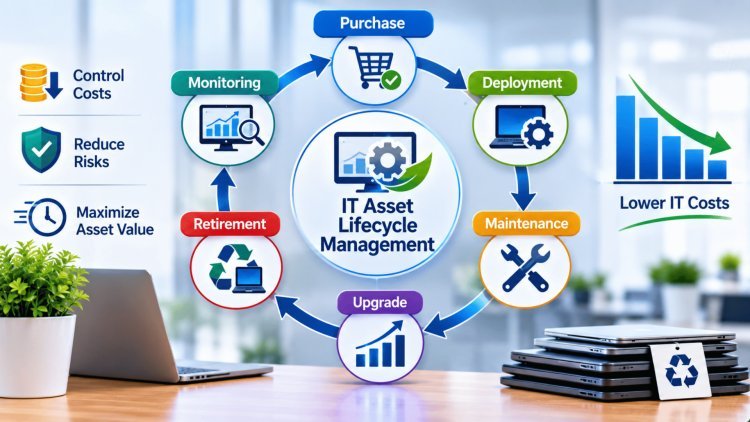
IT Asset Lifecycle Management Controlling Technology Costs from Purchase to Retirement
Every organization's technology portfolio is a living system — assets are acquired, deployed, maintained, upgraded, and eventually retired. Without a structured approach to managing each of these phases, costs spiral, security gaps widen, and operational efficiency erodes. This presentation outlines a disciplined, data-driven framework for taking control of your IT assets across their entire lifecycle, from the moment a purchase order is raised to the final disposition of hardware. The goal: eliminate waste, reduce risk, and ensure every technology dollar delivers measurable value.
STAGES 1 & 2
Beyond Simple Procurement
The first two stages of the IT asset lifecycle — procurement and deployment — are where the most consequential and least visible cost decisions are made. Organizations that treat purchasing as a reactive, transactional activity consistently overpay not just at acquisition, but across the entire asset lifespan.
Strategic lifecycle management begins long before a user receives a device. Standardization, asset governance, and disciplined deployment practices establish the foundation for lower support costs, stronger security, and improved operational visibility.
The Procurement Trap
Ad-hoc buying without standardized hardware configurations is one of the most expensive operational habits an IT organization can develop. When procurement decisions are made independently across departments or on a case-by-case basis, the resulting inventory becomes a patchwork of incompatible models, varied driver requirements, and inconsistent warranty terms.
This diversity drives up support complexity by as much as 25%, as technicians must maintain expertise across a wider range of hardware.
The fix begins with a standardized hardware catalog — a curated list of approved configurations that reduces variation, simplifies imaging and deployment, and consolidates vendor relationships for better pricing.
The Strategic Shift: Total Cost of Ownership
The most important transformation in procurement thinking is the shift from unit price to Total Cost of Ownership (TCO). A lower purchase price frequently masks higher long-term costs in maintenance, compatibility, and disposition.
Before the first dollar is spent, a mature procurement process calculates the full cost trajectory: initial acquisition, warranty and support contracts, software licensing, power consumption, and end-of-life processing fees.
Organizations that adopt TCO modeling typically identify 10–15% in avoidable lifecycle costs that would have been invisible under a purchase-price-only lens.
Deployment as an Asset Foundation
Deployment is not simply the act of handing a device to a user — it is the moment at which an asset's complete record is established.
At day one, every device should be registered with its serial number, warranty expiration date, assigned user, physical location, and security baseline configuration.
Skipping or delaying this step creates "shadow IT" — equipment that exists in the environment but not in the asset management system. These unknown or unmanaged assets are a significant source of hidden cost: they miss security patches, slip past warranty renewal windows, and consume helpdesk resources without accountability.
A disciplined deployment process, integrated with your CMDB or ITAM platform, transforms each new asset from a cost event into a managed, trackable investment with a known performance horizon.
Serial Number Registration
Every asset receives a unique identity in the ITAM system at the point of deployment, linking hardware to warranty, user, and location data for full accountability.
Security Baseline Configuration
Standardized security configurations are applied and documented at day one, ensuring every device enters the environment compliant and patch-current from the first login.
Warranty & Contract Linkage
Warranty terms, support contract SLAs, and renewal dates are recorded and tied to each asset record, preventing costly support gaps and missed renewal windows.
From Purchase to Managed Asset
Procurement and deployment are not administrative tasks. They establish the economic, operational, and security foundation for every asset that enters the environment. Organizations that standardize purchasing, evaluate true lifecycle costs, and enforce disciplined deployment consistently achieve lower support overhead, better security outcomes, and higher asset utilization.
The most effective IT asset programs recognize that cost optimization begins before purchase and accountability begins at deployment. By transforming procurement and deployment into structured lifecycle disciplines, organizations convert technology spending into measurable, manageable long-term value.
Once assets are live in the environment, the operational phase begins — and with it, the opportunity to either protect your technology investment or allow it to silently erode. The difference between organizations that control IT costs and those that constantly chase them lies almost entirely in how rigorously they manage assets during this extended middle phase of the lifecycle.
Without proactive maintenance, minor technical gaps compound into major operational problems. A missed firmware update today becomes a security vulnerability next quarter. An unresolved disk health warning becomes an unplanned outage and emergency hardware replacement next year. These reactive failure events are dramatically more expensive than the preventive actions that would have avoided them — not only in direct costs, but in lost productivity, helpdesk burden, and user frustration. Studies consistently show that the cost of emergency replacement, including expedited procurement, emergency labor, and data recovery, is 3 to 4 times higher than the equivalent planned refresh. Building a proactive maintenance cadence — regular patching, scheduled hardware diagnostics, and periodic user-reported issue reviews — is the foundational investment that makes the rest of the lifecycle manageable.
The cost of emergency replacement is 3–4× higher than a planned refresh. Proactive maintenance is not overhead — it is cost avoidance.
Modern ITAM and endpoint management platforms provide continuous visibility into asset performance — CPU utilization, memory pressure, disk health, and application usage patterns. This data is enormously valuable for two purposes: identifying hardware approaching end-of-useful-life before it fails, and surfacing "ghost assets" — devices and software licenses that are deployed but not actively used. Ghost assets are a pervasive problem: industry benchmarks suggest they account for 5% to 10% of total inventory in organizations without active monitoring. At scale, reclaiming these unused assets and licenses can represent hundreds of thousands of dollars in avoidable spending. License harvesting — the practice of reclaiming underutilized software licenses for redeployment — is frequently the single highest-ROI activity in an ITAM program.
Extending just 20% of a laptop fleet's lifespan by one additional year through proactive maintenance delivers measurable capital savings.
The direct reduction in annual hardware refresh spending when lifespan extension targets are achieved through structured maintenance programs.
The typical percentage of total inventory consumed by deployed-but-unused "ghost assets" in organizations without active utilization monitoring.
The return on investment from disciplined operational maintenance is not theoretical — it is measurable and consistent across organizations that implement structured ITAM programs. The key is treating maintenance not as a cost center, but as the operational engine that maximizes the return on every asset acquisition decision made upstream in the lifecycle.
The Long-Term Performance Engine
The Cost of Neglect
Real-Time Optimization & Ghost Assets
The ROI of Maintenance: A Concrete Example
Fleet Extension Target
Annual Hardware Cost Reduction
Ghost Asset Rate
The upgrade and refresh stage is where the most significant budget decisions in the IT asset lifecycle are concentrated—and where the most money is routinely wasted through arbitrary, calendar-driven replacement cycles. A data-driven approach to hardware refresh replaces assumption with evidence, ensuring that capital is deployed precisely where it delivers the greatest return.
Strategic Upgrades
& Refresh
Asset retirement is far more than a logistics activity. It represents the final security, compliance, environmental, and financial checkpoint in the IT asset lifecycle. When managed correctly, retirement eliminates risk, satisfies audit requirements, and captures residual value. When mishandled, it can expose organizations to regulatory penalties, security incidents, and long-term reputational damage.
Retired devices often contain sensitive business, customer, financial, and operational information. Failure to properly sanitize storage media before disposal can create significant legal, regulatory, and reputational exposure long after the asset leaves the organization.
Retirement programs should follow recognized data-sanitization and electronics-recycling standards that provide documented evidence of secure processing, environmental stewardship, and regulatory compliance.
Retirement does not always mean disposal. Assets with remaining market value can often be resold through certified IT asset disposition programs, converting retired equipment into budget recovery opportunities.
Apply appropriate sanitization procedures based on media type and data sensitivity before disposition.
Utilize certified recycling and ITAD providers that maintain documented environmental and security controls.
Maintain formal evidence proving sanitization or destruction for individual retired assets.
Capture resale proceeds while maintaining complete chain-of-custody and disposition documentation.
The retirement phase determines whether the IT asset lifecycle ends as a secure, auditable business process or remains an ongoing source of risk. Organizations that combine certified sanitization standards, approved ITAD partners, documented destruction records, environmental stewardship, and value-recovery programs transform retirement from a liability event into a governance strength. True lifecycle management is not complete until every asset is accounted for, every data source is secured, every disposition action is documented, and every remaining dollar of value has been recovered.
Stage 5: The Final Value & Security Gate
The Liability of Improper Disposal
Certified Disposition Standards
Recover Remaining Value
Secure Retirement Workflow
Critical Retirement Controls
Lifecycle Closure Requirements
Strategic Takeaway
What's Your Reaction?