Ransomware Incident Response: A Practical Recovery Framework
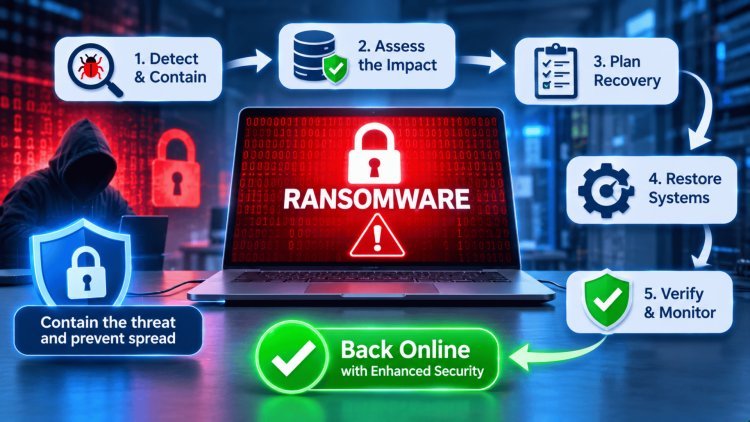
When ransomware strikes, every second matters. This framework provides a structured, battle-tested approach to detecting, containing, recovering from, and hardening against ransomware attacks — giving your organization the best possible chance of full recovery with minimal data loss and downtime.
Phase 1: The Initial Shock and Detection
The first moments of a ransomware incident are the most critical — and the most chaotic. Threat actors are watching. They often deploy ransomware only after spending days or weeks inside your environment, and they monitor your response in real time to move laterally, exfiltrate additional data, or detonate secondary payloads before you can shut them out. How your team responds in the first 15–30 minutes will define the scope and severity of the entire incident.
⏱ Time Is the Enemy
Ransomware encryption can sweep through thousands of files per minute. The moment an alert fires or an employee reports something unusual, your incident response clock starts.
Do not wait for confirmation — assume the worst and act. Alert your incident response team, your CISO, and legal counsel simultaneously.
Every minute of hesitation widens the blast radius.
???? Use Out-of-Band Communication
Your corporate email, Slack, and internal messaging tools are almost certainly compromised or monitored by the attacker.
Switch immediately to personal cell phones, encrypted consumer apps like Signal, or a pre-designated out-of-band communication channel.
Coordinating your response over compromised infrastructure is equivalent to planning a counterattack in front of the enemy.
???? Isolate Immediately — At the Switch Level
Do not simply disable Wi-Fi or unplug individual machines. Work with your network team to segment and isolate at the switch level, cutting off entire VLANs if necessary.
Powering down or disconnecting systems from the network halts active encryption and prevents lateral movement to neighboring systems, file servers, and backup repositories.
Document every action taken with a timestamp — this record will be essential for forensic analysis and insurance claims.
First 15–30 Minutes Priority Checklist
Never communicate your response plan over corporate email or any internal system — assume the attacker is reading every message on your network.
The opening minutes of a ransomware incident are not an investigation phase — they are a containment phase. Speed, isolation, disciplined communication, and immediate documentation determine whether the event remains a manageable security incident or escalates into a full-scale business crisis.
Once the immediate spread is halted, the focus shifts to understanding exactly what happened, preserving the forensic record, and eliminating every trace of the threat actor from your environment. Rushing through this phase — or skipping forensics in favor of speed — almost always leads to reinfection. The goal is not just to stop the current attack, but to ensure the attacker cannot re-enter through the same door.
Remove Persistence
Map Kill Chain
Identify Entry
Preserve Memory
Phase 2: Containment and Eradication
Recovery from ransomware is not simply a matter of restoring from backup and resuming operations. Done carelessly, restoration can reintroduce malware, corrupt clean systems, or return the organization to an environment that still contains attacker persistence mechanisms. A disciplined, methodical clean-room approach is the only safe path back to production.
Phase 3: Surgical Recovery
and Restoration
Recovering from a ransomware incident is only the beginning. Organizations that treat recovery as a learning opportunity strengthen their defenses, improve response capabilities, and significantly reduce the impact of future attacks. Long-term resilience comes from combining operational improvements, targeted security hardening, policy evolution, and organizational learning.
Conduct a structured post-incident review shortly after recovery while information remains fresh. Examine technical failures, communication gaps, delayed decisions, escalation issues, missing procedures, and detection shortcomings to identify opportunities for improvement.
Security improvements should directly address the actual entry point and attack techniques used during the incident. Targeted remediation produces greater risk reduction than broad generic upgrades.
Recovery is incomplete until governance documents, recovery procedures, access controls, and organizational standards have been formally revised to reflect lessons learned from the event.
Time attackers often remain inside environments before ransomware deployment.
Excludes recovery expenses, reputation impacts, and operational disruption.
Demonstrates why paying a ransom does not eliminate future threats.
Organizations with tested response plans typically recover significantly faster.
The organizations that emerge strongest from ransomware incidents are those that treat recovery as a catalyst for change rather than a return to normal operations. By documenting lessons learned, hardening defenses against proven attack paths, updating governance standards, and continuously exercising response capabilities, security becomes an organizational competency rather than a technical function. True cyber resilience is not measured by whether an incident occurs—it is measured by how effectively an organization learns, adapts, and improves afterward.
Phase 4: Post-Incident Resilience
Document the Journey
Harden Defenses Based on Reality
Update Policies & Procedures
Post-Incident Improvement Cycle
Industry Reality Check
Post-Incident Resilience Checklist
Strategic Conclusion
What's Your Reaction?