App Store Optimization vs App Marketing: Building a Complete Mobile Growth Strategy
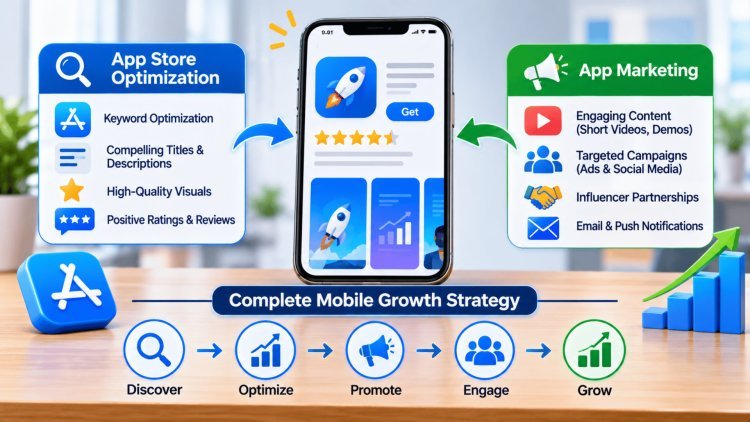
Most mobile teams treat ASO and marketing as separate disciplines — one team optimizes keywords and screenshots while another runs ads and content campaigns. This presentation makes the case that they are inseparable: a unified, end-to-end mobile growth system that compounds over time and drives sustainable revenue.
The Core Truth: Stop Treating ASO and Marketing as Separate
Across the industry, mobile teams consistently fall into the same trap: ASO specialists focus on keywords, metadata, and screenshot design, while marketing teams run paid ads, PR, and content campaigns — operating in separate silos with separate goals and separate budgets. The result is campaigns that spend heavily to drive traffic to store listings that simply don't convert, hemorrhaging budget and generating inflated cost-per-install with no downstream return.
The Silo Problem
When ASO and marketing operate independently, campaigns generate clicks that land on underperforming listings. No matter how well-targeted the ad, if the store page doesn't convert, the spend is wasted.
Keyword rankings improve in isolation, unconnected to the messaging that actually drove a user to search in the first place. The result: discovery and conversion are optimized separately, so neither reaches its potential.
The Unified Fix
The solution is to treat App Store performance as the connective tissue between discovery and downstream revenue. Every touchpoint — from the first ad impression to the store page to the onboarding flow — must be a single, coherent experience designed to move a user forward.
When ASO and marketing share data, creative, and goals, the whole system compounds: organic rankings improve, paid efficiency rises, and revenue per install grows over time.
The Compounding Effect
Discovery and conversion are not separate disciplines. Every increase in store conversion rate improves paid acquisition efficiency. Every marketing campaign creates search demand that influences organic performance. Every improvement in onboarding affects downstream monetization and retention.
The highest-performing mobile growth teams manage these levers as a single system. They continuously optimize the path from impression to install, install to activation, and activation to long-term value.
The App Store is not just a directory — it is your highest-leverage conversion page. Treat it accordingly.
The core transformation is simple: stop optimizing acquisition and conversion separately. When ASO, paid marketing, store creative, onboarding, and retention operate as one integrated growth system, installs become more valuable, campaigns become more efficient, and revenue compounds over time.
App Store marketing is not just about acquiring installs — it covers the entire user journey: discovery, store evaluation, install and activation, retention, and ultimately monetization. Each stage is a gate. Users who drop off at the store listing page never reach onboarding; users who never activate never generate revenue. Phase 1 is about ensuring that every user who discovers your app is given every reason to choose it.
The majority of installs still originate from App Store search. When a user lands on your listing after a search, they spend roughly 3–7 seconds deciding whether to continue. Your icon and first two screenshots must immediately answer the question: "Is this for me?" Icon design should be distinctive at small sizes. Screenshots should lead with the core value proposition, not feature lists. Captions should reinforce the job-to-be-done, not just describe UI elements.
Metadata strategy goes far beyond stuffing keywords. Effective ASO intent mapping means matching your title, subtitle, and keyword fields to the actual search intent of your target users — the specific problems they're trying to solve and the language they use to describe them. Category selection matters too: appearing in a less competitive category can dramatically increase browse-based discovery and editorial feature candidacy.
Conversion rates are heavily influenced by social proof and perceived safety. Ratings and review volume signal quality and reliability. How you respond to negative reviews signals care and responsiveness. Your privacy nutrition label signals trustworthiness, particularly for privacy-conscious users on iOS. All of these signals compound: a listing with 4.7 stars, thousands of reviews, and a minimal data footprint converts significantly better than an identical product with a 3.9-star average.
Over 65% of downloads on the App Store come directly from search. Capturing high-intent, mid-volume keywords with strong relevance to your core use case is more efficient than chasing high-volume head terms dominated by established players.
Prompt users for a review at the moment of highest satisfaction — after a task is completed, a goal is reached, or a streak is maintained. Volume and recency both factor into store ranking algorithms and user perception.
Use Apple's Product Page Optimization and Google's Store Listing Experiments to continuously test icon variants, screenshot order, and feature graphics. Even a 5% conversion lift at the listing level compounds dramatically across organic and paid traffic.
Make the Store Listing Your Conversion Hub
Win at the Shelf
ASO Intent Mapping
Trust Signals
Store Listing Optimization
Search Discovery
Ratings & Review Velocity
Creative A/B Testing
The relationship between paid marketing and organic App Store performance is not one-directional—it is a reinforcing flywheel. When both teams understand and exploit this dynamic, the combined output far exceeds what either discipline achieves alone. This is where sophisticated mobile teams pull ahead of the competition.
Paid campaigns create velocity, organic rankings create free installs, and shared intelligence turns every result into better targeting, metadata, and creative.
Phase 2: Marketing Fuels ASO—
And ASO Steers MarketingRun marketing and ASO as one reinforcing system.
Sustainable mobile growth happens after the install. The final phase of the growth engine focuses on activating users, retaining them long enough to create value, and measuring performance across the entire customer lifecycle. Scaling acquisition before activation and retention are optimized simply increases churn at a higher cost. Long-term growth comes from creating a system where every install has the highest possible chance of becoming a loyal, revenue-generating customer.
The speed at which users experience value directly influences early retention performance. Onboarding should guide users to the core activation event quickly, eliminating unnecessary friction and shortening the path to the product's primary benefit.
Personalized experiences, properly timed permission prompts, and progressive feature introduction help users reach the critical "aha moment" that predicts long-term engagement.
Growth measurement should extend beyond installs. Successful mobile teams track every stage of the user journey, from acquisition and activation through retention, monetization, and lifetime value generation.
Sustainable growth emerges when acquisition, activation, retention, and monetization reinforce each other. Organic discovery, paid campaigns, onboarding optimization, and retention mechanics must function as one integrated system rather than isolated initiatives.
Improved retention increases lifetime value, stronger lifetime value supports higher acquisition budgets, and greater acquisition volume strengthens organic visibility and ranking momentum.
In-store search remains one of the highest-intent acquisition sources for mobile applications.
First-impression assets must communicate value immediately to influence install decisions.
Users reaching the core activation moment generate substantially greater lifetime value.
Profit is the final outcome of a healthy growth system—not the starting point. Organizations that focus first on activation, retention, and measurement build a compounding growth engine where acquisition becomes more efficient, users become more valuable, and marketing spend produces increasingly stronger returns over time. The most successful mobile products do not simply acquire users; they consistently transform installs into engaged, loyal, and revenue-generating customers.
Phase 3: Activation → Retention → Measurement
Prioritize Onboarding Before Scaling
Measure the Entire Funnel
Build the Compounding System
Mobile Growth Flywheel
Mobile Growth Benchmarks
Final Strategic Insight
What's Your Reaction?