Endpoint Management for Growing Businesses: Securing Every Connected Device
As businesses grow, so does the complexity of managing every laptop, smartphone, server, and IoT device connected to your network. This presentation explores how modern endpoint management gives IT teams the visibility, control, and automation needed to secure every device — from onboarding to remediation — at scale.
The Real Problem Isn't IT — It's Unmanaged Exposure
The expansion of remote work, hybrid workforce models, and bring-your-own-device (BYOD) policies has fundamentally changed the security perimeter. The traditional "castle and moat" approach — where your firewall guards a single physical office — no longer holds. Today, every employee's home laptop, personal phone, and cloud-connected tablet represents a potential entry point for attackers.
Organizations with distributed workforces must now secure identities, devices, networks, applications, and data simultaneously across environments they do not fully control. The challenge is no longer perimeter defense — it is visibility and control.
The Attack Surface Has Exploded
Remote and hybrid work means corporate data flows across personal networks, unmanaged devices, and consumer-grade routers. The attack surface now extends far beyond the firewall — to kitchen tables, coffee shops, and hotel lobbies. Each unmanaged endpoint is a blind spot that adversaries actively seek out and exploit.
Unmanaged Devices Are the Weakest Link
The majority of modern endpoint security failures trace directly back to devices that fall outside centralized management or policy enforcement. When a device isn't enrolled in a management platform, it may be running outdated software, misconfigured security settings, or shadow IT applications — none of which IT can see or remediate until it's too late.
Manual Workflows Can't Keep Pace
Threat actors move fast. Exploits for newly disclosed vulnerabilities can appear within hours of a patch being published. Manual patching cycles, spreadsheet-based inventories, and ticket-driven remediation simply cannot match the speed at which modern threats evolve. Automation and centralized policy enforcement are no longer optional — they are foundational requirements for any growing organization.
How Unmanaged Exposure Creates Breach Risk
Organizations with unmanaged endpoints face, on average, a significantly larger blast radius when a breach occurs — because there is no central point of control to quarantine or remediate affected devices quickly.
The modern endpoint is the new perimeter. Security success no longer depends on building higher walls around a single office network. It depends on maintaining visibility, management, and policy enforcement across every device that touches corporate data, regardless of where that device is located.
Effective endpoint management begins at the moment a device is first powered on. Rather than relying on employees or IT staff to manually configure security settings — a process riddled with inconsistency and human error — modern platforms leverage OS-level and provider-level tooling to ensure every device starts life on your network in a known, secure state.
Endpoint management is the practice of centrally provisioning, configuring, securing, monitoring, and maintaining every device across your organization — laptops, smartphones, servers, and IoT hardware alike. It replaces fragmented, device-by-device administration with a unified control plane that gives IT teams a single pane of glass over the entire fleet, regardless of operating system, location, or ownership model.
Zero-touch enrollment uses native OS and provider tooling to automate the entire device setup process. Apple Business Manager allows Mac and iPhone deployments to be pre-configured and pushed automatically the moment a device connects to the internet. Windows Autopilot does the same for PCs — enrolling, configuring, and applying policies without IT ever touching the hardware. Android Work Enrollment creates a managed work profile on personal and corporate Android devices, ensuring corporate data stays separated and secured from day one.
The result: every device is compliant before an employee ever opens an application.
Automated device discovery continuously scans for new endpoints joining your network and immediately adds them to your managed inventory. No device goes unrecorded. IT teams gain real-time visibility into what hardware and software exists across the entire organization — a critical first step toward enforcing policy and maintaining audit-readiness.
Enrollment doesn't just add a device to a list — it immediately applies your organization's baseline security configuration. Encryption is enabled, screen lock policies are enforced, VPN profiles are pushed, and unapproved applications are blocked before the user completes setup. Security is baked in, not bolted on.
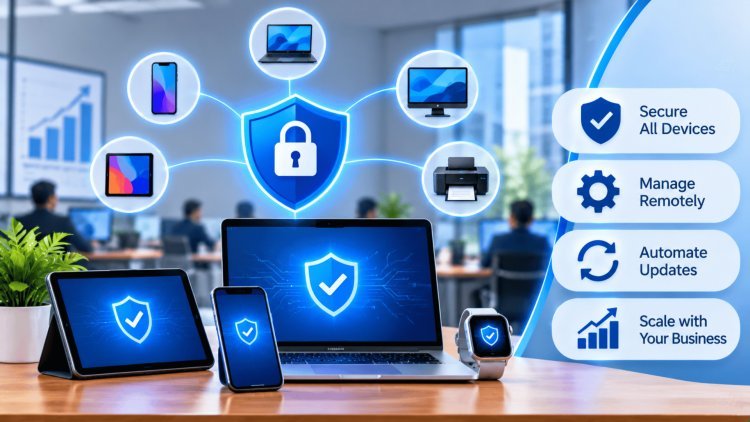
Modern endpoint management platforms support the full breadth of device types — Windows, macOS, Linux, iOS, Android, and even IoT endpoints. Whether your team uses company-issued laptops or personal devices under a BYOD policy, every endpoint can be enrolled, monitored, and governed from a single platform.
Enrollment That Prevents "Unknown Devices"
What Is Endpoint Management?
Zero-Touch Enrollment in Practice
Enrollment Capabilities
Automated Discovery & Inventory
Secure-by-Default Configuration
Multi-Platform, Multi-Device Coverage
Enrollment gets devices into a known state. Ongoing compliance management keeps them there. As software evolves, new vulnerabilities emerge, configurations drift, and policies change—without continuous enforcement, even a well-enrolled fleet degrades over time into a collection of inconsistent, potentially vulnerable endpoints.
Regulators, auditors, and cyber insurers increasingly require demonstrable proof of endpoint compliance—not attestations based on memory or manual checklists. Continuous monitoring with structured telemetry and audit logs gives organizations the evidence they need to satisfy SOC 2, ISO 27001, HIPAA, and other frameworks. When an auditor asks “how do you know your devices are patched and encrypted?”, the answer is a report—not a conversation.
Chapter 2: Keep the Fleet Compliant
— Patch, Policy, and ProofCompliance as Evidence, Not Assumption
Detection is valuable only when it leads to action. Modern endpoint security programs are built around the ability to identify threats, enforce policy compliance, and execute remediation actions automatically and at scale. The objective is to shrink the time between detection and response from hours to seconds, preventing isolated events from escalating into organization-wide incidents.
Secure provisioning from day one.
Apply security baselines automatically.
Reduce vulnerability exposure windows.
Collect telemetry and compliance data.
Respond automatically and recover fast.
Configuration drift is automatically corrected by reapplying approved security baselines. Devices continuously return to a compliant state without requiring manual administrator intervention.
Potentially compromised endpoints can be separated from production environments immediately, limiting exposure while preserving forensic evidence for investigation and response teams.
Security workflows can invalidate access credentials and authentication tokens immediately after suspicious activity is identified, limiting opportunities for unauthorized access.
Lost, stolen, or compromised devices can be secured remotely through lock, wipe, or restricted-access actions designed to reduce data exposure risk.
Regular health assessments verify software status, policy compliance, and security-agent functionality across the entire fleet.
Devices returning from extended offline periods are evaluated and updated before regaining unrestricted access.
Data-protection status can be monitored centrally to ensure encryption remains enabled and operational across endpoints.
Security posture, policy compliance, and remediation activities are consolidated into a single operational view.
Endpoint management is not complete when a device is enrolled. The true measure of maturity is an organization's ability to continuously monitor endpoint health, enforce security standards, detect threats, and remediate issues automatically at scale. By integrating enrollment, configuration, patching, monitoring, and remediation into a unified operational model, organizations create a self-reinforcing security cycle where devices remain visible, compliant, recoverable, and resilient throughout their lifecycle. The strongest endpoint programs transform remediation from a reactive task into an automated operational discipline.
Chapter 3: Remediate Instantly — So Incidents Don't Become Headlines
Secure Endpoint Lifecycle
Automated Self-Healing
Isolation & Quarantine
Credential Protection
Remote Lock & Data Protection
Leave No Endpoint Behind
The Continuous Security Feedback Loop
Strategic Takeaway
What's Your Reaction?