Building a Digital Asset Library: From Chaos to Enterprise Excellence
For marketing and enterprise teams, digital assets are the lifeblood of every campaign, product launch, and brand touchpoint. Yet most organizations manage these assets in a state of fragmented chaos — scattered across shared drives, Slack threads, email attachments, and forgotten cloud folders. This presentation explores how to move from that chaos to a disciplined, scalable, and performance-optimized Digital Asset Library (DAL) that becomes a true competitive advantage.
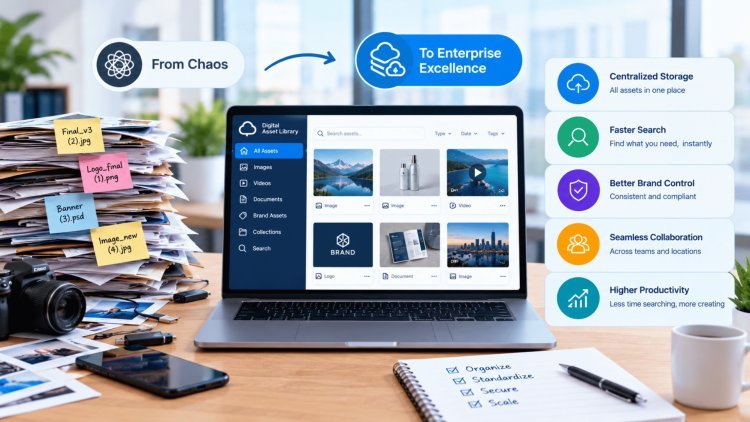
The Hidden Cost of Content Chaos
Every minute a designer spends hunting for the correct version of a logo, or a content manager re-exports a video that already exists somewhere on a shared drive, is a minute stolen from creative work. These inefficiencies compound quietly and catastrophically across enterprise teams. Research consistently shows that knowledge workers spend up to 30% of their workweek simply searching for information — and in marketing, that translates directly to missed deadlines, diluted brand standards, and ballooning production costs.
Why Scattered Drives Kill Productivity
Without a centralized system, teams duplicate effort, version conflicts proliferate, and onboarding new team members becomes a weeks-long ordeal. Brand inconsistency creeps in as outdated logos and off-spec assets get reused simply because they were the easiest to find.
The hidden tax on productivity is enormous — and entirely avoidable. A strategic Digital Asset Library isn't just a prettier folder structure. It's an engineered system with enforced taxonomy, rich metadata, and automated workflows that eliminate the manual overhead entirely.
Storage vs. Strategy: A Critical Distinction
Simple cloud storage (Dropbox, Google Drive) solves the physical problem of where files live — but does nothing to address discoverability, governance, rights management, or distribution. A true Digital Asset Library layers intelligence on top of storage: structured metadata schemas, smart search, access control policies, expiration rules for licensed content, and integrations with downstream publishing platforms.
Time Lost Searching
Average share of the workweek knowledge workers spend locating files and information
Brand Inconsistency Risk
Teams without a DAL are 3× more likely to publish off-brand or outdated assets
Rework Reduction
Organizations with structured DALs report up to 60% reduction in content rework and duplication
A strategic Digital Asset Library isn't just a prettier folder structure. It's an engineered system with enforced taxonomy, rich metadata, and automated workflows that eliminate the manual overhead entirely.
Building a Digital Asset Library that scales with an enterprise requires more than good intentions — it demands deliberate architectural decisions made before a single file is uploaded. The most common failure mode is treating the DAL as an afterthought: a folder hierarchy bolted onto existing storage with no governance, no metadata standards, and no enforcement. The result is a system that becomes just as chaotic as the one it replaced, only larger.
Adopting a Single-Project Engineering philosophy means treating your DAL as a dedicated product with its own roadmap, owners, and success metrics — not a side project managed by whoever has spare bandwidth. This mindset enforces discipline: every structural decision (folder depth, metadata field, permission tier) is evaluated against long-term scalability, not short-term convenience. It prevents scope creep, where teams add ad-hoc folders that undermine the taxonomy. It also ensures a single source of truth for governance decisions, making audits and compliance reviews dramatically simpler.
Effective folder architecture mirrors the way your business actually operates — not how IT imagined it might operate five years ago. For marketing teams, this typically means a top-level hierarchy organized by Campaign → Channel → Asset Type → Locale, with parallel branches for brand foundations (logos, typography, color palettes) and product libraries. For enterprise teams, a functional hierarchy by business unit with cross-referenced campaign overlays often works better. The key is designing for the searcher's mental model, not the archivist's. Teams should be able to locate any asset in three clicks or fewer.
Implementing Defensive Engineering principles means building systems that fail safely and enforce standards automatically. In a DAL context, this translates to: mandatory metadata fields that cannot be bypassed at upload, role-based access control (RBAC) with least-privilege defaults, automated expiry flagging for licensed assets, and immutable audit logs for every asset interaction. Security schemas must account for both internal misuse and external exposure — especially critical when assets include proprietary product imagery, unreleased campaign materials, or personally identifiable information embedded in creative files.
Architecture decisions made in the first 90 days of a DAL implementation will define the system's scalability ceiling for years. Invest in taxonomy design and metadata schema before you invest in tooling.
Foundations: Engineering Your Library's Architecture
Single-Project Engineering Mindset
Folder Structures That Scale With Business Logic
Defensive Engineering for Metadata & Security
Once your library’s foundation is solid, the next evolution is transforming it from a passive repository into an active, intelligent distribution engine. The modern content stack doesn’t just store assets—it delivers them dynamically, integrates with every downstream platform in your marketing ecosystem, and maintains performance at global scale without manual intervention. This is where a Digital Asset Library becomes a genuine competitive differentiator.
Brand assets are operational infrastructure. When a campaign is live and a retail partner’s integration can’t retrieve the correct product image, the cost is measured in real revenue loss—not just inconvenience. 99.99% Uptime Assurance for your DAL requires a multi-region cloud deployment with automatic failover, CDN distribution for static asset delivery, health monitoring with sub-minute alerting, and documented incident response playbooks. For global enterprise teams operating across time zones, this also means eliminating maintenance windows that affect business hours in any region.
Scaling Performance:
The Modern Content Stack99.99% Uptime: The Enterprise Standard
The next frontier for Digital Asset Libraries isn't about storing more assets — it's about making every asset work harder, smarter, and more autonomously. AI-driven capabilities are rapidly moving from experimental features to production requirements for enterprise marketing teams. The organizations that invest in this layer today will compound that advantage over the next three to five years as their competitors are still manually tagging uploads and chasing brand compliance violations.
The path from content chaos to enterprise excellence begins with an honest audit of your current ecosystem. Before evaluating any tooling or platform, map where your assets actually live today, how teams find them, how long that takes, and how often the wrong version gets used. That audit will surface the specific failure modes your architecture needs to solve — and will make the business case for investment far more concrete than any vendor benchmark.
Inventory all current asset storage locations, access patterns, and pain points. Quantify the time cost of current workflows across teams. Review the custom development capabilities available to support your build.
Engage engineering and brand stakeholders to design taxonomy, metadata schemas, and integration requirements. Define your uptime, performance, and security requirements before evaluating any platform.
Launch with a governed pilot library for one team or campaign, validate the architecture under real conditions, then scale with confidence. Avoid big-bang migrations that overwhelm adoption.
Instrument your DAL with usage analytics from day one. Monitor search query success rates, asset retrieval times, and compliance flag volumes. Use that data to continuously refine taxonomy and automation rules — and explore API-first backend integrations to extend the system's reach as your content stack matures.
Audit your current digital asset ecosystem this week and identify your top three workflow bottlenecks. That clarity is the foundation every high-performance library is built on.
The Future: AI, Governance, and Strategic Growth
Your Action Plan: From Audit to Architecture
What's Your Reaction?