UX Research Methods That Help Businesses Build Better Digital Products
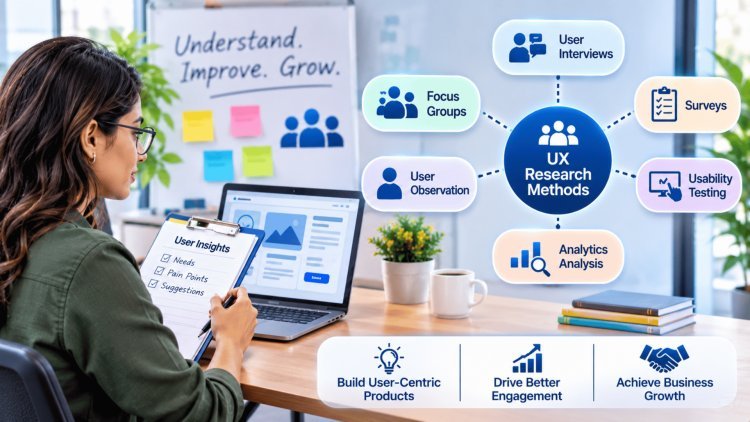
Understanding your users isn't optional — it's the foundation of every successful digital product. This presentation walks through the most effective UX research methods, organized by where you are in the product lifecycle: from early discovery, through design validation, to post-launch optimization. Whether you're a startup defining your first MVP or an enterprise refining a mature platform, the right research method at the right moment can be the difference between a product people love and one they abandon.
CHAPTER 1
Discover the Real Problem Before You Design Anything
The most costly mistake in product development isn't a bad design decision — it's solving the wrong problem entirely. Early-stage teams frequently face the disorienting question: "Where are we even starting?" Without a structured research approach, teams default to assumptions, stakeholder opinions, or what competitors are doing. The result is a product built on a foundation of guesswork.
Exploration-phase research relies on three core methods: in-depth user interviews, competitive landscape analysis, and concept testing. Each serves a distinct purpose. Interviews surface raw, unfiltered user needs. Competitive analysis reveals gaps and opportunities in the market. Concept testing stress-tests early hypotheses before a single line of code is written.
User Interviews
One-on-one conversations that uncover motivations, frustrations, and mental models. The goal isn't to validate a hypothesis — it's to surface ones you didn't know you had.
Recruit participants who represent your target segment, and use open-ended questions to let stories emerge naturally.
Aim for 5–8 interviews per segment to begin identifying patterns.
Competitive Analysis
A systematic review of how comparable products solve similar problems. Go beyond feature lists — analyze the user experience, onboarding flows, error handling, and information architecture of competitors.
This creates a baseline for differentiation and surfaces industry conventions users already expect.
Concept Testing
Present rough ideas — sketches, storyboards, or low-fidelity prototypes — to real users before committing to development.
The key is testing whether the concept resonates directionally, not whether specific UI elements are correct. Early feedback prevents expensive late-stage pivots.
What Each Method Answers
The golden rule: Always pick methods that answer your strategic question — not your implementation question. At this stage, you're asking "Should we build this?" not "How should we build it?"
Great products rarely begin with great ideas. They begin with a deep understanding of real problems. Discovery research replaces assumptions with evidence, reduces risk before investment, and ensures that design and engineering effort are applied to opportunities that genuinely matter to users.
Not all research methods are created equal — and understanding the distinction between attitudinal and behavioral research is fundamental to choosing the right one. Attitudinal research captures what people say they do, feel, or prefer. Behavioral research captures what they actually do. The gap between these two is often where the most valuable product insights live.
Surveys, interviews, and focus groups reveal the "why" behind user behavior. They surface opinions, motivations, expectations, and emotional responses. Use these when you need rich context — when you want to understand a user's mental model, not just track their clicks. Qualitative attitudinal research is especially powerful early in the discovery phase, when you're still forming hypotheses.
Usability testing, field observation, eye-tracking, and session recordings capture what users actually do — often revealing that their behavior contradicts their stated preferences. These methods are essential for validating assumptions formed through attitudinal research. Behavioral data is harder to rationalize or fake, making it a more reliable signal for design decisions.
Neither method type works best in isolation. Use qualitative methods to generate hypotheses and understand the "why" — then apply quantitative methods to confirm whether those patterns hold at scale. For example: interviews reveal that users are confused by a checkout flow; a survey of 500 users confirms that 68% abandon at the same step. Together, they make a compelling case for change. The best research programs cycle fluidly between both, using each to sharpen and validate the other.
Small sample sizes (5–20 participants) reveal nuanced reasons behind behavior. Ideal for exploring unfamiliar problem spaces, diagnosing pain points, or understanding edge cases that quantitative data flags but cannot explain.
Large-scale surveys, analytics, and A/B tests confirm whether patterns observed qualitatively are statistically significant and widespread. They allow teams to prioritize by impact — focusing effort on issues that affect the most users.
Mixed-method approaches dramatically reduce the risk of acting on incomplete signals. When qualitative and quantitative data point in the same direction, teams can move forward with confidence. When they diverge, it's a signal to dig deeper.
The "Listen-First" Toolbox: What Users Need and Why
Attitudinal Methods
Behavioral Methods
Qualitative + Quantitative: Stronger Together
Use Qualitative When You Need Context
Use Quantitative to Confirm and Scale
Combine for Confidence
Once your team has a directional design, the research focus shifts from discovery to validation. This is where formative and summative research methods earn their keep. Formative research evaluates whether the design is heading in the right direction—it informs and shapes ongoing design decisions. Summative research measures whether the final design actually works for users.
Use formative research to shape decisions, summative research to verify outcomes, and benchmarking to demonstrate measurable progress over time.
Validate the Design,
Then Prove It WorksValidate direction. Measure performance. Prove improvement.
Product launch is not the end of research—it marks the beginning of continuous learning. Once users interact with a product in real-world conditions, teams gain access to behavioral signals, usage patterns, and customer feedback that cannot be discovered in controlled testing environments. The most successful digital products are built through ongoing measurement, optimization, and evidence-based decision making.
Analytics platforms provide large-scale visibility into user behavior. Funnel analysis highlights abandonment points, while cohort analysis reveals how engagement changes over time. Clickstream data uncovers navigation patterns and exposes friction hidden within complex user journeys.
Heatmaps, scroll maps, click maps, and session replays reveal micro-level behavioral friction. These tools show exactly where users hesitate, mis-click, abandon workflows, or fail to engage with important content.
Continuous usability testing helps teams identify new issues introduced through product iterations. Frequent lightweight testing prevents usability debt from accumulating and keeps decision-makers connected to real customer experiences.
NPS, CSAT, and CES surveys track customer sentiment over time. When paired with behavioral analytics, survey data explains not only what users are doing, but how they feel about the experience.
User interviews, contextual inquiry, ethnographic observation, and concept testing reveal motivations, unmet needs, and mental models before solution design begins.
Card sorting, tree testing, moderated usability sessions, benchmarking, and experimentation validate information architecture and task completion paths.
Analytics, clickstream analysis, session recordings, heatmaps, and longitudinal surveys provide scalable optimization insights from actual user behavior.
The strongest UX research programs are not defined by any single method—they are defined by their ability to apply the right method at the right stage of the product lifecycle. Discovery research reveals customer needs, validation research confirms design decisions, and post-launch measurement uncovers optimization opportunities at scale. The best product teams never rely on intuition alone. They build a continuous research engine that transforms evidence into decisions, decisions into improvements, and improvements into measurable business outcomes.
After Launch, Optimize with Evidence — Not Intuition
Analytics & Clickstream Analysis
Session Recordings & Heatmaps
Ongoing Usability Checks
Longitudinal Surveys
Continuous Optimization Loop
Match Method to Moment
Research Decision Framework
Final Takeaway
What's Your Reaction?