Omnichannel eCommerce Development: Creating a Unified Shopping Experience
How leading retailers are breaking down channel silos to deliver seamless, consistent, and customer-first journeys — from discovery to delivery and beyond.
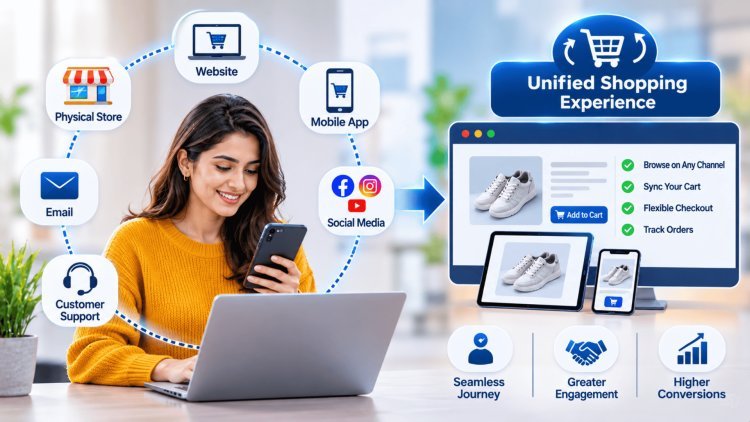
From "Many Channels" to "One Journey"
Most retailers today sell across multiple platforms — their own website, mobile app, marketplace listings, and physical stores. But multichannel alone is not omnichannel. The difference is coordination. While multichannel means being present on many platforms, customers immediately notice when inventory levels, return policies, or service quality fail to match across those touchpoints. Omnichannel goes deeper: it coordinates the entire customer experience so that discovery, purchase, fulfillment, and support stay consistent no matter where the journey begins or ends.
The Multichannel Problem
Channels operate in silos. A shopper finds a product advertised on Instagram, visits the website to purchase, then walks into a store to return it — only to be told the store "can't see" the online order. Each channel feels like a different company.
The Omnichannel Promise
Omnichannel retail treats the customer journey as a single, continuous experience. The core continuity goal: a shopper can discover a product on one channel, purchase on another, and receive support on a third — and throughout that entire journey, the experience remains coherent, personalized, and effortless.
The customer should never have to repeat information, re-establish context, or navigate disconnected policies simply because they moved from one channel to another.
Unified Brand Experience
Consistent messaging, product information, pricing logic, and customer expectations across every touchpoint.
Shared Customer Context
Service and support teams have visibility into the customer's complete journey rather than a single channel interaction.
Journey Continuity
Customers can move seamlessly between channels while maintaining carts, wishlists, rewards, preferences, and order visibility.
What True Omnichannel Looks Like
The Strategic Difference
Multichannel focuses on reach. Omnichannel focuses on continuity. One strategy adds touchpoints; the other connects them. Organizations often invest heavily in opening new channels while neglecting the systems, data, and operational processes required to make those channels feel unified from the customer's perspective.
The goal is not to be everywhere — it is to feel like one brand everywhere. Omnichannel is a coordination strategy, not a channel expansion strategy.
Customers do not think in channels. They think in outcomes. The most successful retailers design every website visit, store interaction, mobile session, delivery update, and support request as part of one connected journey that feels continuous from beginning to end.
Behind every seamless customer experience is a backend architecture that eliminates data fragmentation. The most visible symptom of a broken omnichannel stack is inventory inaccuracy — and the business cost is staggering. IHL Group research cited by Shopify estimates that inventory distortion (the combined cost of stockouts and overstocks driven by fragmented systems) costs the retail industry $1.7 trillion annually. That figure encompasses lost sales from empty shelves, margin destruction from excess stock, and customer trust eroded by "in stock" items that aren't. Fixing this starts with the data layer.
A unified inventory layer aggregates stock levels across every warehouse, store, and fulfillment center into a single, continuously updated view. This eliminates overselling, enables ship-from-store, and powers accurate delivery promises at the moment of purchase — not after the fact.
A single customer ID ties together purchase history, browsing behavior, loyalty status, support tickets, and return patterns across every channel. Staff in-store can greet a returning customer with context. Online recommendations improve because they draw on the full relationship, not just one session.
Omnichannel coordinates the experience across channels. Unified commerce goes further by centralizing the backend itself — inventory, orders, customers, promotions, and fulfillment — into one platform. The result is a genuine "single source of truth" with no reconciliation lag between systems.
When inventory lives in separate databases for each channel, discrepancies are inevitable. A product showing "2 in stock" online may already be sold in-store. A return processed in-store may take days to show back in the online catalog. Promotions activated in one system may not fire correctly in another. Each of these gaps creates a moment of friction that erodes customer confidence and increases operational cost — in support tickets, manual corrections, and lost repeat purchases.
When all systems draw from one authoritative data layer, every downstream decision improves automatically. Fulfillment routing becomes smarter because it sees all available stock in real time. Personalization engines become more accurate because they have complete behavioral histories. Customer service resolution times drop because agents see the full order and interaction timeline in one view. The investment in data unification compounds over time — every system that plugs in becomes more valuable because of what it can now share and receive.
Industry-wide loss from stockouts and overstocks driven by fragmented inventory systems (IHL Group, via Shopify).
A unified profile merges all touchpoints — purchase, loyalty, support — into a single customer record for consistent, personalized service.
When backend systems are centralized into one platform, inventory and order data are always current — no batch syncs, no delayed updates.
The Engine Room: Unified Data, Unified Inventory
Real-Time Inventory Sync
Unified Customer Profiles
Unified Commerce vs. Omnichannel
Why Fragmented Data Breaks the Experience
The Single Source of Truth Advantage
Annual Inventory Distortion Cost
Customer ID Across All Channels
Reconciliation Lag in Unified Commerce
Building omnichannel is an operational transformation, not just a technology project. The most successful implementations follow a disciplined sequence: understand the current journey in full detail, prioritize the highest-value use cases, and then connect the systems that make those use cases possible at scale. Attempting to do everything at once is the most common failure mode—it delays launch, overloads teams, and often delivers a half-finished experience that frustrates customers more than the fragmented state it replaced.
Audit the journey, prioritize high-value use cases, and close every integration gap before scaling the omnichannel experience.
How Teams Build It
(Without Breaking the Customer)Build in sequence. Connect deliberately. Protect the customer.
The ultimate objective of omnichannel transformation is not merely connecting channels—it is creating a retail operating model where inventory, customer data, fulfillment logic, and commerce experiences operate as a single real-time ecosystem. When synchronization occurs in seconds rather than batch updates, every customer touchpoint becomes more accurate, efficient, and trustworthy.
Real-time inventory visibility allows fulfillment engines to automatically select the optimal inventory source for every order. Distribution centers, retail stores, and third-party logistics providers become part of a single fulfillment network operating from continuously updated inventory data.
Intelligent order routing improves delivery speed, reduces transportation costs, minimizes stockouts, and eliminates the oversell situations that damage customer trust and increase support workload.
Unified commerce moves beyond traditional integration strategies by centralizing inventory, order management, promotions, customer profiles, and operational workflows into a single shared platform.
Customers no longer experience isolated channels. Instead, they interact with a single intelligent retail ecosystem that recognizes preferences, purchase history, loyalty status, and shopping intent regardless of the touchpoint being used.
Promotions remain consistent, inventory availability becomes reliable, service interactions become contextual, and every engagement feels connected to the previous one.
Map every interaction across the customer lifecycle and identify friction, inconsistencies, and context loss between channels.
Establish a centralized source of truth for inventory, promotions, orders, and customer information.
Deploy capabilities such as BOPIS, ship-from-store, cross-channel returns, and unified loyalty programs.
Consolidate channels onto a shared backend foundation capable of supporting real-time intelligence and personalization.
The future of retail is not a collection of connected channels but a unified operating system where inventory, customer intelligence, fulfillment, and commerce experiences operate from a single real-time foundation. As organizations move from omnichannel coordination to unified commerce, the concept of channels begins to disappear entirely. Customers no longer navigate separate systems—they simply interact with a brand that recognizes them, understands their needs, and consistently delivers on its promises at every touchpoint.
The Modern Endgame: Real-Time Unified Shopping
Real-Time Inventory & Fulfillment Intelligence
Unified Commerce: One Source of Truth
One Continuous Brand Journey
Unified Commerce Operating Model
Transformation Roadmap
Audit the Journey
Unify the Data Layer
Launch High-Value Use Cases
Evolve to Unified Commerce
Strategic Conclusion
What's Your Reaction?