Headless Commerce vs Traditional eCommerce: Choosing the Right Store Architecture
Two fundamentally different philosophies for building your online store — each with distinct trade-offs in speed, flexibility, cost, and complexity. This guide breaks down what actually matters when choosing your architecture.
Start Here: What "Headless" Actually Changes
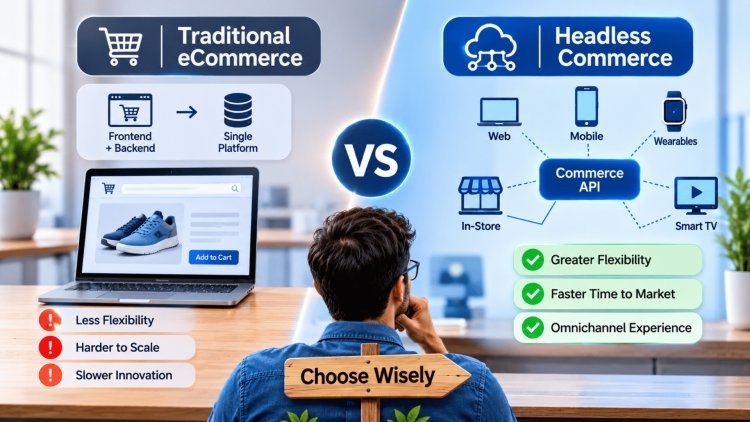
At its core, the headless vs. traditional debate is about where the boundaries of your system sit — and who owns what. Understanding this split is the foundation for every decision that follows.
Traditional Commerce
The storefront (what customers see) and the commerce engine (inventory, checkout, payments) are tightly coupled inside a single platform. Everything lives together — themes, product catalogs, payment flows, and content management tools are all part of one integrated system. Changes to any layer happen within the same environment.
Headless Commerce
The storefront layer (front end) is completely decoupled from the commerce engine (back end). They communicate exclusively through APIs. Your development team builds and maintains the front end independently, choosing their own framework and deployment pipeline, while the back end handles transactions, inventory, and data.
What Actually Changes
The real shift isn't just technical — it's organizational. Headless moves ownership of the customer experience firmly onto your internal team, while traditional keeps much of that responsibility with the platform vendor.
The headless decision is fundamentally a decision about ownership. Traditional commerce buys simplicity by accepting platform boundaries. Headless commerce buys freedom by accepting responsibility. The right choice depends on how much control your organization needs and how much operational complexity it is prepared to manage.
Traditional platforms like Shopify, BigCommerce, and WooCommerce were built around a core promise: get to market quickly without deep engineering investment. For a large segment of merchants, this remains the right choice — not because of technical limitations, but because the operational model genuinely fits their needs.
Traditional platforms center their experience around predesigned, conversion-optimized themes. Merchants can configure layouts, colors, typography, and product pages through a visual editor without writing a single line of code. App marketplaces extend functionality — adding subscriptions, reviews, upsells, and loyalty programs — in minutes rather than months. This dramatically compresses the time between idea and live store.
One of the most underrated advantages of traditional platforms is that marketing, merchandising, and content teams can operate independently. Product launches, promotional banners, landing page updates, and collection changes don't require a developer ticket. This operational independence has real business value — teams move faster and engineering resources aren't consumed by routine content changes.
Traditional platforms shine when your design requirements are achievable within theme settings and available apps, when you're resource-constrained on engineering, when you're early-stage and need to validate before investing in custom infrastructure, or when your commerce needs are primarily single-channel (web). The managed infrastructure also means less DevOps burden — uptime, security patches, and performance scaling are handled for you.
The constraint of traditional commerce isn't a flaw — it's a deliberate design choice. But as brands grow, they sometimes hit architectural ceilings: deeply custom checkout flows require proprietary APIs, unique page layouts push against theme structure, and performance optimization has limited levers. Custom code and third-party apps can extend capabilities, but each addition increases technical debt and can introduce compatibility issues during platform updates.
Traditional Commerce Era: Launch Fast, Operate Simple
Theme-First Setup & Speed to Market
Non-Technical Team Empowerment
Where Traditional Commerce Fits Best
The Real Trade-Off: Customization Ceilings
Headless commerce offers genuine, measurable advantages for the right organization—but those advantages come with a cost structure that many teams underestimate at the outset. Understanding both sides of this equation is essential before committing.
Headless commerce can unlock custom experiences, omnichannel delivery, and performance gains—but only for teams prepared to own the build, integration, and operational burden.
Headless Commerce Era: Personalization
at Scale (But Pay the Complexity Tax)Weigh the flexibility against the complexity tax.
The debate between headless and traditional commerce platforms often focuses on technology rather than business readiness. In practice, there is no universally superior architecture. The right choice depends on organizational maturity, engineering capacity, growth objectives, operational capabilities, and implementation timelines. The best architecture is the one your team can successfully operate, optimize, and scale over time.
Headless commerce requires ongoing engineering ownership beyond launch. Dedicated front-end developers must continuously maintain integrations, improve performance, and support evolving customer experiences.
Initial implementation costs rarely reflect the true economics of a commerce platform. Infrastructure management, integrations, monitoring, hosting, maintenance, and developer support all contribute to long-term operating expenses.
Headless implementations demand extensive testing, validation, and integration coordination before launch. Projects operating under strict deadlines often benefit from the accelerated deployment schedules of traditional platforms.
Organizations supporting distinct experiences across websites, mobile apps, retail environments, marketplaces, and emerging channels often benefit from headless architectures that separate presentation layers from commerce functionality.
Rapid launches, seasonal opportunities, and replatforming deadlines require proven deployment efficiency.
Teams with shared or constrained development resources benefit from simpler operational models.
Theme customization satisfies most design and content requirements without extensive custom engineering.
Marketing and merchandising teams can operate independently without constant engineering support.
Unified commerce platforms offer a hybrid approach between traditional and fully headless architectures. By combining storefront experiences, content management, commerce functionality, and operational tooling within a single ecosystem, they provide additional flexibility without introducing the complexity typically associated with fully decoupled implementations.
Unified platforms often deliver a substantial portion of headless flexibility while reducing integration complexity, operational overhead, and long-term maintenance requirements.
The right architecture is not the most advanced architecture—it is the architecture your organization can operate effectively today while creating a pathway for future growth. A highly sophisticated headless environment managed by an under-resourced team can underperform a well-executed traditional platform. Success comes from aligning technology decisions with business readiness, operational maturity, and long-term strategic goals. Build for your current reality, while keeping a clear roadmap toward the capabilities you will need tomorrow.
The Decision Rule: Why the "Best" Architecture Depends on Timing
Developer Capacity & Ownership
Total Cost of Ownership
Launch Timeline Realism
Multi-Channel Complexity
Architecture Evaluation Framework
When Traditional Commerce Wins
The Middle Path: Unified Commerce Platforms
The Timing Principle
What's Your Reaction?