The Modular Monolith: Architectural Clarity Without the Distributed Tax
A deep dive into one of software architecture's most pragmatic and underutilised patterns — and why it might be exactly what your business needs right now.
The Hidden Trap: Big Ball of Mud
Few engineering teams intentionally create unmaintainable systems. Most start with reasonable designs that gradually erode under delivery pressure, deadline-driven shortcuts, personnel changes, and years of accumulated technical debt. Over time, architectural boundaries blur until the application becomes a tightly coupled web of dependencies where understanding, modifying, and testing any feature becomes increasingly difficult.
How Entanglement Begins
The modular monolith reclaims the simplicity of a single deployable unit while imposing the structural discipline that prevents entropy. It is a monolith architected with the rigour of microservices—without paying the distributed-systems tax.
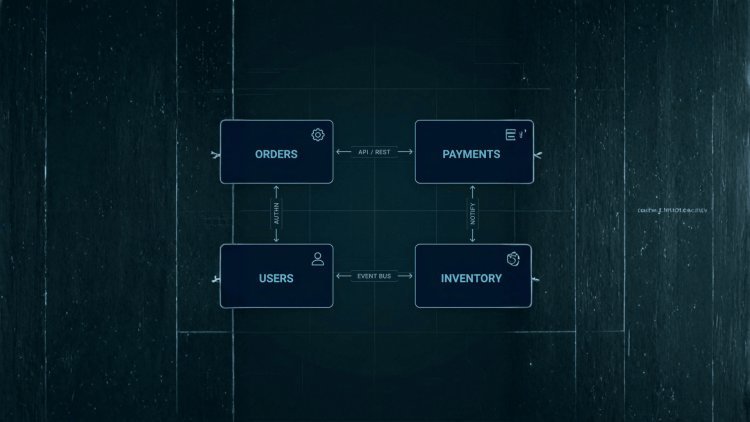
Putting folders named “Orders” and “Payments” next to one another does not create a modular monolith. The boundaries must control dependencies, protect internals, and define how domains communicate.
A modular monolith is one deployable application with many deliberately bounded business domains. It keeps the operational simplicity of a monolith—simple deployments, no internal network latency, and easy local development—while adding the structural evolvability of microservices through clear ownership, independent changeability, and future extraction readiness. It is not a compromise. It is a considered architectural choice: one runtime, one pipeline, and strict contracts between modules.
Defining the
Modular MonolithOne Runtime, Many Domains, Explicit Contracts
interfaces onlyConventional Monolith vs Modular Monolith
Dimension
Conventional Monolith
Modular Monolith
Deployment
Usually one deployable unit
One deliberate deployable unit
Dependencies
Any class may import any other class
Hard, enforced module boundaries
Organisation
Technical layers: controllers, services, repositories
Business domains: Orders, Inventory, Payments, Users
Changeability
Changes can spread unpredictably
Changes stay within clear ownership boundaries
Future evolution
Extraction is risky and expensive
Modules are candidates for future extraction
What Makes the Pattern Work
A Monolith Without Boundaries Is Not Modular
The Modular Monolith Principle
The modular monolith is not just a technical choice — it’s a strategic business decision that accelerates delivery, reduces operational costs, and enhances long-term sustainability. Forward-thinking engineering leaders adopt it deliberately for its balance of simplicity and scalability.
Working within clean, cohesive domain slices allows developers to move fast without fear. Features are added within bounded contexts, refactors remain contained, and code reviews stay focused. New team members ramp up quickly because the system mirrors business concepts they already understand.
Microservices demand complex infrastructure — service discovery, tracing, gateways, orchestration. A modular monolith avoids this entirely: one process, one deployment, one log stream. The savings in infrastructure and platform engineering effort often free entire team members for product work.
Modular monoliths are not dead ends. Cleanly separated modules with defined contracts make future extraction into microservices straightforward. Teams gain optionality without paying for complexity upfront — evolution becomes a choice, not a necessity.
Network Latency — in-process calls eliminate microservice hop overhead.
Deployment Pipeline — one artifact, one rollback strategy, simpler CI/CD.
Infrastructure Cost Reduction — typical savings for teams under 50 engineers.
The modular monolith delivers speed, simplicity, and scalability — empowering teams to build great software faster and more sustainably, without the premature complexity of distributed systems.
Why Businesses Choose the Modular Monolith
Developer Velocity & Maintainability
Low Operational Overhead
Future-Proof Without Premature Complexity
Key Insight
Do not start with microservices to solve problems you do not yet have. Begin with a well-structured modular monolith, enforce boundaries rigorously, and extract only when reality — not hype — demands it. This path compounds into long-term engineering excellence.
When to Use It — And When to Move On
✅ Use a Modular Monolith When...
⚙️ Consider Extraction When...
Final Wisdom
What's Your Reaction?