School Management Software Development: Essential Features for Modern Educational Institutions
A comprehensive guide to building the digital backbone that empowers administrators, educators, parents, and students — transforming operational complexity into seamless, intelligent workflows for the institutions of tomorrow.
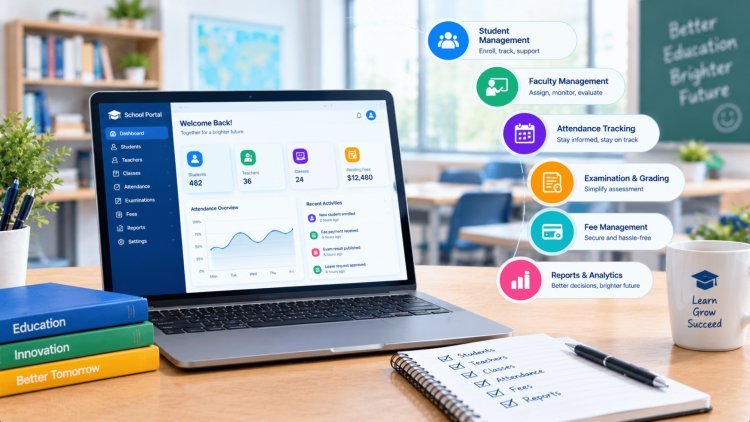
The Digital Transformation of Education
The modern educational institution is no longer just a place of learning — it is a complex operational ecosystem managing hundreds or thousands of stakeholders simultaneously. From enrollment records and timetables to fee collection and parent communications, the volume and velocity of data generated every single day is staggering. Yet, a surprising number of institutions still rely on fragmented spreadsheets, disconnected email threads, and siloed paper-based processes to manage this complexity.
Moving Beyond Spreadsheets
Spreadsheets were never designed to serve as institutional databases. When a school's critical data lives across dozens of files maintained by different staff members, version conflicts, data duplication, and human error become inevitable daily occurrences. A unified digital backbone — a purpose-built School Management Software (SMS) — replaces this chaos with a single, living system of record. Every department operates from the same data, in real time, with full accountability and audit trails built in.
The True Cost of Fragmented Data
The consequences of fragmented, manual data management extend far beyond minor inconveniences. Missed fee payment reminders, incorrect exam results, delayed report cards, and uncommunicated timetable changes erode trust between institutions and the families they serve.
Operationally, administrative staff spend disproportionate hours on data entry, reconciliation, and error correction — time that could be invested in student support and strategic planning. Studies in educational administration consistently show that institutions adopting integrated management platforms reduce administrative overhead by 30–45%, while simultaneously improving stakeholder satisfaction scores.
Explore our development capabilities to see how we bridge the gap between complex institutional needs and intuitive, scalable software architecture — purpose-built for education.
Admin Time Saved
Average reduction in administrative workload after SMS adoption
Faster Reporting
Speed improvement in generating institutional performance reports
Data Accuracy
Achievable record accuracy with centralized, validated data pipelines
Parent Engagement
Increase in parent-school communication frequency via digital portals
A unified digital backbone replaces fragmented data systems with a single, living system of record operating in real time across the institution.
Before any feature can deliver value, the foundation of a school management system must be uncompromisingly secure and rigorously accurate. Every workflow — from attendance to examinations — rests on the integrity of the underlying data architecture. Institutions handling sensitive student records, medical information, and financial data must meet regional and international compliance standards, and any breach or data loss carries serious legal, reputational, and human consequences.
Not every user should see every piece of data. A well-designed SMS implements granular, rolebased access control ensuring that principals access school-wide analytics, teachers view only their class rosters, parents see only their child's records, and administrative staff operate within clearly defined functional boundaries.
This layered permission architecture prevents accidental data exposure, limits the blast radius of any potential breach, and creates a defensible compliance posture under regulations like FERPA, GDPR, and local data protection laws. Access logs and session audits provide full accountability for every data interaction.
A Centralized Student Information System (SIS) serves as the single, authoritative source of truth for every data point associated with a student — from enrollment details and academic transcripts to health records, attendance history, behavioral notes, and emergency contact information. When data lives in one validated, real-time system, every stakeholder from the class teacher to the school nurse operates with identical, current information. This eliminates the dangerous scenario where a student's allergy information is updated in one system but not another, or where a student's academic standing is assessed using outdated records. The SIS becomes the institutional memory — persistent, accurate, and always accessible.
Modern educational software development must embed compliance from the ground up, not bolt it on as an afterthought. This means end-to-end encryption for data in transit and at rest, regular automated backups with tested restoration procedures, penetration testing schedules, and clear data retention and deletion policies. Institutions must be able to demonstrate compliance to regulators, auditors, and parents on demand. A compliance-first SMS architecture gives administrators the confidence to focus on education rather than data governance anxiety.
View our secure architecture approach to learn how we protect institutional integrity and ensure compliance with educational data regulations — from initial design through ongoing maintenance.
Foundational Pillars: Data Accuracy and Security
Role-Based Access Control (RBAC)
Centralized Student Information Systems
Compliance-First Architecture
With a secure foundation in place, the operational layer of a school management system is where institutions experience the most immediate, measurable gains. These are the features that administrative staff, teachers, and finance teams interact with daily—and where thoughtful software design translates directly into hours recovered, errors eliminated, and revenues improved. The best SMS platforms don’t just digitize existing manual processes; they fundamentally reimagine how educational operations should flow.
The best school management platforms reimagine educational operations—not merely digitize manual processes.
Operational Excellence:
Features That Drive EfficiencyHours recovered. Errors eliminated. Revenues improved.
The most forward-thinking educational institutions are not simply digitizing their current operations — they are building adaptive, intelligent ecosystems that will continue to evolve alongside pedagogical innovation, regulatory change, and shifting stakeholder expectations. A truly future-ready SMS is not a static software purchase; it is a living platform designed for continuous improvement, expanding capabilities, and deeper intelligence over time.
Parent engagement is one of the strongest predictors of student success, yet traditional communication channels — printed newsletters, phone chains, and generic email blasts — consistently underperform. Mobile-first parent portals and progressive web applications place real-time attendance records, examination schedules, fee payment history, academic performance summaries, and direct teacher messaging into every parent's daily workflow.
Push notifications ensure urgent communications such as school closures, medical alerts, and payment reminders reach families immediately. Two-way messaging channels create a centralized communication record for every student relationship while reducing fragmented email and phone communication.
Artificial intelligence is rapidly becoming a practical operational asset within school administration. AI-powered dashboards reveal trends and patterns that are difficult to identify through manual review of educational data.
Predictive attendance models can identify students at elevated risk of disengagement before absence patterns become severe. Subject-level performance analysis highlights learning gaps across individuals, classes, and cohorts, supporting targeted academic interventions and curriculum planning.
Resource optimization tools evaluate classroom utilization, staff workload distribution, and equipment allocation. Natural-language query interfaces allow school leaders to obtain complex insights instantly without manually generating reports.
A future-ready Student Management System is never an isolated platform. Open API architectures enable integration with learning management systems, library software, transportation systems, cafeteria management platforms, and government reporting portals.
As institutions expand through new campuses, grade levels, or multi-school networks, the technology stack must scale horizontally without requiring complete reimplementation. Cloud-native architectures ensure long-term scalability while protecting the institution's technology investment.
The educational landscape of 2026 will demand software that thinks ahead. Institutions that invest now in intelligent, integrated, and scalable management platforms will be positioned to attract families, retain talented staff, and deliver measurable improvements in educational outcomes. Institutions that delay modernisation risk accumulating technology debt that becomes increasingly expensive and disruptive to resolve.
The right development partner does more than build software. They understand the operational rhythms of educational institutions, the sensitivity of student information, and the unique needs of stakeholders ranging from students and parents to school boards and administrators.
Establish the foundation for long-term growth through strong security, compliance controls, and scalable infrastructure.
Deliver appropriate access levels for students, parents, teachers, administrators, and governance teams.
Convert institutional data into actionable insights through predictive reporting and AI-assisted decision support.
Connect students, teachers, and families through modern communication and engagement experiences.
Whether you are a single-campus private school replacing spreadsheet-based administration or a multi-school network seeking unified operations, digital transformation begins with understanding your unique operational challenges and implementing technology designed for your exact context. From secure infrastructure and workflow automation to AI-powered insights and parent engagement platforms, every capability should work toward a single objective: reducing administrative burden so more time, energy, and resources can be invested directly into education.
Start your digital transformation today and build an educational management environment designed for the challenges and opportunities of 2026 — where every administrative hour saved is an educational hour gained.
The Future-Ready Institution
Mobile-First Parent Portals
AI-Augmented Dashboards
Integration & Scalability
Built for 2026 and Beyond
Your Transformation Starts Here
Educational Hours Gained
What's Your Reaction?