Access Control: RBAC vs. ABAC
In an era of cloud-first infrastructure, distributed workforces, and increasingly sophisticated threats, knowing who is asking for access is no longer enough. The question has evolved: Who is asking, from where, on what device, at what time, and for what purpose? This presentation explores the two dominant access control philosophies — Role-Based Access Control (RBAC) and Attribute-Based Access Control (ABAC) — and makes the case for a smarter, layered approach to enterprise security.
The Era of Stability: Role-Based Access Control (RBAC)
For more than three decades, Role-Based Access Control (RBAC) has been the foundation of enterprise identity management. Formalized in 1992 and broadly adopted throughout the 1990s and early 2000s, RBAC introduced a structured, scalable approach to authorization by assigning permissions to roles rather than directly to individual users. Its simplicity, auditability, and operational efficiency made it the dominant access control model across government, healthcare, finance, and large-scale enterprises.
Assign Roles Once. Scale Access Everywhere.
RBAC simplified enterprise security by connecting access rights to business functions, allowing organizations to manage thousands of users through a manageable set of standardized roles.
How RBAC Works
Instead of assigning permissions directly to individuals, organizations define business roles and associate permissions with those roles. Users inherit access automatically based on their assigned role.
Typical RBAC Structure
Finance Analyst
- Financial dashboards
- Reporting tools
- Budget analytics
Sales Manager
- CRM pipeline data
- Sales forecasting
- Team reporting
HR Administrator
- Employee records
- Payroll systems
- HR workflows
Why RBAC Became The Standard
The Era Of Stability
RBAC flourished when organizations were relatively stable, hierarchical, and predictable. Employees generally remained within clearly defined departments, responsibilities changed slowly, and access requirements aligned closely with organizational charts. Under these conditions, roles accurately represented real business functions and could be maintained with minimal effort.
The "Role Explosion" Problem
As organizations became more dynamic, exceptions multiplied. Temporary projects, contractors, cross-functional teams, mergers, acquisitions, remote work models, and specialized business processes all required unique access configurations. The result was an ever-growing inventory of overlapping roles.
How Role Explosion Happens
Consequences Of Role Explosion
Role Creep
Users accumulate permissions over time, becoming increasingly over-privileged.
Audit Complexity
Reviewing thousands of overlapping roles becomes labor-intensive and error-prone.
Compliance Risk
Excessive role complexity increases the likelihood of unauthorized access exposures.
M&A Challenges
Mergers and acquisitions often create massive overlapping role inventories that are difficult to rationalize.
RBAC grants access at assignment and persists until revoked. It cannot evaluate context at the moment of access — such as device type, location, or time of day. This static nature mismatches modern dynamic threat environments where context is critical.
Roles often grant more access than individuals need, violating the Principle of Least Privilege. Over-provisioned identities expand the blast radius of compromised credentials, enabling lateral movement in breaches. Research shows these identities are among the most common entry points for attackers.
Role management requires continuous manual effort: creating roles, assigning users, reviewing memberships, and cleaning stale access. As organizations scale, this becomes an operational bottleneck. Inaccurate access inventories create compliance gaps scrutinized under SOX, HIPAA, and GDPR.
Over-provisioned roles amplify breaches: attackers inherit all permissions tied to a compromised account. Static RBAC cannot adapt to modern zero-trust environments — highlighting the need for contextual, dynamic access models that enforce least privilege in real time.
The Breaking Point: Why Roles Aren't Enough
Static by Design
The Over-Provisioning Risk
The Complexity Wall
Key Insight
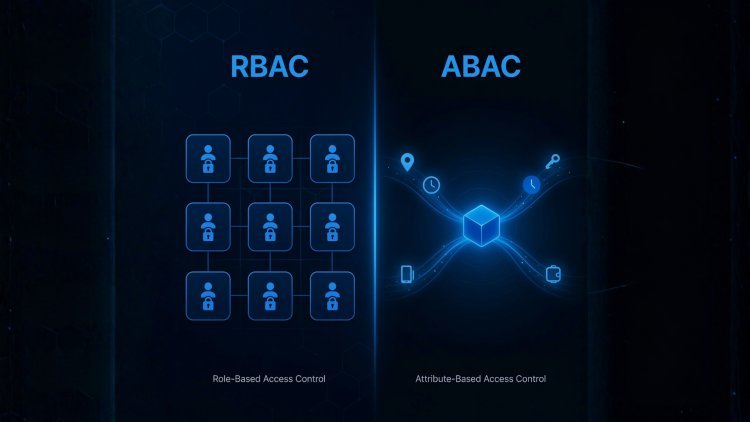
RBAC starts with a user's role. ABAC goes further by evaluating who the user is, what resource is being requested, what action is being performed, and the surrounding environment at the exact moment access is requested.
Every access request is evaluated against current attributes such as clearance level, department, geographic context, device compliance, and time of access.
ABAC policies can express detailed business conditions without creating dozens of narrowly defined roles, reducing administrative complexity as organizations grow.
ABAC can express a policy such as allowing read-only access to financial records only when several conditions are simultaneously true.
ABAC enables security policies to respond to changing enterprise conditions instead of relying only on a fixed role assignment made earlier.
ABAC replaces broad, static access assignments with policy-driven decisions based on real-time context. By combining user, resource, action, and environmental attributes, organizations can achieve finer-grained security without creating an unmanageable collection of specialized roles.
The Modern Shift: Attribute-Based Access Control (ABAC)
RBAC
Dynamic, Real-Time Decisions
Precision at Scale
One Policy, Multiple Conditions
Attribute Sources
From Static Identity to Context
No access control framework is universally superior. Role-Based Access Control (RBAC) and Attribute-Based Access Control (ABAC) solve different problems and excel under different operating conditions. The decision is not simply about security. It involves balancing implementation complexity, administrative overhead, auditability, user experience, scalability, and long-term governance requirements. Understanding these tradeoffs is essential when designing a modern identity and access management strategy.
RBAC emphasizes simplicity and operational efficiency. ABAC emphasizes flexibility, context-awareness, and adaptive security. Modern enterprises increasingly use both together rather than choosing one exclusively.
RBAC excels where organizational structures are clear and responsibilities change infrequently. Access management becomes highly predictable because permissions are assigned through standardized business roles rather than individually managed exceptions.
ABAC moves beyond static roles by evaluating multiple attributes during each access request. Decisions can consider user identity, department, location, device posture, sensitivity of data, time of access, risk score, and numerous other contextual variables.
Leading security architects increasingly recommend a layered authorization model rather than an either-or decision. RBAC provides baseline permissions aligned with business functions, while ABAC introduces contextual controls around sensitive resources, privileged actions, and elevated-risk situations.
RBAC remains exceptionally effective for managing routine access at scale and providing a clear, auditable foundation for identity governance. ABAC delivers the contextual intelligence required for modern Zero Trust environments, cloud platforms, sensitive data protection, and dynamic workforce models. Rather than replacing RBAC, ABAC increasingly complements it. The most successful authorization architectures combine RBAC's simplicity with ABAC's flexibility, creating a security model that is both operationally manageable and resilient against modern threats.
Comparing the Heavyweights RBAC vs ABAC
The Right Model Depends On The Environment
Side-By-Side Comparison
Dimension
RBAC
ABAC
Initial Setup
Low complexity. Map roles to organizational structure and assign users.
Higher upfront investment requiring policy design, attribute definitions, and integrations.
Ongoing Administration
Administration grows significantly as role counts increase.
Policy-centric approach reduces need for creating new roles.
Security Granularity
Coarse-grained and largely context-independent.
Fine-grained decisions based on user, resource, device, location, risk, and context.
Zero Trust Alignment
Requires additional controls to achieve full Zero Trust posture.
Naturally aligned with continuous verification principles.
Compliance Auditability
Straightforward in smaller and structured environments.
Rich audit data with full policy and attribute context.
Best Fit
Stable organizations with predictable access needs.
Dynamic, cloud-native, highly regulated environments.
Simplicity & Stability
ABAC Delivers Context-Aware Security
How ABAC Evaluates Access
What Matters Most
The Hybrid Gold Standard
Hybrid Access Strategy
Why Hybrid Models Win
The Future Is Not RBAC Or ABAC. It's Both.
RBAC remains a solid baseline for governance. Keep roles coarse-grained and design them with ABAC integration in mind. Use ABAC policies to handle exceptions and edge cases, avoiding role explosion while preserving simplicity.
Deploy ABAC for regulated data, privileged operations, and high-risk resources. Compliance frameworks like SOX, HIPAA, PCI-DSS, and GDPR increasingly reward contextual, auditable access control. Zero Trust mandates make ABAC not just strategic but necessary.
In a perimeter-less world, context is the new perimeter. Every access decision must consider the user, the resource, the device, and the moment — not just a static role assigned months ago. This dynamic intelligence layer ensures resilience against evolving threats.
The future of enterprise security lies in layering RBAC and ABAC intelligently. Organizations that treat access control as a living, context-aware system will detect threats faster, recover with confidence, and earn lasting trust from customers and regulators.
Conclusion: The Path to Future-Proof Security
1. Start with RBAC, But Plan for ABAC
2. Transition to ABAC Where Stakes Are Highest
3. Secure the Resource, Not Just the User
Key Insight
What's Your Reaction?