Building Event Management Software for Conferences and Large-Scale Events
A comprehensive guide to designing, building, and scaling the digital infrastructure that powers world-class conferences, summits, and large-scale events — from registration to real-time analytics.
From Manual Chaos to Centralized Infrastructure
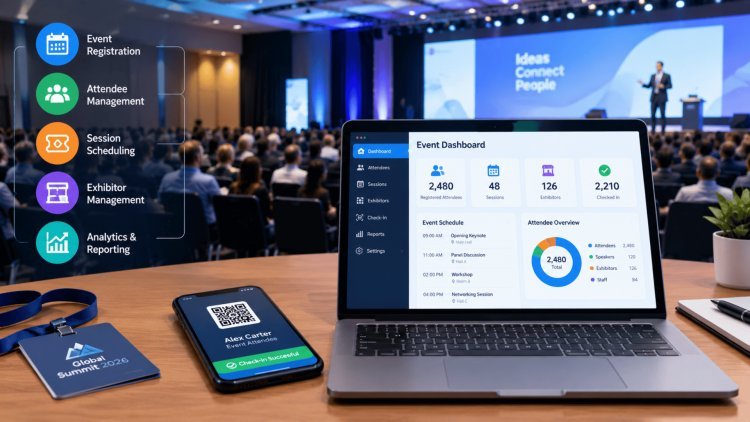
The era of spreadsheets, siloed email threads, and disconnected booking tools is over. Modern event management platforms operate as full-scale operational hubs — centralizing every function from pre-event planning through post-event analytics into a single, cohesive environment. For conferences hosting hundreds or thousands of attendees, this shift from manual coordination to intelligent infrastructure is not just a convenience; it is an operational necessity.
Venue & Format Sourcing
The lifecycle begins long before registration opens. Platform administrators define venue parameters including room capacity thresholds, breakout session layouts, accessibility compliance standards, and hybrid streaming compatibility. Whether the event is fully in-person, fully virtual, or a blended hybrid model, the platform must accommodate flexible room configurations and AV requirement tracking from day one.
Strategic Agenda Architecture
Robust Agenda Management capabilities are the backbone of multi-track conference clarity. Organizers can build parallel session tracks, assign session rooms, define time blocks, and resolve scheduling conflicts — all within a visual drag-and-drop interface. Color-coded track labeling, speaker assignment views, and conflict detection algorithms ensure that no two featured sessions clash, and that every room is optimally utilized throughout the event duration.
Hybrid Streaming Integration
Native connections to platforms like Zoom, Teams, and custom RTMP streams allow every session to reach both physical and remote audiences simultaneously.
Room Capacity Intelligence
Dynamic capacity management tools flag over-registered sessions and suggest room reassignments before conflicts become day-of disasters.
Centralized Dashboard
A unified command center gives event directors real-time visibility into every operational layer — registrations, schedules, staff assignments, and vendor status — at a glance.
Centralization is not simply about consolidating tools. It is about creating a single operational environment where planning, scheduling, communication, venue management, and live event execution remain synchronized from the first planning meeting through final reporting.
Modern event management platforms succeed by replacing fragmented coordination with a single source of operational truth for every stakeholder.
Content is the heartbeat of any major conference. Managing the end-to-end pipeline — from initial proposal submission through final published session pages — requires purpose-built tooling that automates the tedious while empowering the creative. Well-designed event platforms transform what was once a months-long email nightmare into a streamlined, transparent, and collaborative workflow.
Modern CFP systems do far more than collect form submissions. They orchestrate the entire abstract review lifecycle: intake validation, automated acknowledgment emails, blind or open peer-review assignment, multi-criteria scoring rubrics, and final acceptance or rejection notifications. Reviewers access dedicated portals where they evaluate submissions, leave structured feedback, and vote — all without a single spreadsheet. Organizers monitor submission volumes, reviewer progress rates, and scoring distributions through live dashboards, dramatically reducing the administrative burden of curating a highquality program.
Seamless integration allows confirmed speakers to update their Speaker Profiles directly within the platform — uploading professional headshots, editing biographies, submitting session descriptions, and even providing AV and technical requirements. This self-service model eliminates the back-and-forth email chains that plague traditional event coordination and ensures that the public-facing conference website always reflects the most current speaker information without manual admin intervention.
Beyond speaker bios, administrators oversee a rich ecosystem of content modules: interactive floor plans with clickable booth and session-room overlays, downloadable session presentation files, sponsor content cards, networking activity listings, and workshop prerequisite materials. Each module is permissions-controlled, allowing different stakeholder groups — sponsors, speakers, exhibitors — to manage their own content within defined guardrails, reducing the administrative load on core event staff while maintaining brand and content standards.
Assign reviewers automatically by topic track, expertise tag, or availability. Conflict-of-interest detection prevents reviewers from scoring submissions by their own institution or coauthors.
Clickable venue maps let attendees pre-plan their routes between sessions, locate sponsor booths, identify accessibility routes, and find registration desks — reducing crowd congestion and improving navigation.
A centralized file repository allows speakers to upload slide decks before the event and attendees to download materials post-session — creating lasting value beyond the event itself.
Mastering the Content Pipeline
Automated Call for Papers (CFP)
Speaker Portal Self-Service
Consac.dev Content Module Management
Peer Review Workflows
Interactive Floor Plans
Session Material Library
A world-class event is measured not only by the quality of its content but also by the quality of its attendee experience and the depth of insights generated throughout the event lifecycle. Modern event management platforms are designed to capture meaningful engagement signals at every interaction while simultaneously creating memorable experiences that increase participation, satisfaction, and long-term event loyalty.
Registration workflows extend far beyond ticket purchases. Advanced registration modules gather detailed attendee profile information including job roles, industry sectors, company characteristics, professional interests, dietary preferences, and accessibility requirements while maintaining a streamlined user experience.
Conditional logic allows forms to adapt dynamically based on attendee type, ensuring participants view only questions relevant to their registration category while reducing friction and improving completion rates.
Multi-day conferences require continuous attendee interaction. Integrated engagement features support moderated Q&A sessions, live polling, collaborative participation tools, networking feeds, session interactions, and audience-driven content experiences.
Gamification strategies such as attendance tracking, networking challenges, session achievements, and leaderboard systems encourage deeper involvement while increasing overall event participation and satisfaction.
Sponsors and exhibitors increasingly require measurable return on investment. Digital lead retrieval systems capture attendee interactions using QR scanning, NFC technology, and business-card recognition workflows while enriching each lead with event participation context.
Structured lead packages with CRM-ready exports and direct platform integrations allow exhibitors to prioritize follow-up activities based on engagement depth rather than simple contact collection.
Event success becomes measurable through comprehensive analytics that transform engagement activities into actionable business insights.
Session attendance heatmaps reveal audience behavior patterns across venues and time periods.
Download rates, session engagement, content views, and participation metrics identify the most valuable programming.
Connection volumes and interaction trends provide insight into relationship-building outcomes.
NPS scores, surveys, and participant feedback support continuous improvements for future editions.
Interactive polling and live Q&A experiences significantly improve attendee participation and satisfaction.
Digital lead retrieval systems capture significantly more actionable sponsor and exhibitor intelligence.
Conditional registration workflows improve relevance and reduce abandonment during sign-up.
The most successful events combine exceptional attendee experiences with intelligent data collection. Every registration field, networking interaction, poll response, session attendance record, and exhibitor engagement creates a richer understanding of participant behavior. When these insights are unified within a single event platform, organizers gain the ability to improve future events, demonstrate measurable stakeholder value, increase sponsor renewal rates, and build experiences that grow stronger with each edition.
Attendee Experience and Data Capture
Comprehensive Registration Modules
Live Engagement Tools
Exhibitor & Sponsor Data Intelligence
Post-Event Intelligence Dashboard
Attendance Insights
Content Performance
Networking Activity
Satisfaction Metrics
From Attendee Experience to Strategic Intelligence
Scaling to meet enterprise-grade demands requires deliberate architectural choices — made early — that pay dividends across every future event edition.
Building event management software that performs flawlessly for a 200-person summit is a very different engineering challenge from one that must support a global technology conference at enterprise scale.
Large-scale events attract enterprise clients whose IT and security teams demand rigorous compliance documentation before approving platform usage.
Must be architected at the database level, with attendee consent management, data retention policies, and right-to-erasure workflows built into the platform from the ground up rather than retrofitted as afterthoughts.
The next frontier in event technology is native AI integration through Model Context Protocol (MCP) architectures — enabling event platforms to connect contextually with large language models for real-time personalization at scale.
Start building your scalable infrastructure now. Every event you run on a well-architected platform generates compounding data intelligence that makes every subsequent event faster to plan, cheaper to operate, and more valuable to every stakeholder involved.
Turn each conference into a repeatable, data-driven success story.
Scaling the Future of Conferences
Enterprise Security & Compliance Architecture
AI-Driven Innovation for 2026 and Beyond
The Event Lifecycle Roadmap
What's Your Reaction?