Building Property Management Software for Modern Real Estate Businesses
The real estate industry is undergoing a profound digital transformation. Property managers, investors, and real estate firms are rapidly abandoning legacy spreadsheets and manual workflows in favor of intelligent, cloud-powered platforms that deliver speed, accuracy, and scale. This presentation explores the architecture, features, and strategic partnerships required to build world-class property management software that positions your business for long-term success.
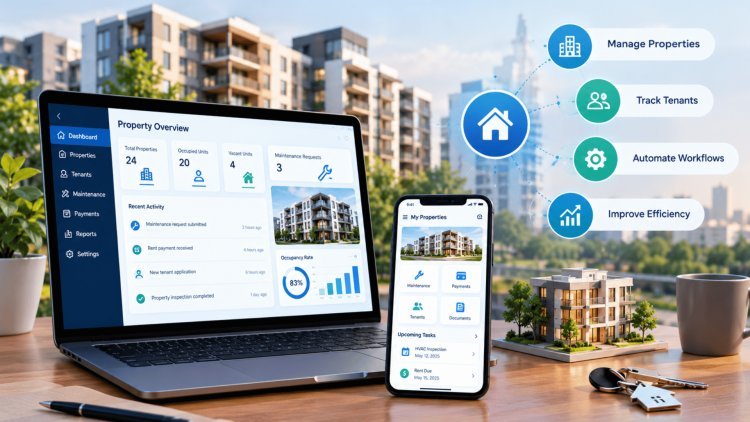
The Digital Shift in Real Estate
Property management is no longer defined by clipboards, manual ledgers, or phone-tag maintenance requests. Today's market demands automated, cloud-based ecosystems capable of handling portfolios of any size with precision and real-time visibility. The shift is not merely operational — it is fundamentally reshaping how real estate businesses compete, grow, and serve their tenants.
Market Growth at a Glance
The global property management software market is projected to reach $5.89 billion by 2033, driven by a robust 6.4% compound annual growth rate (CAGR). This explosive expansion reflects surging demand for platforms that consolidate leasing, maintenance, communication, and financial reporting into a single, unified interface.
Early adopters who invest in purpose-built digital infrastructure today will capture a decisive competitive advantage as the market matures and consolidates around best-in-class platforms.
We help businesses transform ideas into successful digital experiences — building the intelligent platforms that keep modern real estate firms ahead of the curve and ready for tomorrow's challenges.
Market Size by 2033
Global property management software projected value
CAGR Growth Rate
Compound annual growth driving the industry forward
Managers Going Digital
Of property managers actively seeking cloud-based solutions
The future of property management belongs to connected, cloud-based platforms that unify operations, improve tenant experiences, and scale effortlessly with portfolio growth.
Building property management software that scales requires deliberate, forward-thinking architectural decisions from day one. The foundation you lay during development will determine whether your platform can support 10 properties or 10,000 — and how quickly you can expand capabilities as your business grows. Cutting corners on architecture is the single most common reason property tech platforms fail to scale.
Architectural decisions made in the first 6 months of development determine 80% of your platform's long-term scalability ceiling. Invest in robust foundations before rushing to feature delivery.
Essential Architecture for Scaling
The most successful property management platforms share a common philosophy: replace fragmented, manual workflows with intelligent, integrated systems that surface the right information at the right moment. Below are the three capability pillars that define best-in-class property management software—each one addressing a critical pain point experienced by property managers, landlords, and real estate investors every single day.
Best-in-class property management platforms replace fragmented, manual workflows with intelligent, integrated systems built for scale.
Core Features for
Modern OperationsSurface the right information at the right moment.
Building a world-class property management platform is not a one-time project — it is an ongoing strategic partnership between your business and a development team that understands both technology and the complexities of modern real estate operations. The most successful implementations follow a structured approach from initial discovery through continuous post-launch evolution.
From requirement analysis and architecture design through agile development sprints, quality assurance testing, phased deployment, and long-term support, every stage requires disciplined planning and clear stakeholder alignment. A structured delivery process minimizes rework, accelerates time-to-market, and ensures the platform aligns closely with operational goals and business outcomes.
Effective engagement models include dedicated project leadership, transparent reporting processes, milestone-based delivery schedules, and continuous stakeholder visibility from discovery through production support.
The next generation of property management software incorporates digital twin technology and Building Information Modeling (BIM) to maximize asset value throughout the property lifecycle. These capabilities extend beyond operations and maintenance into design validation, renovation planning, capital expenditure forecasting, and long-term portfolio optimization.
Digital twins create continuously evolving virtual representations of physical assets, accumulating operational intelligence over time and enabling predictive maintenance, energy efficiency initiatives, and data-driven facility management decisions.
Analyze business processes, portfolio structures, user roles, workflows, integrations, and reporting needs to define platform scope accurately.
Establish system architecture, UX frameworks, database structures, security controls, and API strategies before development begins.
Deliver working software through iterative sprint cycles supported by continuous stakeholder feedback and transparent progress tracking.
Execute phased deployment, support user adoption, monitor performance metrics, and continuously evolve the platform as portfolio requirements expand.
Whether you are building your first centralized property management platform or modernizing an existing portfolio ecosystem, success depends on combining industry expertise, scalable architecture, and a commitment to continuous improvement. The strongest platforms are not simply launched — they evolve alongside the properties, stakeholders, and markets they serve.
Contact us at info@consac.dev to begin your transformation journey today.
Partnering for Long-Term Growth
A Structured Development Journey
Leveraging Advanced Technologies
Why Choose Consac.dev?
Development Roadmap
Discovery & Requirements
Architecture & Design
Agile Development
Launch & Scale
Ready to Build Your Scalable Real Estate Future?
What's Your Reaction?